New Delhi: A report about internal objections within the Election Commission of India over aspects of the Special Intensive Revision (SIR) of electoral rolls has triggered a fresh political controversy, with opposition parties questioning the poll panel’s decision-making process.
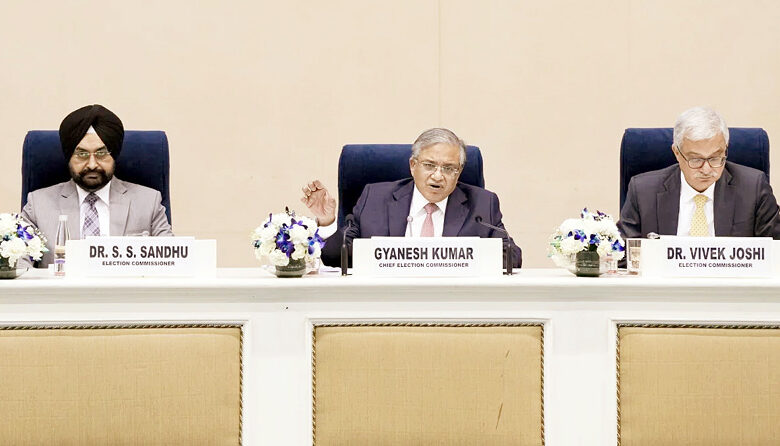
According to an investigation published by The Indian Express, Election Commissioners Sukhbir Singh Sandhu and Vivek Joshi recorded objections at least 14 times over a period of about 10 months. The reported objections concerned issues including voter registration, deletion and restoration of names, changes linked to Form 6, access to electoral databases and the functioning of election software. Four of the objections were reportedly recorded on a single day.

The report has drawn particular attention to Form 6, which is used by citizens to apply for inclusion in the electoral roll. According to the reported objections, additional declarations connected with the previous SIR were introduced for new applicants. The two Election Commissioners questioned the manner in which the change was introduced and raised concerns about its legal and procedural basis.
Another issue highlighted in the report concerns the management of electoral data. The objections reportedly raised questions about the gradual centralisation of access to electoral-roll databases and the role of state-level election officials. A separate software-related issue in Goa involved 97 voters whom local officials had reportedly found eligible, but whose inclusion could not initially be recorded through the system.
The developments have prompted opposition leaders to intensify their criticism of the Election Commission. Leaders from several opposition parties have demanded greater accountability over the reported objections, while some have linked the controversy to wider concerns about voter-list revisions and the conduct of elections.
However, the Election Commission has rejected the suggestion that the reported objections demonstrate a breakdown or division within the constitutional body. ECI officials said that the concerns raised by Sandhu and Joshi were part of the internal deliberative process and maintained that all major decisions, including those concerning SIR, had the approval of all three Election Commissioners — Chief Election Commissioner Gyanesh Kumar, Sandhu and Joshi.

The Commission’s position is therefore different from the interpretation drawn from the reported objections. While the existence of internal concerns has been reported, the ECI maintains that these did not translate into disagreement over the final decisions adopted by the Commission.
The controversy has also generated questions from political commentators about the significance of dissent within a multi-member constitutional institution. Some have questioned whether differences recorded internally should be viewed as evidence of institutional disagreement or as part of the normal process through which decisions are examined before being finalised.
The episode has brought several substantive issues into focus: how changes to voter-registration procedures are authorised, who controls access to electoral databases, how software affects decisions taken by field-level election officials, and how objections raised by members of the Commission are dealt with internally.
For now, the central dispute is not simply about whether objections were raised. It is about what those objections mean for the functioning of the Election Commission and whether they affected any final decisions concerning electoral rolls.
With SIR continuing to generate debate across several states, scrutiny of the Commission’s procedures, voter-data management and mechanisms for resolving internal concerns is likely to remain an important part of the wider discussion over electoral transparency.