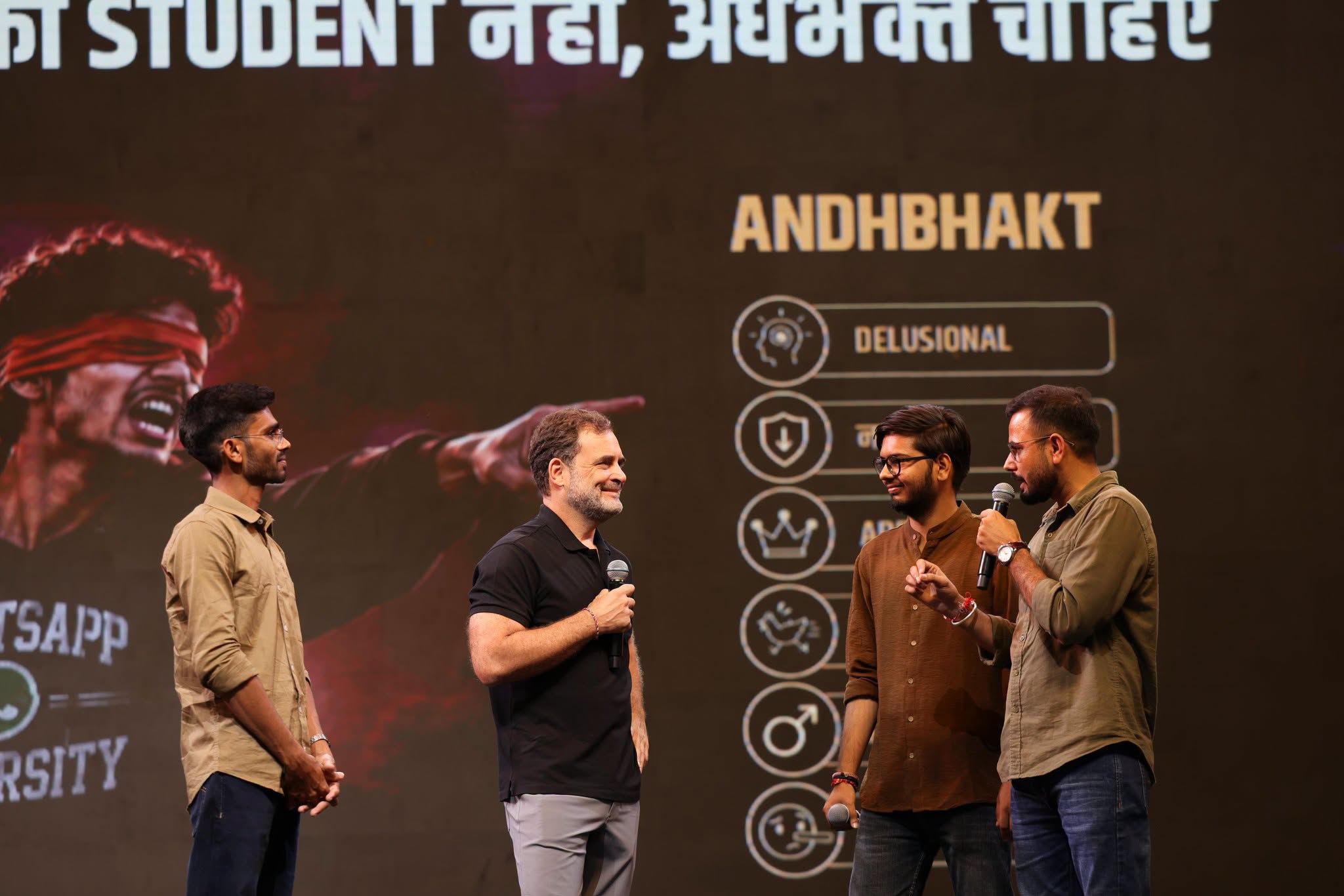
New Delhi: After using the Bharat Jodo Yatra to build a wider public outreach, the Congress has turned its attention to students and young people through a campaign titled “Students’ Voice”, led by Rahul Gandhi. The initiative has raised questions about whether the party is attempting to establish a stronger connection with young voters ahead of upcoming elections.
The campaign began in Kota, Rajasthan, on June 17, 2026, and has since expanded to cities including Dehradun, Prayagraj and Pune. Congress organisers have indicated plans for a much wider student-contact programme, reportedly covering around 800 cities and districts, following an initial phase involving 28 programmes.

Unlike the Bharat Jodo Yatra, which sought to engage people across a broad range of social and political backgrounds, the latest campaign is focused more specifically on students, competitive-exam aspirants and young people seeking employment.
Education costs, examination-related difficulties, recruitment delays, alleged paper leaks, unemployment and the availability of government jobs have emerged as recurring themes at the programmes.
Kota, one of India’s major education and competitive-examination centres, provided an early setting for the campaign. The event focused on issues faced by students preparing for entrance and competitive examinations. Subsequent programmes in Dehradun and Prayagraj also brought examination systems, recruitment processes and employment opportunities into the political conversation.
The campaign has given the Congress an opportunity to engage with a section of society whose concerns are closely linked to education and employment. However, participation in political programmes cannot by itself be treated as evidence of electoral support. Attending an event, listening to a political leader and ultimately voting for a party are separate decisions.
The proposed expansion of the campaign suggests that the Congress intends to maintain sustained contact with students rather than treat the initiative as a series of isolated events. Youth Congress units and state-level organisations are also being encouraged to extend the outreach to colleges and universities.

The strategy also places emphasis on issues that directly affect young people’s prospects. Paper leaks or cancelled examinations can disrupt years of preparation, while delays in recruitment can create uncertainty for government-job aspirants. Rising education costs and limited employment opportunities are similarly issues that can influence young voters’ political priorities.
For the Congress, however, raising these concerns is only one part of the political challenge. The larger question is whether the party can translate its criticism of existing systems into clearly defined policy proposals. Measures concerning examination security, recruitment timelines, transparency in selection processes, affordable education and employment generation would determine the substance of its student outreach.
The campaign also differs significantly from the Bharat Jodo Yatra in its approach. The earlier journey was built around extensive public interaction across states and communities, while “Students’ Voice” concentrates on a particular demographic and a defined set of concerns. This makes it both a public-contact exercise and an organisational effort aimed at strengthening the party’s engagement with young people.
Students, however, do not constitute a politically uniform constituency. Their views can vary according to region, economic circumstances, education, caste, employment prospects and individual political preferences. Consequently, greater visibility among students cannot automatically be interpreted as a shift in the wider youth vote.
The planned expansion to hundreds of cities and districts indicates that the Congress is treating student outreach as a longer-term political initiative. Its eventual impact will depend on whether the campaign generates sustained engagement, whether the party develops concrete policy responses to the issues being raised and whether those concerns influence electoral behaviour.
For now, “Students’ Voice” represents another phase in the Congress’s public outreach strategy. From a nationwide social mobilisation exercise through the Bharat Jodo Yatra to a more targeted engagement with students and examination aspirants, the party is seeking to build a continuing conversation around education, recruitment, employment and the future of India’s young population.