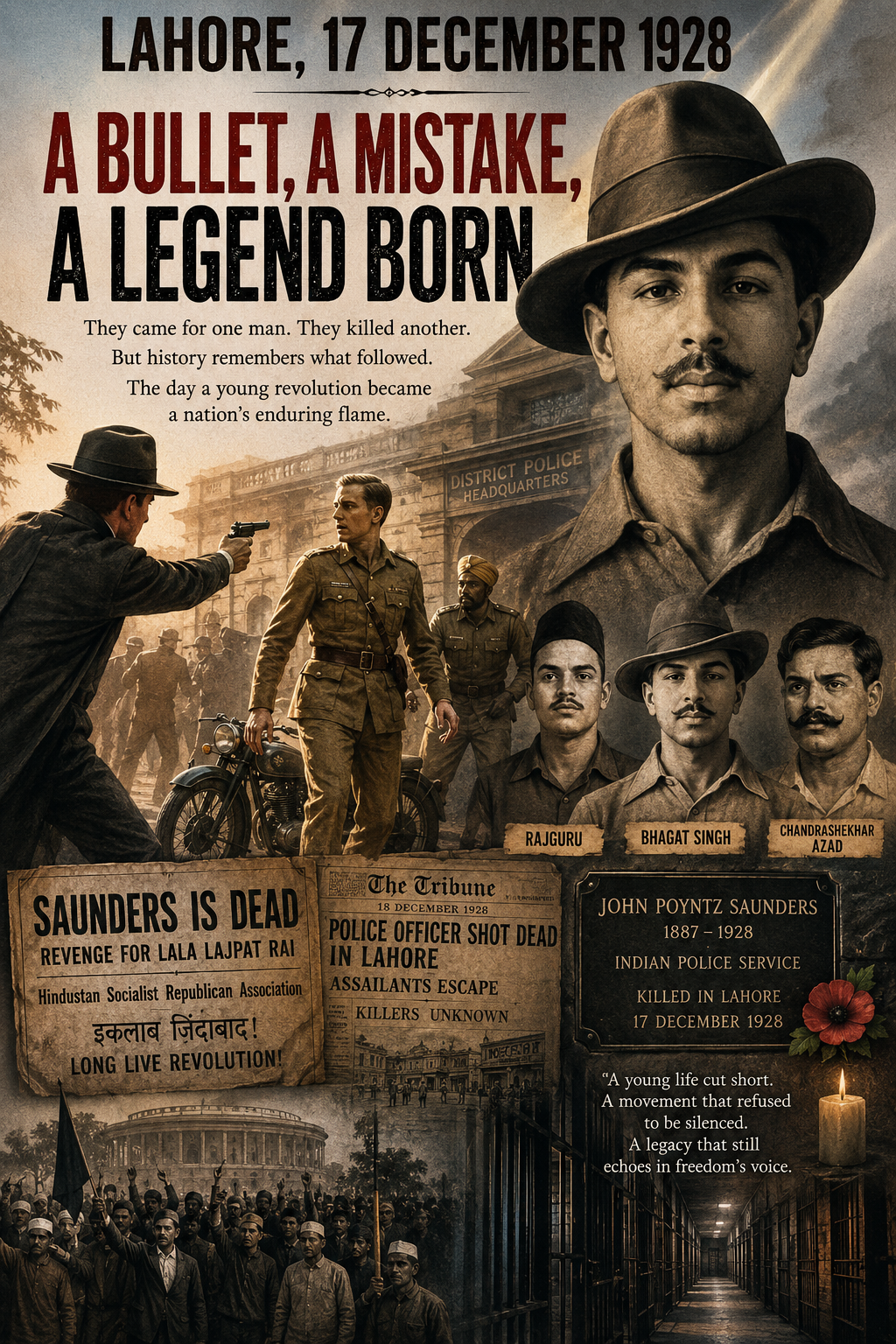
The winter light was already beginning to slant low over Lahore on the afternoon of December 17, 1928, when a young Englishman named John Poyntz Saunders walked out of the District Police Headquarters toward his motorcycle. He was only twenty-one, barely more than a boy in the eyes of the empire he served, born in Peterborough and newly arrived in the ranks of the Indian Police Service less than two years before. Beside him walked Head Constable Chanan Singh, and neither man had any reason to suspect that this ordinary walk across the compound would be the last either of them would ever take.
Not far away, hidden in plain sight among the passersby, a handful of young revolutionaries waited with pistols concealed beneath their clothes. They called themselves the Hindustan Socialist Republican Association, and they had come to Lahore that day not for Saunders at all, but for another man entirely — a senior officer named James Scott, whose name had become, in the weeks prior, a symbol of everything they hated about British rule.

The story that brought them there had begun a month earlier, on a bright October afternoon when the aging but still formidable Lala Lajpat Rai stood at the head of a peaceful march against the Simon Commission — a British body sent to consider India’s constitutional future while pointedly excluding any Indian from its membership. The protest had been calm, dignified, almost ceremonial in its restraint. But the police response was not. Batons rose and fell, and among those struck down was Lajpat Rai himself, a man revered across the country as the “Lion of Punjab.” He never fully recovered from his injuries, and on November 17, seventeen days after the beating, he died. The British authorities shrugged off any responsibility, and that shrug, more than the blows themselves, is what lit the fuse.
For the young men of the HSRA, Rai’s death could not go unanswered. They resolved to kill Scott, the officer they believed had commanded the charge, both as vengeance and as a message to the empire that its violence would not go unmet. For days, one of their number, Jai Gopal, kept watch outside the police headquarters, memorizing the comings and goings of the officers, waiting for Scott to appear.
But on the afternoon of the seventeenth, it was Saunders who walked out the door — young, uniformed, and, in the anxious eyes of a man watching from a distance, close enough in bearing and dress to be mistaken for his intended target. Gopal gave the signal. There was no time for a second look, no moment to question the resemblance. The machinery of the plan was already moving.
Rajguru struck first. A quiet, deadly marksman, he raised his Mauser pistol and fired a single shot that caught Saunders as he neared his motorcycle. Then Bhagat Singh, only twenty-one himself, stepped forward and emptied his pistol into the fallen man, unwilling to leave anything to chance. Saunders died there on the ground, in the same compound he had walked through only moments before.


Chanan Singh, the head constable who had been walking beside him, did not run. He gave chase after the attackers, and for that courage he too was shot down — this time by Chandrashekhar Azad, the group’s fiercest and most elusive member, who would go on to evade capture for years afterward. The revolutionaries slipped away through Court Street and across the grounds of a nearby college, vanishing into the city before any alarm could properly be raised.
It was only afterward, in the quiet aftermath of their own violence, that the enormity of the mistake became clear. The posters they had prepared in advance announced the killing of Scott. Now they had to be hastily rewritten, the name changed, the act reframed — not as the precise vengeance they had planned, but as a broader strike against British authority itself, regardless of which officer had actually fallen. The official police report, filed that same day, could only record the killers as unknown.
Bhagat Singh did not linger in Lahore. He shaved his beard, cut his hair, and slipped out of the city disguised as a wealthy Anglo-Indian gentleman, leaving behind the identity that had made him a fugitive. But he did not disappear from history. The following April, he and his comrades carried their fight into the very heart of British power, setting off bombs in the Central Legislative Assembly in Delhi — an act meant not to kill, but to be heard. It was this act that led to his arrest, and eventually to his return to Lahore to stand trial for Saunders’ death as well, folded into what became known as the Lahore Conspiracy Case.
The trial itself was no ordinary proceeding. A special tribunal was created by ordinance, sidestepping the normal course of law, and the case against Bhagat Singh rested heavily on the testimony of Jai Gopal — the very man whose mistaken glance had set the tragedy in motion, and who now turned approver in exchange for his own pardon. On October 7, 1930, the verdict came down: death for Bhagat Singh, Rajguru, and Sukhdev Thapar. Every appeal that followed was rejected. On the evening of March 23, 1931, the three men were hanged within the walls of Lahore Central Jail.
What remains of that December afternoon is a strange and sorrowful knot of history — a young Englishman who had barely begun his career, killed not for who he was but for who he was mistaken to be; a band of revolutionaries whose fury, aimed at one man, fell instead on another; and a movement that transformed a case of mistaken identity into one of the most enduring symbols of India’s fight for freedom. Bhagat Singh, in dying for a killing he did not originally intend, became something larger than the act itself — a name invoked for generations as the embodiment of youthful sacrifice and revolutionary conviction. Saunders, meanwhile, is remembered more quietly, his name inscribed on a small plaque in Peterborough Cathedral, a young man who walked out of a building one afternoon and into the current of a history far larger than himself.












 https://www.youtube.com/watch?si=RtToJsBhYBatUrym&v=mOuYNSdhjHA&feature=youtu.be