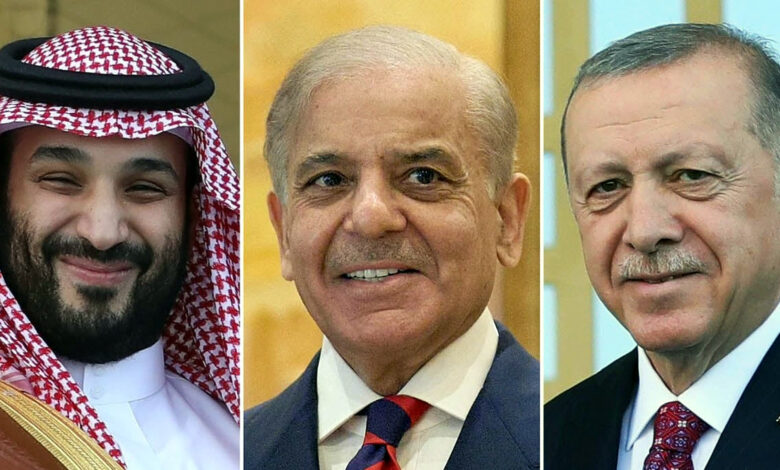
Qatar: The joint defence agreement signed by Saudi Arabia, Türkiye and Pakistan in Mecca is more than a three-country military partnership. It signals a changing strategic landscape in West Asia, where traditional security arrangements are being challenged and new centres of power are emerging.
The most significant provision of the agreement is its collective-defence principle: an armed attack on any one of the three countries would be considered an attack on all three.

On paper, the arrangement appears formidable. The real question, however, is whether Riyadh, Ankara and Islamabad would actually be prepared to risk their soldiers, economies and strategic interests for one another when a real conflict erupts.
Calling the agreement an “Islamic NATO” would therefore be premature. NATO’s strength does not rest merely on the principle that an attack on one member is an attack on all. It is backed by decades of institutional development, integrated military planning, intelligence-sharing, interoperability, joint command structures and established defence commitments.
The Mecca agreement does not yet appear to possess comparable institutional depth.It would be more accurate to view it as an attempt by three countries to strengthen strategic deterrence and expand their security options. At the same time, dismissing the agreement as symbolic would also be a mistake.
The three countries bring very different strengths to the table. Türkiye has a rapidly expanding defence industry, advanced drone capabilities and a substantial military structure. Saudi Arabia possesses enormous financial resources and energy wealth.
Pakistan has decades of military experience, a large standing army and nuclear weapons capability.According to the figures cited in the original analysis, Türkiye’s military expenditure in 2025 was around $30 billion, compared with $11.9 billion for Pakistan and $83.2 billion for Saudi Arabia. India’s military spending stood at approximately $92.1 billion.
The combined figures make the three-country arrangement strategically significant, but adding their capabilities together does not automatically create an integrated military force.
Saudi Arabia’s Strategic Calculation
Saudi Arabia is perhaps the most interesting component of the agreement. For decades, Riyadh relied heavily on the United States for its security. But changing regional dynamics have encouraged Saudi policymakers to reconsider whether dependence on a single external security provider is sufficient.
Tensions with Iran, the Houthi threat in Yemen, instability around the Red Sea and the possibility of attacks on critical energy infrastructure have all influenced Saudi security thinking.
Closer defence cooperation with Pakistan and Türkiye can therefore provide Riyadh with an additional layer of strategic security.
But this also creates a major contradiction. Saudi Arabia’s primary objective is not to win regional wars; it is to maintain stability. Its economic transformation programme depends heavily on tourism, investment, infrastructure, diversification and international business.
A prolonged regional conflict could directly undermine these ambitions. If Pakistan or Türkiye became involved in a conflict that did not directly threaten Saudi interests, would Riyadh really send troops or commit significant financial and military resources?
That could become the agreement’s biggest test
Türkiye’s Balancing Act
Türkiye’s position is even more complicated. Ankara has traditionally avoided being permanently locked into a single regional camp. It is a NATO member but maintains important relations with Russia and pursues its own strategic interests in Syria, Libya, the Caucasus and the eastern Mediterranean.
Türkiye has significantly improved its relations with Saudi Arabia, but the two countries have not always shared identical regional priorities.
Consequently, Ankara would likely be cautious about committing its forces to a conflict in which its direct national interests were not at stake.
The agreement could therefore provide Türkiye with greater strategic influence without necessarily obliging it to participate automatically in every conflict involving its partners.
Pakistan’s Strategic Opportunity
For Pakistan, the agreement could have considerable strategic value.
Islamabad has maintained longstanding defence ties with Saudi Arabia and has also deepened military cooperation with Türkiye. The agreement potentially strengthens both relationships simultaneously.
However, Pakistan’s principal security concerns remain focused on India and Afghanistan rather than West Asia. Its economy has also faced significant structural pressures.
Pakistan could gain diplomatic and strategic support through the arrangement, but whether it could sustain a major military commitment in West Asia while managing its existing security challenges remains an important question.
The most sensitive issue is Pakistan’s nuclear capability.
Pakistan is the world’s only Muslim-majority nuclear-armed state. However, that does not mean its nuclear arsenal automatically becomes a security umbrella for its allies. Nuclear weapons are primarily instruments of national survival and deterrence. Sharing that capability under a multilateral defence arrangement would represent an entirely different level of commitment.

For that reason, describing the Mecca agreement as a nuclear alliance would go beyond the available evidence.
Iran Watches Closely
Iran’s response is another important dimension. Ibrahim Rezaei, associated with Iran’s parliamentary National Security and Foreign Policy Commission, has reportedly dismissed the agreement as a “paper agreement” incapable of guaranteeing Saudi security. The reaction suggests that Tehran is taking the development seriously rather than treating it as merely ceremonial diplomacy.
Iran’s concern could stem from the possibility that it may increasingly face a coordinated security arrangement rather than dealing separately with Saudi Arabia, Türkiye and Pakistan.At the same time, both Saudi Arabia and Türkiye have indicated that the agreement is not directed against a particular country or intended to create a sectarian military bloc. Its stated objective is collective security and regional stability.
That distinction matters. If the agreement evolves into an explicitly anti-Iranian alliance, regional polarisation could intensify significantly.
Why India Is Watching
For India, the most immediate concern is not simply Pakistan but energy security and maritime stability. The Strait of Hormuz is one of the world’s most important energy corridors. According to the figures cited in the original analysis, an average of around 20.9 million barrels per day of oil and petroleum liquids passed through the waterway during the first half of 2025, representing roughly one-fifth of global petroleum liquids consumption.
A large majority of crude oil and condensate transported through Hormuz is destined for Asian markets, with China, India, Japan and South Korea accounting for a substantial share.
This means that any major military confrontation in West Asia could quickly affect Asian economies. India’s concern therefore extends well beyond the Saudi-Türkiye-Pakistan military equation. If maritime insurance costs rise, shipping routes are disrupted or oil supplies are affected, the consequences could spread from petrol and diesel prices to aviation fuel, transportation, fertiliser costs and industrial production.
India-Saudi Ties Add Another Dimension
India’s economic relationship with Saudi Arabia is too substantial to view the new security arrangement purely through a military lens. The two countries have developed extensive economic, energy and defence ties. Bilateral trade has grown significantly, while Saudi Arabia remains an important source of crude oil for India. Defence cooperation has also expanded through military exercises and institutional dialogue.
For New Delhi, therefore, Saudi Arabia is not simply a country that has entered a security arrangement with Pakistan. It is also an important partner in energy, investment, trade, the Indian diaspora and regional stability.India would consequently need to avoid a Pakistan-centric response and instead examine the broader transformation taking place across West Asia.
The Agreement’s Biggest Weakness
The central weakness of the arrangement is that the strategic interests of its three members do not always overlap.
Saudi Arabia wants to maintain channels for reducing tensions with Iran. Türkiye wants to preserve its independent regional role. Pakistan remains primarily focused on India and Afghanistan.
Under these circumstances, the declaration that an attack on one will be treated as an attack on all may send a powerful political message, but it does not necessarily guarantee an identical military response in every conflict.
History shows that alliances are ultimately tested not by declarations but by decisions made during crises. If Saudi Arabia, Türkiye and Pakistan develop joint military exercises, intelligence-sharing mechanisms, defence production, missile-defence cooperation, maritime-security arrangements and eventually some form of integrated command structure, the Mecca agreement could become the foundation of a significant new regional security architecture.
If those mechanisms fail to materialise, the agreement could join the long list of international security arrangements whose political language proved stronger than their practical military commitments.
A New Security Equation
The Mecca agreement should therefore neither be celebrated prematurely as the birth of an “Islamic NATO” nor dismissed as a piece of diplomatic paper.
The real story has only begun.
West Asia’s balance of power is changing. Iran faces growing strategic pressure, Saudi Arabia is redesigning its security policy, Türkiye is expanding its regional influence, and Pakistan is seeking new strategic partnerships.
For India, the message is clear: simply reacting to individual developments in West Asia will no longer be sufficient.
Energy security, maritime routes, Gulf politics and the evolving military relationship between Pakistan and Türkiye need to be viewed within a single strategic framework.
The next major conflict in West Asia may not remain confined to battlefields. Its consequences could be felt in oil markets, shipping lanes, insurance premiums, trade routes and economies thousands of kilometres away.The real test of the Mecca agreement, therefore, will not be the strength of its language. It will be whether its three signatories are prepared to turn that language into institutions, capabilities and concrete action when a genuine security crisis arrives.