The Last Gatekeeper of Awadh
Everyone in the town agreed that Raghav had been born old.
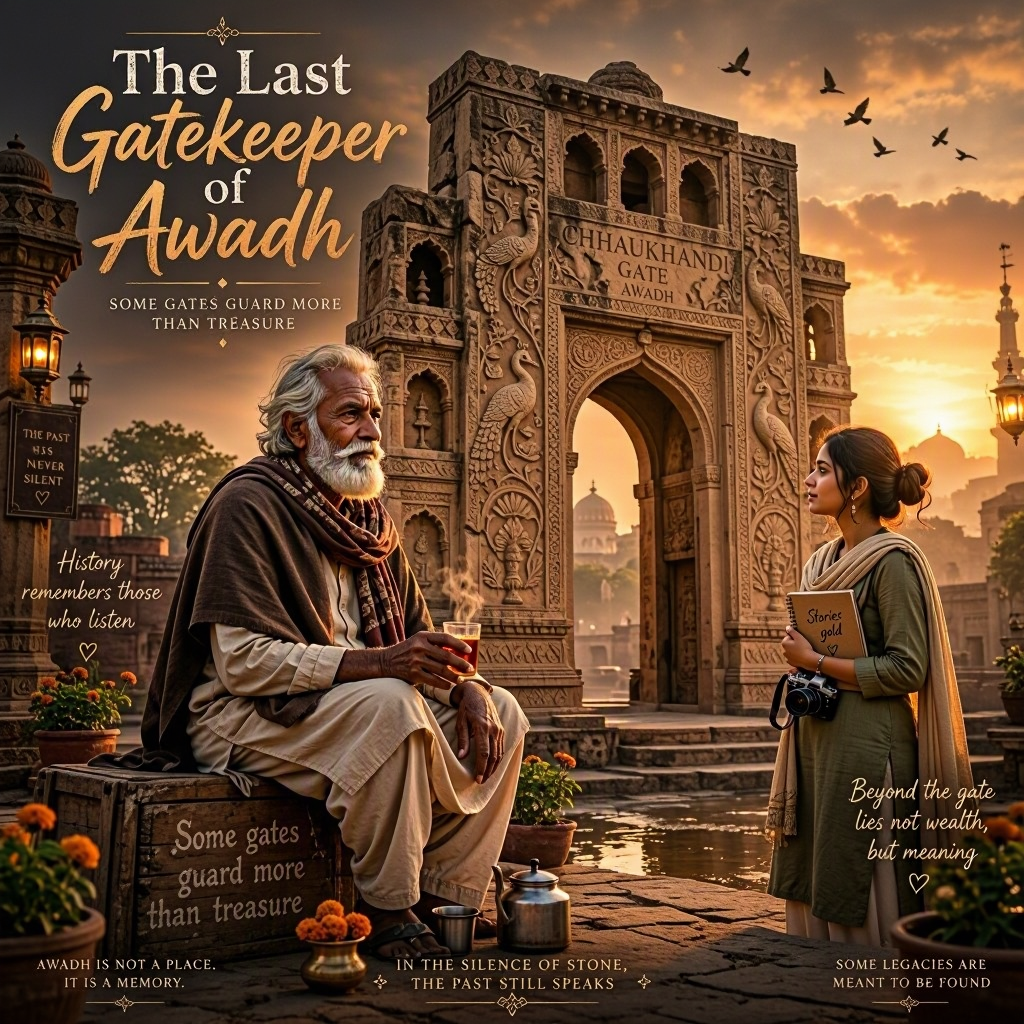
He lived in a one-room house pressed against the side of the Chaukhandi Gate, so close that his kitchen wall and the gate’s ancient brickwork seemed to share a single shadow. Every morning he swept the stones, and every evening he sat on an upturned crate with a glass of tea, watching the light turn the brick orange. In forty years, people said, he had spoken fewer words than most men say in a week.
They also said he knew where the treasure was. Nobody could say what it was. Gold, said the tea-stall owner. Jewels, said the schoolteacher. The town’s youth had dug around the gate’s foundations at night more than once, and Raghav had simply stood and watched them until they felt foolish and left.
Meera arrived in the first week of monsoon with a canvas bag, a camera with a cracked lens cap, and a notebook already half full.
“Don’t bother with him,” the guesthouse owner told her over breakfast. “He won’t talk. Last year some professor from Delhi sat there three days. Raghav gave him tea on the third day. That was all.”
“I’m not after treasure,” Meera said.
The man laughed. “Everyone says that.”
She was a historian, and she meant it. She had spent two years reading about Awadh in archives where the ceiling fans barely turned, and somewhere in a crumbling gazetteer she had found a single line about a gate that “keeps more than it shows.” That was it. One line and a hunch.
So she went and stood in front of the gate, and she didn’t dig anywhere. She photographed the carvings: vines, peacocks, a border of tiny repeating lotuses worn almost smooth by two centuries of rain. She sketched the faded inscriptions. When her hands got tired she sat on the step and just looked.
Raghav watched her from his crate and said nothing.
This went on for weeks. She worked at the gate in the mornings and in the library in the afternoons, and she began to nod at him when she passed, the way you nod at a neighbor. One day he nodded back. A week later, a glass of tea appeared on the step beside her, still hot, and when she turned around he was already walking away.
“Thank you,” she called.
He lifted one hand without looking back.
It was a Thursday when she noticed the pattern. The light had gone low and purple, and she was packing up when the shadows of the carvings fell across the stone at a different angle than usual. The lotuses lined up. Twelve of them, in a slanting row, that she had never seen as a row before.
She opened her notebook with shaking fingers.
The storm came three days later. The sky went the color of a bruise by afternoon, and the town shuttered itself, pulling in washing and dragging carts under awnings. Meera should have stayed in her room. Instead she was at the gate when the first fat drops hit, running her thumb along the twelve lotuses one by one.
Lightning cracked across the sky and lit the whole carved face of the gate for half a second, and in that flash she saw it. A seam. A thin dark line in the stone that had always been hidden by shadow, running straight down from the seventh lotus.
“Oh,” she said out loud.
“It’s the eighth,” said a voice behind her.
She turned. Raghav stood in the rain with water running off his white hair, holding an old umbrella he wasn’t using. His voice was low and rough, like a door that hadn’t been opened in a long time.
“The seventh is what the clever ones press,” he said. “My grandfather told me that. The eighth is the real one.”
“You can talk,” Meera said, stupidly.
“When there’s something to say.” He stepped forward, set his palm against the eighth lotus, and pushed.
Something deep inside the wall clicked. Then the stone swung inward on hinges that had been oiled, she realized, recently and carefully. Behind it was a narrow passage, dark and dry, smelling of dust and old paper.


She didn’t find gold. She found shelves. Scrolls tied with faded cord, bound ledgers, bundles of letters, a whole wall of manuscripts in Persian and Urdu and Awadhi, wrapped in cloth against the damp. Court records. Poems. A cook’s account book from some long-dead kitchen, with notes in the margins about who liked their rice with more saffron.
Meera put her hand over her mouth.
“My family kept it,” Raghav said quietly behind her. “Seven generations. Nobody ever wanted to know what was inside. They wanted what they thought was inside.”
“Why show me?”
He looked at her for a long moment. “You sat on the step for a month and didn’t touch anything. And you thanked me for the tea.”
They worked through the rest of that monsoon and into the cold season. She read, he made tea, and sometimes he would pick up a scroll she was struggling with and tell her a story about the family that had written it, passed down in fragments through his own family. She photographed everything, page by page, and began writing to a university she trusted.
Word got out anyway. It always does.
The man came on a bright morning in November, in a clean white kurta and an expensive watch, with two younger men a respectful step behind him. He introduced himself as a descendant of the old ruling house. He smiled a great deal.
“A heritage of this importance,” he said, “should be in proper hands. Family hands. I’m sure you understand, uncle.”
Raghav said nothing. He had gone back to being a man of few words.
“We’ll take care of everything. Cataloguing, security. Naturally there would be compensation.”
“The gate is closed today,” Raghav said.
“It’s a public monument.”
“Then come back with the papers that say so.”
The man’s smile thinned. Meera, who had come out of the passage with dust on her sleeves, stepped up beside Raghav without being asked. “The university has already been told what’s inside,” she said. “Every page is photographed. If anything happens to this collection, a lot of people will want to know why.”
It was a small lie, since the university had only just received her first letter. But the man did not know that. He looked at the two of them for a moment, an old gatekeeper and a woman with a notebook, and something calculating crossed his face.
“We’ll see,” he said, and left.
That evening they sat on the step together, Raghav on his crate, Meera with her knees pulled up.
“Will he come back?”
“Probably,” Raghav said. “People like that always come back.”
“What do we do?”
He took a long sip of tea. “Hurry,” he said. “And tell more people.”
Meera laughed, surprised. Then she opened her notebook and began to write the second letter.













 https://www.youtube.com/watch?si=RtToJsBhYBatUrym&v=mOuYNSdhjHA&feature=youtu.be