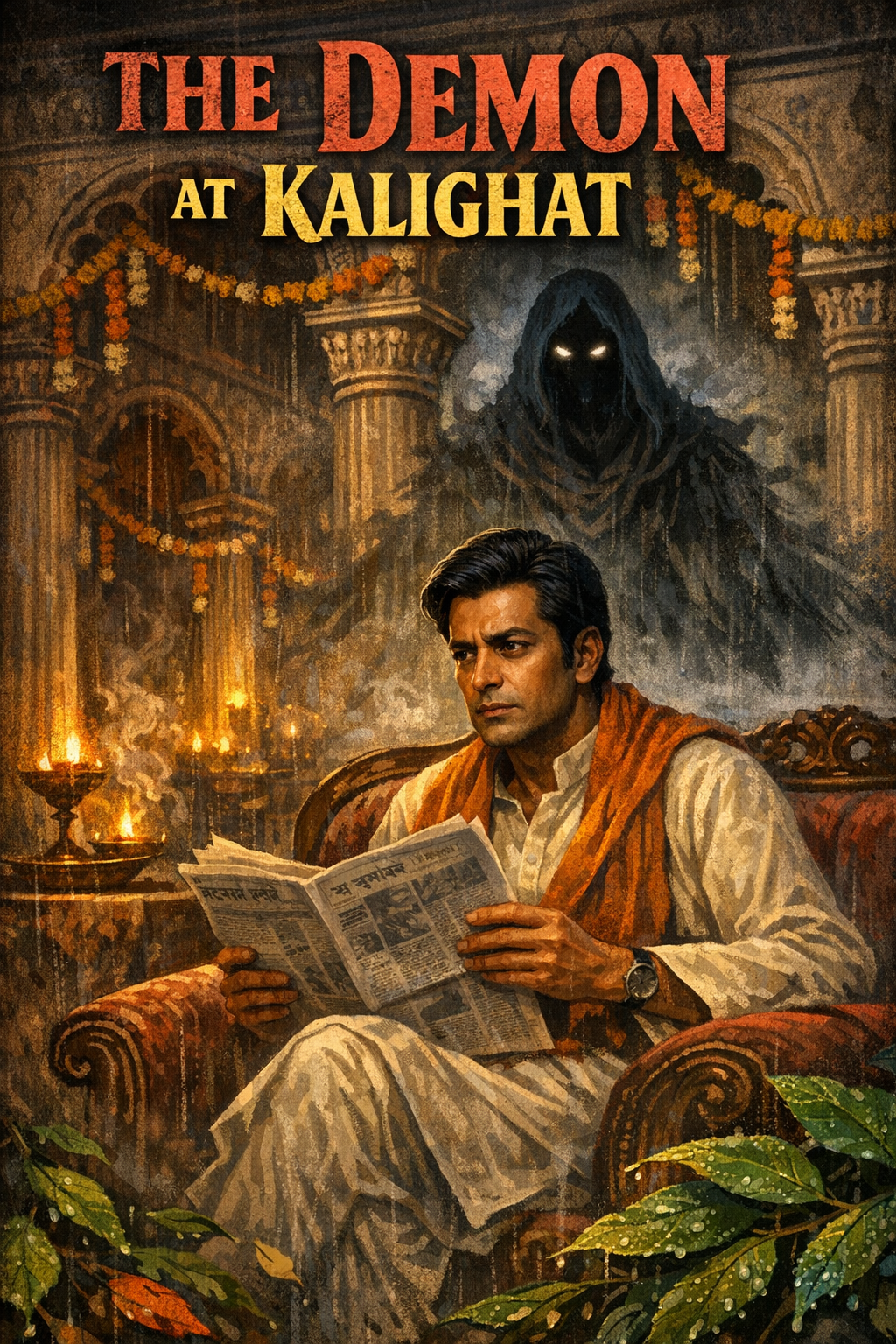
Feluda had been sitting on the sofa for twenty minutes with the same newspaper open to the same page when Jatayu arrived. I knew he was thinking, because he hadn’t turned the page and he hadn’t lit his cigarette.
It was the morning of Mahalaya. Somewhere in the neighborhood a radio was playing the old dawn recitation that Bengal has listened to for generations, and the air in Ballygunge already smelled of wet leaves and approaching Puja. Baba had gone out to buy sweets. Mother was in the kitchen. And Lalmohan Ganguly, better known to his readers as Jatayu, came up the stairs of 21 Rajani Sen Road two at a time, holding his chest.
“Mr. Mitter,” he gasped. “Felu-babu. A ghost.”
“Sit down, Lalmohanbabu. Topshe, get him some water.”
“I am not exaggerating. I was at my cousin’s in Kalighat last night, and there’s a barowari Puja on the lane behind the temple. The Ghoshal family’s thakurdalan, you know, two hundred years old. And everyone there is saying the same thing. A figure at the gate after midnight. Tall. Cloaked. And when anyone approaches, puff.” He flung his hands open. “Gone. They say it’s Mahishasura himself, angry that we forget his story every year and only celebrate his death.”
Feluda finally folded the newspaper. “Did your cousin see it?”
“Well. No. But his neighbor’s brother-in-law did.”
“Ah,” said Feluda. “Reliable.”
But he was already reaching for his notebook.
The Ghoshal thakurdalan stood at the end of a narrow lane, its pillars chipped and its floor cracked, the whole house leaning slightly toward the courtyard like an old man listening. Workmen were bending bamboo for the pandal. The idol-maker’s assistants were painting the last faces. Somewhere a dhaak drummer was tuning, a rattle of sound that made my stomach flutter the way it does every year.
The head of the family, a gentle, anxious man named Binoy Ghoshal, led us to the old carved panel above the central doorway. It showed the goddess spearing the buffalo demon, in dark teak, worn smooth by two centuries of incense smoke and monsoon air.
“It was never like this before,” he said quietly. “People say he has been changed. That he’s angry.”
I looked up and felt a small chill. The demon’s face was fierce, with bulging eyes, bared teeth and a twisted brow.
Feluda stood very still. He looked at it for a full minute, then another, and then he did something that made Jatayu step back: he took a Charminar from his pocket, did not light it, and began to walk slowly around the dalan, studying the floor, the pillars, the walls.
“Topshe,” he said at last. “What do you see?”
“A scary demon.”
“Look again.”
I looked. “A very scary demon.”
He sighed. “Binoybabu, do you have a photograph of this carving from before?”
There was one, as it turned out, an old family picture from some wedding decades ago, with the panel visible behind the bride. Feluda held it beside the real thing.
“Look at the demon’s face in the photograph,” he said.
I did. And I understood.
The old Mahishasura wasn’t terrifying. He was tired. His brow was heavy, his mouth slightly open, his eyes turned down toward the goddess’s spear, almost resigned. It was the face of a proud man who had seen his own end coming. Whoever had carved him two hundred years ago had given even a demon a little dignity.
The carving above us now was a stranger’s idea of evil.
“This isn’t the same panel,” Feluda said quietly. “It’s a copy. A good one, but the carver gave it a modern face. He thought a demon should look like a demon.”
Binoy Ghoshal went pale. “But who would…?”
“Someone who needed you to stop looking too closely. Someone who needed the family frightened of the dalan at night.” Feluda finally lit his cigarette. “A restless spirit is the perfect cover. Nobody wants to be near a haunted house after dark.”
The trail led where trails in our cases often lead, to a library.
In the old reading room off College Street, among shelves that smelled of damp paper and vanished ink, the librarian, a stooped man in thick glasses, dug out the manuscript the Ghoshal family elders had mentioned. A handwritten account of a forgotten ritual, supposedly meant to appease the demon’s spirit.
“Has anyone else asked for this?” Feluda said.
The librarian considered. “A gentleman, three weeks ago. Very polite. He signed the register.”
Feluda turned the register toward the light. The name was written in a neat, rounded hand: S. Bose.
“Topshe, look at the way he forms his ‘B’.”
“It’s a big loop.”
“It’s a big loop that starts below the line. That’s not how a man writes his own name. That’s how a man writes someone else’s.” Feluda wrote something in his notebook. “Our ghost reads, Topshe. He read this manuscript to learn the chant. He wanted his haunting to sound authentic.”
Jatayu, who had insisted on coming, looked up from a glossy volume he’d pulled off a shelf. “So he is educated? Not a real ghost?”


“Lalmohanbabu,” said Feluda, “I have never yet met a real ghost. I have met a great many men who find ghosts useful.”
On the night of Saptami, we hid.
It was almost one in the morning. The lane was dark except for a single bulb hanging from a bamboo pole. Feluda sat on the stairs of a closed shop with his back against a wall, perfectly still. I crouched beside him. And Jatayu, who had refused to stay home on the grounds that “a writer must experience danger firsthand,” was folded awkwardly behind a stack of earthen pots, trying to breathe quietly and failing.
“Mr. Mitter,” he whispered. “Are you sure he’ll come?”
“Quiet.”
“I only mean…”
“Lalmohanbabu.“
He went silent. For nearly an hour nothing moved except mosquitoes. Then, very faintly, I heard a footstep.
A figure slid out of the dark, tall, in a long dark shawl, and went straight to the dalan gate. It paused. Then, in a low, rough voice, it began to chant. The words rolled out slow and strange, and a cold hand closed around my neck.
Feluda stood up.
“That’s enough,” he said, not loudly.
The chanting stopped. The figure turned, and Jatayu, behind his pots, chose that moment to sneeze.
The figure bolted. Feluda was after him in two strides, but it was Jatayu, of all people, who ended it. Panicking, he lunged out of hiding, tripped over a pot, and fell directly across the running man’s path. They went down together in a tangle of shawl and shouting.
“I have him!” cried Jatayu from underneath. “Mr. Mitter! I’ve captured the ghost!”
“Yes, Lalmohanbabu,” Feluda said, and for once I saw him fight back a grin. “Well done.”
The man under the shawl wasn’t tall at all. He had been wearing platform sandals. When the torchlight hit his face I saw a thin, frightened boy of perhaps twenty-five, with clay under his fingernails.
His name was Bubai Pal, and he had learned to carve in the art school at Kumartuli, and he was the grandson of the old master who had once restored this very panel.
He told it all in the police station, in a flat, exhausted voice. An antiques dealer from Park Street had spotted the original teak panel years ago during a visit, and for months had been trying to buy it, offering the Ghoshals less than a fraction of its worth. When they refused, he found Bubai, who owed him money from a failed workshop, and made him an offer. Carve a replica. Make it good enough to pass for a few days. Scare the family out of the dalan at night so the swap could be made and the original smuggled out before Puja ended.
“I didn’t want to change the face,” Bubai said, staring at the table. “My grandfather always said that old carver knew something. That a demon should look like someone who had loved his own pride too much. But the dealer said, make it frightening. People believe frightening.”
The original panel was found three days later, wrapped in gunny sacks in a godown in Burrabazar, ready to be shipped to a buyer abroad. The dealer was arrested at his own gallery door, still insisting there had been some misunderstanding.
Inspector Mukherjee from Lalbazar, an old friend of Feluda’s, rubbed his forehead when he heard the full story. “A ghost,” he said. “In this day and age. And people believed it.”
“People believe what’s convenient to believe,” said Feluda. “Especially at night.”
On Dashami we went to the ghat.
The whole city seemed to have come with us. Drums, conch shells, vermilion smeared on a thousand foreheads, women pressing sindoor onto each other’s faces, the goddess’s great idol swaying on a hundred shoulders toward the river. Binoy Ghoshal stood on the bank with his family, and the old teak panel had been returned to its place two nights before, the tired, dignified demon looking down once more at the goddess’s spear.
“Do you think he forgave us?” Jatayu said suddenly. He was holding a paper cup of tea and looking at the water.
“Who?”
“The demon. Mahishasura. We forgot his story, and then somebody used it to scare people.”
Feluda was silent for a moment, watching the idol tilt and slide into the river with a soft, enormous splash.
“I think,” he said slowly, “the old carver understood something. That a villain isn’t only a villain. That there’s a human being somewhere inside, and a story we ought to remember. The person who recarved that face forgot it. The person who carved it first never did.”
He took out his notebook and wrote one last line, then closed it.
“Come on. Ma has made payesh.”
“Mr. Mitter,” said Jatayu, perking up at once. “I have been thinking. For my next novel. A demon who is misunderstood. I shall call it…”
“Lalmohanbabu,” said Feluda, “let’s get through the payesh first.”
I laughed, and Feluda shook his head, and behind us the drums rolled on over the river, and the city went on celebrating, as it always does, for a goddess who wins and a demon who never quite disappears.













 https://www.youtube.com/watch?si=RtToJsBhYBatUrym&v=mOuYNSdhjHA&feature=youtu.be