Byomkesh Bakshi and the Shadow Warrior
Byomkesh never liked it when a woman came to him with a dry face.
Tears, he said, were honest. Tears meant a person hadn’t yet decided what to hide. But Madhabi Das sat in our room at Harrison Road that Tuesday evening with her back straight and her hands folded, and she told us about her missing husband as if she were reading out a shopping list.
“Arjun left the office on the fourteenth. His car came back without him. That’s all.”
“No letter? No quarrel?”
“Nothing.”
“The police?”
“They said businessmen run off all the time.” Her mouth tightened. “He didn’t run, Byomkesh-babu. He was frightened of something for weeks. He kept checking the locks.”
When she left, Byomkesh stood at the window for a long while, watching the gaslamps flicker on one by one down the road. I knew better than to speak. Then he said, without turning, “Ajit, a woman who isn’t crying has usually done all her crying already. She wasn’t here to be comforted. She wanted a result.”
“So you’ll take it?”
“Of course I’ll take it.” He turned. “A frightened man who checks locks and then vanishes from a moving car. That is not a runaway, Ajit. That’s a man somebody was waiting for.”
It took us nine days to hear the name.
Byomkesh’s method has never changed. He doesn’t chase. He sits in tea shops, he lets paan sellers complain about their knees, and he waits until the same detail surfaces three times from three mouths that have never met. This time the detail was a name, spoken low, with a glance over the shoulder.
Chhaya-yoddha. The Shadow Warrior.
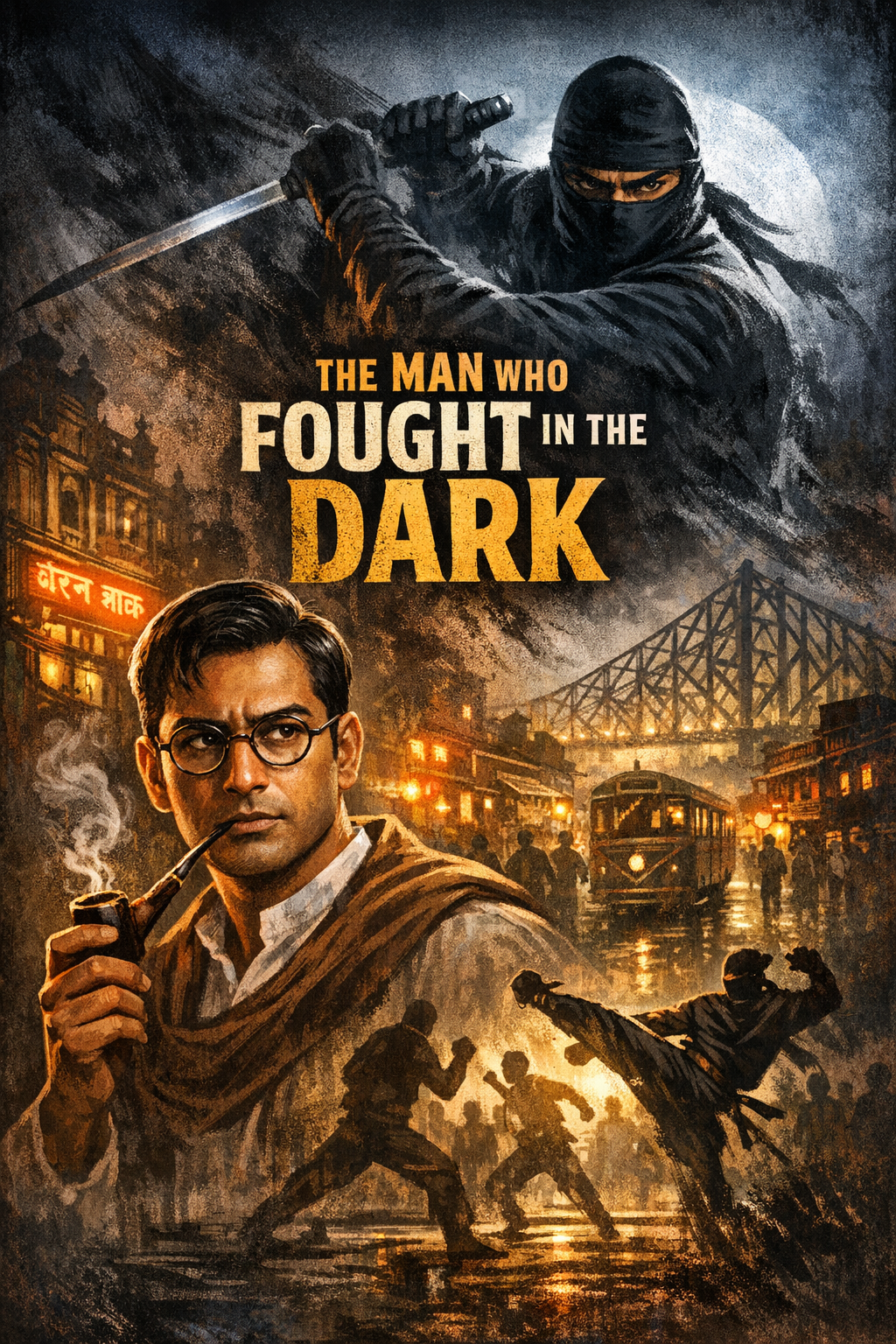
“A fighter,” said a rickshaw-puller at the Sealdah crossing, not meeting our eyes. “Fights in the dark, behind the old jute godown past Cossipore. Masked. Nobody has ever hit him twice. They say he can tell where your fist will land before you know.”
“Who runs the fights?”
The man laughed without humour. “Sahib, you ask like a man who wants to be hurt.”
That night Byomkesh dressed as a clerk with money to lose. I went as the clerk’s loud, foolish cousin. Satyabati stood in the doorway and watched us go with her arms crossed.
“If either of you comes back with a broken nose,” she said, “he sleeps on the stairs.”
“Noted,” said Byomkesh gravely.
The godown reeked of kerosene and sweat and old jute. A hundred men stood packed in a ring around a patch of packed earth lit by four hurricane lamps, and the noise they made was like a wave breaking and breaking and breaking. Bets changed hands in whispers. Somewhere a bottle smashed.
Then the noise dropped.
He came into the ring wearing a black cloth over the lower half of his face, bare-chested, barefoot. He wasn’t large. That was the first thing I noticed. He moved like a man walking on a floor he’d already memorized. The wrestler across from him, a giant from some akhara in Howrah, charged. The masked man stepped aside, almost lazily, and the giant went through the space where he’d been standing and hit the ground.
It was over in under a minute. No one spoke. The crowd had only come to watch something they couldn’t quite believe.
Byomkesh didn’t watch the fight. I noticed that later. He was watching the men watching it, and the little knot of well-dressed spectators on the raised platform at the back, where one heavy man in a silk shawl took the money and did not smile.
“Ajit,” Byomkesh murmured. “Look at the shawl.”
“The fat one?”
“He is the owner of Pramatha Jute Mills. Three weeks ago, Arjun Das wrote a letter to the Commerce Board asking for an audit of his accounts.” He said it so quietly I almost missed it. “Remember that.”
I won’t pretend I understood it all at once. Byomkesh rarely lets me. He prefers to keep the shape of a thing to himself until it’s complete, and then lay it out in one calm sentence that makes you wonder how you ever missed it.
What I can tell you is that he returned to the godown alone, three nights later, and waited.
I know because he told me afterward, and because he came home with a split lip.


The Shadow Warrior found him inside the empty ring after the last bout, in the half-dark. Byomkesh had been sitting on an overturned crate with his hands visibly open.
“You shouldn’t be here,” the masked man said. His voice was young, and tired.
“Neither should you,” said Byomkesh. “Neither of us belongs in a godown at two in the morning. But I’m here for Arjun Das, and I think you are too.”
There was a silence. Then the masked man moved, and Byomkesh, who is no fighter, took one clean blow to the mouth and went down on one knee. He told me later that he had seen it coming and had not wished to dodge.
“You hit like a man who doesn’t want to hit,” he said, spitting blood into the dust. “Every strike you threw tonight in the ring pulled up just short. You’ve been fighting for three months and not once have you finished an opponent properly. Why?”
The fist stayed raised. It was trembling very slightly.
“Because your job isn’t to win,” Byomkesh went on, “it’s to be seen here. Every night. Where the man in the silk shawl can watch you. A fighter nobody can touch makes a wonderful guard dog, and a convenient alibi. If the owner of Pramatha Mills is accused of anything, he can say he spent every night at the akhara, in public view, surrounded by witnesses. And you, brave man, have been standing in the lamplight keeping him honest by accident.”
The masked man lowered his arm.
“Arjun Das is not dead,” Byomkesh said, much more gently. “He’s in a room somewhere close to here, and you are the one person in this godown who knows where. I think you were told he would be killed if you refused to fight. I think you’ve spent three months looking for a way out.”
For a long moment, nothing. Then slowly, the masked man reached up and pulled the cloth from his face.
He was perhaps twenty-three. His name, he said, was Kartik. His younger sister worked in the owner’s house.
Arjun Das was found alive the next morning, thin and furious, locked in a storeroom behind the godown with a small stack of ledgers hidden beneath the floorboards that he’d somehow managed to retrieve and keep. Those ledgers were enough. By evening Inspector Ramkamal of Lalbazar, who had not wanted to take the case seriously, was taking it very seriously indeed, and the man in the silk shawl was explaining to a very small room why a jute mill’s accounts did not add up.
It turned out the audit would have exposed more than bad bookkeeping. Three officials in the Commerce Department were in on it. That was the “conspiracy at the highest level,” as the newspapers put it afterward. But I’ve always thought the newspapers got the story wrong. The high places didn’t matter much. What mattered was a young man in a black cloth, fighting in the dark every night so that someone else could be safe.
Madhabi Das came to Harrison Road a week later with her husband, who was still limping. She took Byomkesh’s hand in both of hers.
“I didn’t cry,” she said, “because I was afraid that if I started I wouldn’t stop. Thank you.”
“You were the best client I’ve had this year,” said Byomkesh, and meant it.
When they had gone, Satyabati came in with tea and looked at Byomkesh’s lip.
“You went and got hit on purpose, didn’t you?”
“A little.”
“Byomkesh.”
“It was effective.”
She sighed, set down the tray, and pressed a damp cloth against his mouth with more force than strictly necessary. He winced. I hid a smile behind my cup.
“Kartik’s sister is coming to work here,” she said. “I’ve already told her. She’ll help with the kitchen. And Kartik can sleep in the back room until he finds something steady.”
“Satyabati,” said Byomkesh, startled. “We can’t just…”
“We can,” she said. “We have.”
Outside, the lamps were coming on along the street one by one, the way they always do. Byomkesh looked at his wife for a moment, then at me, and shook his head, smiling, defeated by the one person in Calcutta he had never been able to deduce.
“The truth-seeker,” he said, “is outnumbered in his own home.”
“Drink your tea,” said Satyabati.













 https://www.youtube.com/watch?si=RtToJsBhYBatUrym&v=mOuYNSdhjHA&feature=youtu.be