Uttar Pradesh’s Mission 2027: Yogi Government’s Gen-Z Plan and the Politics of Youth
Lucknow: As Uttar Pradesh moves towards the 2027 Assembly elections, the state’s political discourse is increasingly focusing on a demographic force that could play a decisive role at the ballot box: young voters.The Yogi Adityanath government is preparing an integrated youth policy aimed at addressing the aspirations of people between 16 and 35 years of age, including students, researchers, young professionals and entrepreneurs.

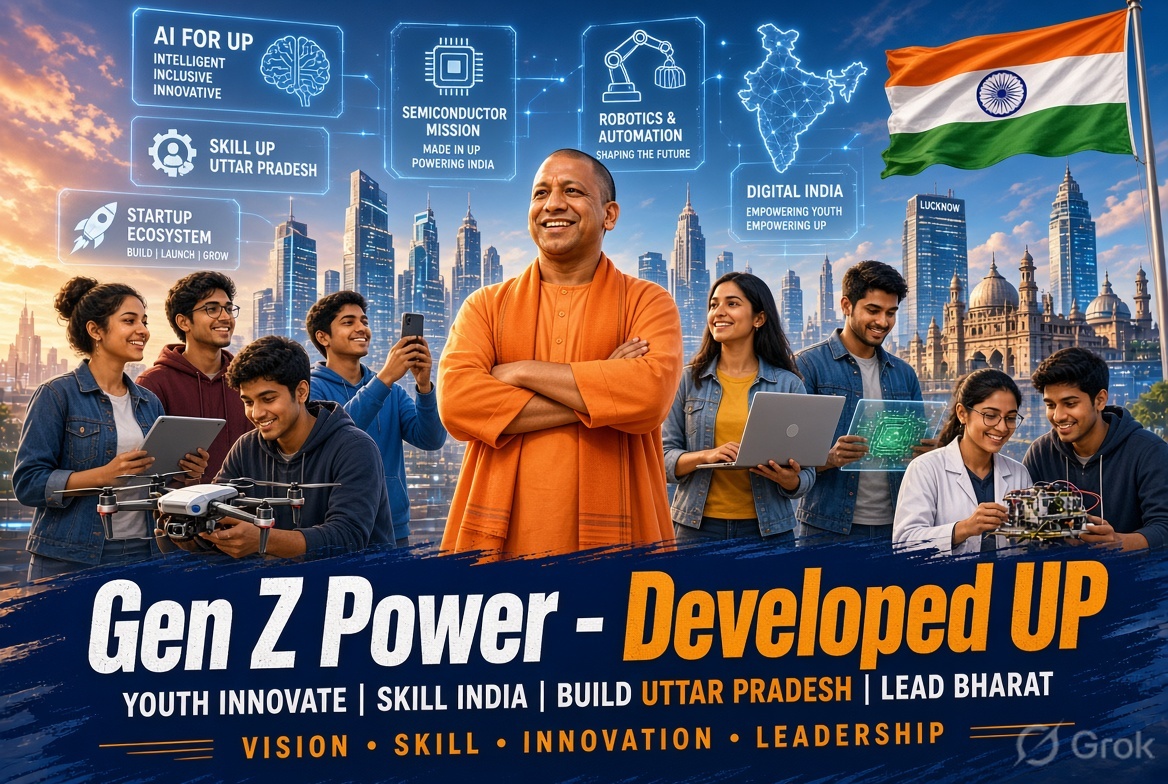
The proposed policy, being described as a “Gen-Z Plan”, places employment, skill development, technology, education, entrepreneurship and digital access at the centre of its approach. The policy reflects a recognition that younger voters are entering politics with expectations different from those of earlier generations. For many of them, employment opportunities, transparent recruitment examinations, education, digital security and access to new technologies are more immediate concerns than traditional political identities.
A Youth-First Approach
The proposed integrated youth policy is based on a “Youth First” approach, with the government seeking greater participation from young people in policy formulation. Rather than limiting youth-oriented programmes to financial assistance or welfare benefits, the stated objective is to equip young people with skills that can make them competitive in a rapidly changing global economy.The policy places particular emphasis on emerging technologies such as artificial intelligence, robotics, cybersecurity, drones, data analytics and semiconductor technology. Industrial Training Institutes and polytechnic institutions are being encouraged to align their training programmes with changing industry requirements.
The government’s broader objective is to create an ecosystem in which young people can find employment within the state while also encouraging them to become entrepreneurs and job creators.
The Mukhyamantri Yuva Udyami Vikas Abhiyan is being positioned as an important component of this strategy. At the same time, industrial and employment zones are being promoted as a means of attracting investment and generating employment opportunities outside the traditional urban centres.Expanding Access to Coaching and EducationAnother major component of the proposed policy is the decentralisation of competitive-examination preparation.The government plans to expand the Mukhyamantri Abhyudaya Coaching Scheme, which provides coaching support to students preparing for competitive examinations. The proposed expansion would take the programme beyond district headquarters and into universities and college campuses across the state.The objective is to reduce the geographical and financial disadvantages faced by talented students from rural and economically weaker backgrounds.
The government is also considering a unified digital platform through which young people could access information about scholarships, internships, career opportunities and eligibility for various government schemes. Such a platform could simplify access to services currently spread across multiple portals and departments.Connecting Young Officers with StudentsOne of the more distinctive elements of the proposed approach is the plan to connect young IAS, IPS and IFS officers with secondary and intermediate school students.Under the proposed “Youth Adda” or dialogue sessions, officers would interact directly with students and discuss career planning, civil services preparation and other professional opportunities.
The initiative is intended to make government services and career pathways more accessible to students while reducing the psychological distance between young people and the administration.The government is also focusing on sports infrastructure as part of its youth strategy. Plans include sports grounds at the gram panchayat level, mini sports complexes at the development-block level and sports excellence centres at the divisional level.
The stated objective is to provide young people with opportunities for physical activity and talent development while helping them stay away from substance abuse and other social problems.The Political DimensionBeyond its administrative objectives, the youth policy has an obvious political dimension as Uttar Pradesh prepares for the 2027 Assembly elections.
Young voters constitute a significant section of the state’s electorate. A large number of voters between 18 and 35 entered adulthood after the political changes of the past decade and may have different priorities from older generations.For this section of the electorate, transparent examinations, timely recruitment, private-sector employment, entrepreneurship and access to modern skills can be more immediate political concerns than traditional caste-based mobilisation.The government’s focus on youth therefore represents an attempt to build a political narrative around opportunity, technology and development.

The issue is particularly significant because employment and recruitment examinations have emerged as sensitive subjects in youth politics. Allegations of examination irregularities, paper leaks, cancellations and delays in recruitment have contributed to frustration among aspirants in several parts of the country.
For the ruling BJP, addressing these concerns could be crucial to maintaining its appeal among younger voters. The youth policy consequently serves both as a governance initiative and as an attempt to establish direct political communication with a generation that increasingly consumes information through digital platforms.
Opposition Questions the Timing
The opposition, however, is expected to scrutinise the policy closely.The Samajwadi Party and Congress have questioned whether the government’s youth initiatives can translate into meaningful employment and argue that young people are primarily looking for actual jobs rather than new schemes and digital platforms.Opposition leaders have also highlighted pending recruitments and vacancies in government departments, arguing that the credibility of any youth policy will ultimately depend on whether recruitment processes become faster, transparent and free from examination irregularities.
The opposition has also questioned the proposed involvement of senior civil servants in school-level mentoring programmes. Critics argue that administrative outreach cannot substitute for structural reforms in education, recruitment and employment.The debate reflects a larger political question: will young voters judge governments primarily on promises and policy announcements, or on measurable outcomes such as jobs, recruitment, wages, education quality and opportunities for entrepreneurship?
A High-Stakes Electoral Test
The answer could have major consequences for the 2027 Uttar Pradesh Assembly elections.For the Yogi Adityanath government, the integrated youth policy provides an opportunity to present Uttar Pradesh as a future-oriented state focused on technology, skills and innovation. If effectively implemented, it could strengthen the state’s human-resource base and help attract investment in emerging sectors.For the opposition, youth employment provides an opportunity to challenge the government’s record and turn recruitment, examination transparency and unemployment into central electoral issues.
The political contest is therefore likely to extend beyond traditional caste and community calculations. The aspirations of Gen-Z and younger millennials could increasingly influence campaign strategies, policy announcements and political messaging.Ultimately, the success of Uttar Pradesh’s “Gen-Z Plan” will depend less on its branding and more on implementation. Young voters are likely to measure the policy against tangible outcomes: whether examinations are conducted fairly, recruitments are completed on time, new industries create jobs, education becomes more accessible and young entrepreneurs receive meaningful support.If those objectives are achieved, the initiative could become more than an electoral strategy.
It could help transform Uttar Pradesh into a major hub for skilled human capital, technology and innovation.For now, however, the policy has opened a new political battleground. As Mission 2027 takes shape, the question is no longer simply which party can mobilise traditional vote banks, but which political force can convince Uttar Pradesh’s youngest voters that it understands their aspirations—and can deliver on them.