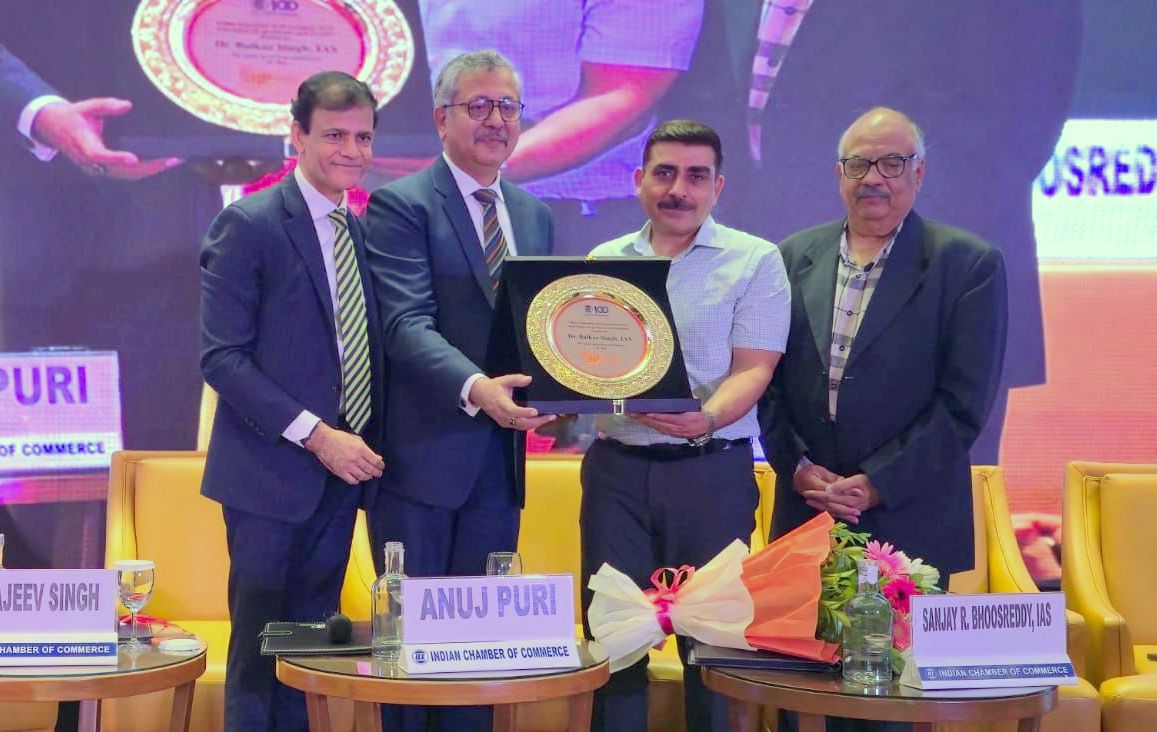
Lucknow: The Indian Chamber of Commerce (ICC) organized the ICC UP Real Estate Summit 2026 at Taj Mahal Hotel in Lucknow, bringing together policymakers, regulatory authorities, developers, investors, consultants, and industry experts to discuss the evolving real estate landscape of Uttar Pradesh and its role in achieving the state’s ambitious one trillion-dollar economy vision.
The summit focused on key themes including infrastructure-led growth, rising housing demand in emerging cities, regulatory reforms, technology integration, and the future of commercial and co-working spaces. Senior government officials, urban planners, and industry leaders highlighted how Uttar Pradesh is rapidly emerging as one of India’s most significant investment and urban development destinations.

The event began with a welcome address by Dr. Rajeev Singh. This was followed by a theme address from Sanjay R. Bhoosreddy. The keynote speech was delivered by Anuj Puri, while Avanish Kumar Awasthi attended as the chief guest.
Four major sessions were organized during the summit, focusing on the future drivers of Uttar Pradesh’s real estate sector. Discussions explored how expressways, airports, industrial corridors, policy reforms, and rapid urbanization are transforming the state into a major investment hub.
Another session examined the transition from affordable to aspirational housing, highlighting the growing importance of Tier-2 and Tier-3 cities, PMAY-driven development, regulatory transparency through RERA, and diversification in housing supply.
A dedicated technology session explored the growing influence of artificial intelligence-based proptech, digital land records, GIS mapping, BIM, data analytics, and smart building technologies in project planning and management.
Industry experts also discussed the rise of next-generation co-working spaces shaped by hybrid work culture, AI-enabled office experiences, ESG-based office development, and increasing demand for community-driven workspaces.

Speaking at the summit, ICC Director General Rajeev Kumar Singh said Uttar Pradesh’s development is no longer limited to the NCR region. He noted that enhanced connectivity through expressways, airports, and industrial corridors is creating new growth centers across smaller cities and towns, opening significant opportunities for real estate, infrastructure, and industrial development.
Dr. Balkar Singh emphasized that real estate and housing remain among the strongest indicators of economic growth. He said policy reforms, improved connectivity, expanding expressway networks, airport development, and the strengthening role of RERA have significantly boosted investor confidence. He added that projects such as Jewar Airport, regional capital zones, convention centers, and integrated townships are paving the way for balanced and decentralized urban growth.
UP RERA Chairman Sanjay R. Bhoosreddy stated that following the market surge witnessed in late 2023, Uttar Pradesh’s real estate sector has entered a phase of robust growth. He highlighted strong appreciation in property prices and renewed investor confidence in NCR micro-markets including Noida, Greater Noida, and the Yamuna Expressway region.
According to Bhoosreddy, UP RERA currently oversees one of the country’s largest real estate ecosystems, with more than 3,000 registered projects and steadily increasing investments each year. He revealed that project registrations crossed the 3,000 mark in 2025, while investment commitments reached nearly ₹85,000 crore. The sector is now targeting investments exceeding ₹1.25 lakh crore in the coming years.
The summit concluded with industry leaders stressing that Uttar Pradesh is evolving beyond an NCR-centric market into a multi-city growth model driven by infrastructure expansion, policy support, institutional investment, and rising urban aspirations. Experts said future development in the state will integrate residential, commercial, industrial, technological, and social infrastructure to create sustainable urban ecosystems.