August 1925 hung heavy and humid over the United Provinces, the kind of heat that made the British Raj feel permanent, unshakeable, eternal. But in a modest house in Shahjahanpur, a young poet named Ram Prasad Bismil was done waiting for permission from history.
He’d watched the Non-Cooperation Movement collapse a few years earlier, watched Gandhi call it off after Chauri Chaura, and something in him had refused to accept that patience alone would ever move the British Empire. So Bismil, along with a small band of dreamers who called themselves the Hindustan Republican Association, decided they would write their own chapter. Revolution needed money — for weapons, for safe houses, for the long underground fight ahead — and they had decided the government’s own treasury would fund the movement meant to end it.

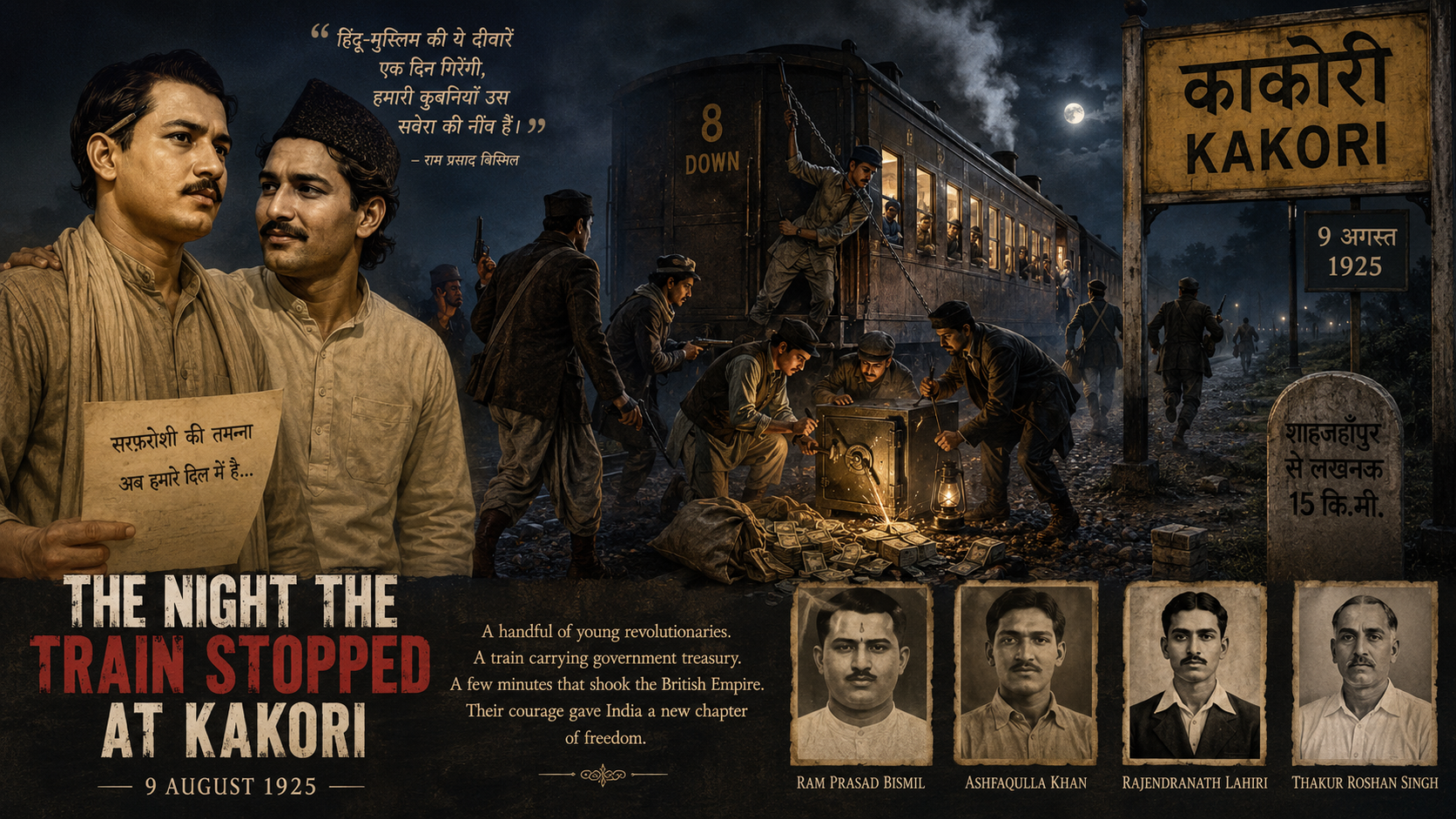
Beside Bismil stood Ashfaqulla Khan, and if you wanted a single image to hold onto from this whole story, it would be the two of them together — a Hindu and a Muslim, inseparable, laughing off the empire’s oldest trick of turning communities against each other. Their friendship wasn’t a footnote to the revolution. In many ways, it was the revolution — proof of what a free India might actually look like.
Around them gathered others: Rajendranath Lahiri, quiet and resolute; Chandrashekhar Azad, already earning a reputation as someone the British could never quite catch; Sachindra Bakshi, Manmathnath Gupta, Mukundi Lal, and a handful more young men who’d decided their lives were worth staking on an idea.
Their target was almost poetically ordinary: the Number 8 Down train, rattling along the rails from Shahjahanpur toward Lucknow, carrying nothing more dramatic than bags of government cash collected from stations along the line. On August 8th, fate nearly closed the door on them — the train slipped past Kakori before they were ready. Most groups might have called it off. Instead, they spent the night sharpening the plan.
The next evening, August 9th, they boarded in twos and threes, scattered across different compartments so as not to draw attention — some in second class, some tucked into the third-class carriages among ordinary travelers heading home. As the train reached Kakori, a small station some fifteen kilometres northwest of Lucknow, Rajendranath Lahiri reached up and pulled the emergency chain.
The train shuddered to a halt near the village of Bajnagar.
What followed took only minutes. The group moved quickly, securing the guard’s compartment, working the heavy iron safe open with hammers and chisels until it gave up its contents — roughly Rs 4,600, no fortune even then, but enough to keep a revolution breathing a while longer. In the chaos of those few minutes, tragedy intruded where none had been intended: a passenger, a lawyer named Ahmed Ali, was fatally struck when a weapon discharged accidentally. It was the one thing the young revolutionaries had never planned for, and it would follow them into every courtroom and every headline that came after.


Then they vanished into the dark, scattering toward Lucknow and beyond, carrying with them both the money and the knowledge that nothing would be the same again.
They were right about that, though not in the way they hoped. The British response arrived like a hammer. A manhunt swept across the entire province. Bismil was taken in October. Ashfaqulla ran — first toward Nepal, then into hiding for over a year — before betrayal finally caught up with him in December 1926. Only Azad slipped through every net the empire cast, disappearing into legend until 1931.
The trial dragged on for more than a year, nearly forty names on the charge sheet, twenty-nine standing before the court. On the 6th of April, 1927, the verdicts came down like a closing door: Bismil, Ashfaqulla, Lahiri, and Thakur Roshan Singh sentenced to hang. The rest scattered into long imprisonment, some shipped off to the Cellular Jail in the Andamans, that other kind of ending.
Every appeal failed.
On the 17th of December, Rajendranath Lahiri went first, at Gonda Jail. Two days later, on the 19th, the other three followed within hours of each other in three different cities — Bismil at Gorakhpur, Ashfaqulla at Faizabad, Roshan Singh at Naini. Witnesses would later say they walked to their deaths without flinching, singing songs of a free India, still — even then — calling for Hindu-Muslim unity to outlive them. In his last letters, Bismil asked nothing for himself, only that his countrymen honor his death by holding onto that unity long after he was gone.
What happened at Kakori was never really about the money in that iron safe. It was a signal — proof that a new generation had arrived, one unwilling to wait quietly for freedom to be granted. The HRA’s funds from that night helped it grow into the Hindustan Socialist Republican Association, and the memory of four men walking calmly to the gallows lit something in the revolutionaries who came after — Bhagat Singh among them.
A century on, Kakori is a quiet station now, easy to miss on a map. But for one evening in 1925, it was the place where a handful of young Indians stopped a train, startled an empire, and left their names written permanently into the long, unfinished story of a nation’s freedom.












 https://www.youtube.com/watch?si=RtToJsBhYBatUrym&v=mOuYNSdhjHA&feature=youtu.be