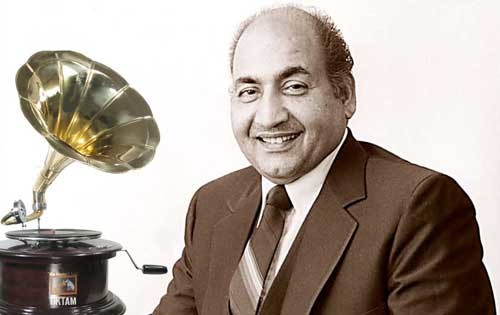
Mumbai: There are a handful of voices in the history of Indian cinema that aren’t merely heard — they’re felt. Mohammed Rafi belonged to that rare company. His voice carried the tenderness of love, the ache of separation, the faith of devotion, the fire of patriotism, and, just as often, the quiet courage to smile through life’s struggles. That’s precisely why Rafi’s songs were never confined to one era, one actor, or one generation. Decades on, they still live in millions of hearts.
A Universe of Emotion in a Single Voice
What set Rafi apart, above all, was his sheer range. He wasn’t simply a gifted singer — he was an artist who absorbed the emotion behind a song and brought it to life in his own voice. In one moment he could plumb the depths of sorrow, as in “O Duniya Ke Rakhwale”; in the next, he could turn playful and mischievous, as in “Sar Jo Tera Chakraye.” “Chaudhvin Ka Chand Ho” carries all the delicacy of romance, while “Man Tadpat Hari Darshan Ko Aaj” carries the weight of devotion. And in his patriotic songs, his voice had a way of filling listeners with energy. That was Rafi’s extraordinary gift — whatever the song, whatever the emotion, whatever the character on screen, his voice became the face of that feeling.

A Different Voice for Every Actor
In Hindi cinema, playback singing has never been just about singing a song — it’s about lending a voice to the character on screen, and in this craft, Rafi had few equals. He found a distinct tonal shade for each star he sang for: the playful charm of Dev Anand, the gravity of Dilip Kumar, the romantic flair of Rajendra Kumar, the restless energy of Shammi Kapoor, the rugged masculinity of Dharmendra. His voice carried such range that audiences rarely felt they were hearing the same singer behind such different personalities.
A Favorite of India’s Greatest Composers
Rafi worked with nearly every major composer in Indian film music — Naushad, Shankar-Jaikishan, S.D. Burman, O.P. Nayyar, Madan Mohan, Ravi, Laxmikant-Pyarelal, and many others — lending their compositions new heights with his voice. His singing showed a firm grip on classical music alongside an easy command of folk melodies, and he could handle the most demanding compositions in a way that made them sound effortless to the listener. That, in the end, is the mark of a truly great artist — making difficult art look so simple that the listener forgets how hard it actually was.
A Humility as Great as His Talent
Rafi’s greatness wasn’t confined to his voice — it showed in how he carried himself. Despite immense popularity and extraordinary success, there was not a trace of ego in him. His personality was a reminder that true stature isn’t about standing above others, but about becoming more humble because of it. In an industry where competition was only natural, Rafi’s gentle, cooperative nature set him further apart — he treated a song less as personal achievement and more as a shared act of musical devotion.
Love Greater Than Any Award
Rafi received several prestigious honors over his career, including the Padma Shri and a National Film Award. But arguably his greatest reward was the sheer love the public gave him. Even today, when his voice plays on the radio, older listeners are pulled back into memory, while a younger generation finds in that same voice something that still feels relevant. That, perhaps, is what real artistic immortality looks like.


July 31, 1980: A Voice Fell Silent, Not the Music
Mohammed Rafi passed away on July 31, 1980, and Indian music lost one of its greatest voices that day. But his voice never truly went quiet. Whether it’s playing from an old radio, being performed at a concert, resurfacing in a film rerun, or being covered by a young singer today, Rafi returns to us again and again. Time can take away the body — it cannot take away true art.
A Masterclass for a New Generation
Music today has entered an age of advanced technology. Digital recording and modern tools have reshaped how singing itself works. And yet Rafi’s relevance hasn’t dimmed one bit — because technology can polish a voice, but it cannot manufacture feeling. Notes can be arranged with precision, but a soul cannot be engineered in. The real power of Rafi’s voice lay in its intimacy. His songs are a reminder that great singing was never just about hitting high notes — it’s the art of understanding the emotion hidden behind the words and carrying it straight into the listener’s heart.
Rafi: One Name, Countless Emotions
To try and box Rafi into a single category would do a disservice to the sheer scale of his artistry. He was the voice of romance and of devotion; the voice of heartbreak and of humor; the voice of patriotism and of friendship and the simple joys of life. His voice gave lovers the language of love, gave the heartbroken company in their pain, gave the devout a voice for their faith, and gave patriots a song to stir their spirit. Perhaps that’s why Rafi wasn’t merely a singer — he was, in a very real sense, a portraitist of the Indian emotional landscape, painting in sound.
Immortality Has a Melody of Its Own
Great artists leave us, but their art lives on after them. The secret to Mohammed Rafi’s immortality is simple: he didn’t just sing his songs — he lived them. His voice carries the fragrance of Indian soil, the warmth of Indian culture, and a universal language of human emotion that needs no dictionary to understand. Rafi is no longer with us in body, but when his voice rises with an old song, it feels as though time pauses for a moment, and that wandering minstrel of melody sits before us once more, singing straight from the soul.
Mohammed Rafi remains immortal for one simple reason: his voice never stopped at the ears — it went straight to the heart. And the notes that live in the heart never truly die.












 https://www.youtube.com/watch?si=RtToJsBhYBatUrym&v=mOuYNSdhjHA&feature=youtu.be