Khyati Agrawal Gupta
Observed from 1-7 August, World Breastfeeding Week, launched by WABA in 1992, isn’t just about celebrating breastfeeding. It’s about ensuring mothers receive the counselling, support & resources they need when breastfeeding becomes unexpectedly difficult.
Only 48% of babies under six months worldwide are exclusively breastfed, compared to 63.7% in India. Breast milk acts as a baby’s first natural immunisation, protecting against life-threatening infections like diarrhoea & pneumonia while improving brain development, cognitive performance & gut health.
The challenge begins when a baby arrives too soon.
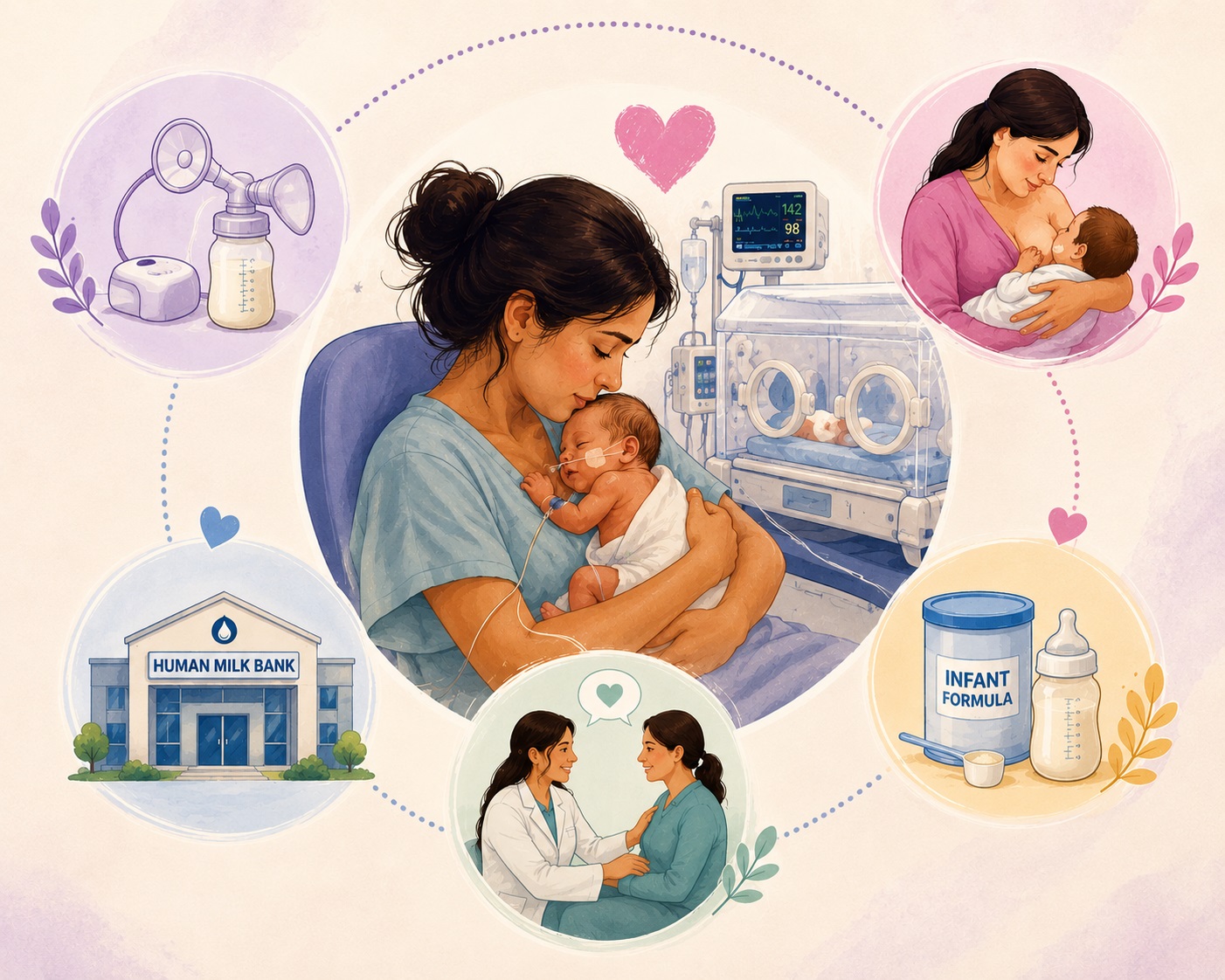
India records the highest number of preterm births in the world. Although milk production can begin after a premature delivery, emergency surgery, pregnancy complications & stress of watching the preterm newborn hooked up to ventilators & monitors in the NICU often delay or reduce milk supply. The immediate separation of mother & baby also prevents early skin-to-skin contact & suckling, two key triggers for establishing breastfeeding.
Most premature babies cannot coordinate sucking, swallowing & breathing before 34-36 weeks of gestation. They are therefore fed tiny quantities of expressed milk- sometimes just 1-2 ml through a tube passed into the stomach until they are strong enough to breastfeed safely. The impact? What should have been a natural process quickly snowballs into a medical challenge. For mothers, the emotional toll is immense. Many struggle with guilt, societal pressure, anxiety & the feeling that their body has ‘failed’ them, while babies lose the protective benefits of their mother’s milk during their most vulnerable days.

At this stage, doctors often recommend supplemental formula feeding. Modern infant formulas have advanced remarkably over the past two decades, closely replicating the nutritional composition of breast milk. When does formula not work? “Some of the medical conditions make it necessary to give only breast milk such as necrotizing enterocolitis (NEC) & cow milk protein intolerance,” says Dr. Aakash Pandita, Director, Paediatrics & Neonatology at Medanta Lucknow. “So we should always try for mother’s milk. The second best option is donor EBM.”
This is where human milk banks become lifesaving. KGMU’s Human Milk Bank, Uttar Pradesh’s first, has provided safe pasteurised donor milk to more than 1,700 critically ill & premature babies since 2019. Lucknow’s second milk bank opened at Command Hospital in 2024, while Medanta is now setting up theirs.
Then what’s the hold up? “There is hardly any knowledge about human milk banks among the masses. The ones who know are hesitant due to fear of infections, religious beliefs, hygiene concerns, doubts about the health of the donor mother & other taboos around it,” Dr. Pandita sighs. Donor milk is medically screened, pasteurised & microbiologically tested before reaching newborns.
What else can be done? WHO recommends early lactation counselling, Kangaroo Mother Care & psychological support. Equally important is to raise awareness & bust cultural myths to encourage eligible mothers with surplus milk to donate.
As a new mother of a preterm baby, I’ve learnt that feeding isn’t always a choice- it can be often shaped by medical circumstances. That’s why the conversation needs to move beyond ‘Breast is Best’ to ‘Fed is Best’. So whether that means breastfeeding, supplemental formula feeding or donor milk, this World Breastfeeding Week, let’s ensure every mother has access to knowledge, guidance & resources to make the best choice for her baby.










 https://www.youtube.com/watch?si=RtToJsBhYBatUrym&v=mOuYNSdhjHA&feature=youtu.be