New Delhi: In May this year, a bizarre political meme transformed into one of India’s biggest online youth movements almost overnight. The so-called “Cockroach Janata Party” (CJP) emerged not as a conventional political organization, but as a sharp, satirical rebellion powered by memes, frustration, and Gen Z humor.
What began as an internet joke quickly exploded into a nationwide digital phenomenon.

The trigger came after controversial remarks attributed to Chief Justice of India Surya Kant during a Supreme Court hearing. Reports claimed unemployed youth and sections of activists or journalists were compared to “cockroaches” and “parasites” attacking the system without contributing. Although later clarification suggested the comments targeted individuals using fake qualifications, the damage had already been done online.
Within hours, social media users seized upon the insult. Instead of rejecting the label, many young Indians embraced it ironically.
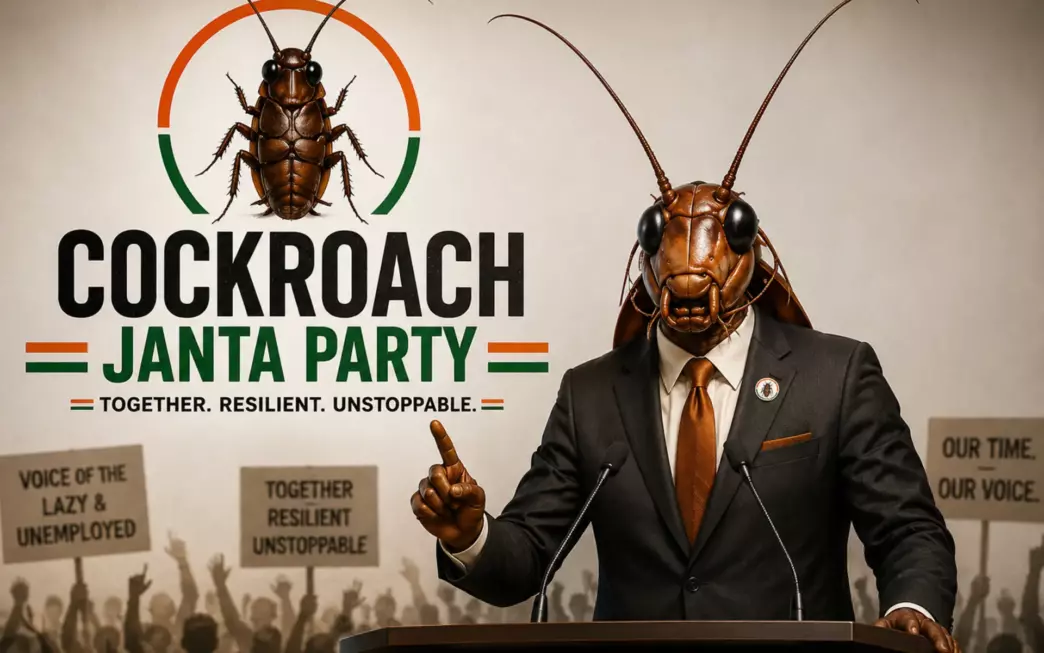
That momentum was harnessed by Abhijeet Dipke, a Boston University student and former political communications strategist, who launched the Cockroach Janata Party around May 16, 2026. The movement branded itself as the “Voice of the Lazy & Unemployed,” using absurdist humor to spotlight serious concerns like unemployment, exam paper leaks, rising economic anxiety, corruption, and the growing disconnect between institutions and young citizens.
Unlike traditional political campaigns filled with speeches and rallies, CJP thrived entirely online. Its official platform, Cockroach Janata Party, leaned heavily into self-aware satire. Membership was jokingly open to people who were:
- “Unemployed by force or choice”
- “Chronically online”
- “Experts at ranting”
- “Victims of competitive exam trauma”
The humor struck a nerve because it reflected genuine frustrations. Millions of students and graduates across India have spent years navigating intense competition, delayed recruitment drives, paper leak controversies, and shrinking job opportunities. Instead of formal activism, many found release through memes and digital satire.
The movement’s social media rise was extraordinary. Reports suggested its Instagram following surged into the tens of millions within days, potentially overtaking the official accounts of major political parties in engagement metrics. Short-form videos, AI-generated campaign posters, parody manifestos, fake election promises, and ironic slogans flooded timelines across India.
On X (formerly Twitter), the main account reportedly gained hundreds of thousands of followers before being withheld in India following legal complaints. Backup accounts immediately appeared, further fueling the movement’s anti-establishment image.
Part of the appeal lay in the symbolism itself.
Cockroaches survive.
They adapt.
They refuse to disappear.

Young users began reframing the insult as a badge of resilience — a sarcastic declaration that despite unemployment, systemic failures, and public ridicule, they were still here, still visible, and impossible to crush entirely.
The movement also showcased how political communication has evolved in the AI and meme era. CJP used polished graphics, fast-turnaround satire, viral audio clips, AI-generated speeches, and internet-native language to reach audiences far more effectively than many mainstream campaigns.
Critics questioned whether the movement represented authentic grassroots frustration or a cleverly engineered digital campaign. Allegations surfaced regarding bots, manipulated engagement, and possible political affiliations. Some political voices accused it of indirectly helping opposition narratives, while supporters argued it simply exposed realities many young Indians already felt.
Regardless of the debate, the movement achieved something significant: it transformed internet humor into a large-scale expression of generational anger.
International media outlets including BBC, Al Jazeera, and The Guardian began covering the phenomenon as an example of modern digital protest culture emerging in India.
As of May 22, 2026, the Cockroach Janata Party remains unofficial, unregistered, and largely satirical. Whether it eventually fades as a meme trend or evolves into something politically meaningful is still uncertain.
But its impact is already undeniable.
It revealed how deeply frustration runs among young Indians — and how humor, sarcasm, and viral culture have become powerful tools of collective expression in the digital age.
A single controversial remark sparked a movement.
An insult became an identity.
And millions online turned satire into protest.