The fog arrived early that winter.
It rolled across Lucknow like a living thing, swallowing roads, monuments, and memories alike. Beneath the pale glow of street lamps, the city seemed suspended between centuries—its Nawabi grandeur fading into shadows, its secrets buried beneath layers of history.

For investigative journalist Ayaan Rizvi, sleepless nights were nothing new.
From his small apartment overlooking Hazratganj, he spent most evenings chasing stories that others were afraid to touch. Corrupt politicians, land mafias, missing files, mysterious deaths—he had made a career out of uncovering uncomfortable truths.
But on that December night, the truth came looking for him.
A heavy knock echoed through his apartment.
Ayaan glanced at the clock.
2:17 a.m.
Another knock.
He opened the door.
No one was there.
Only a weathered brown envelope rested on the doormat.
Its paper looked decades old.
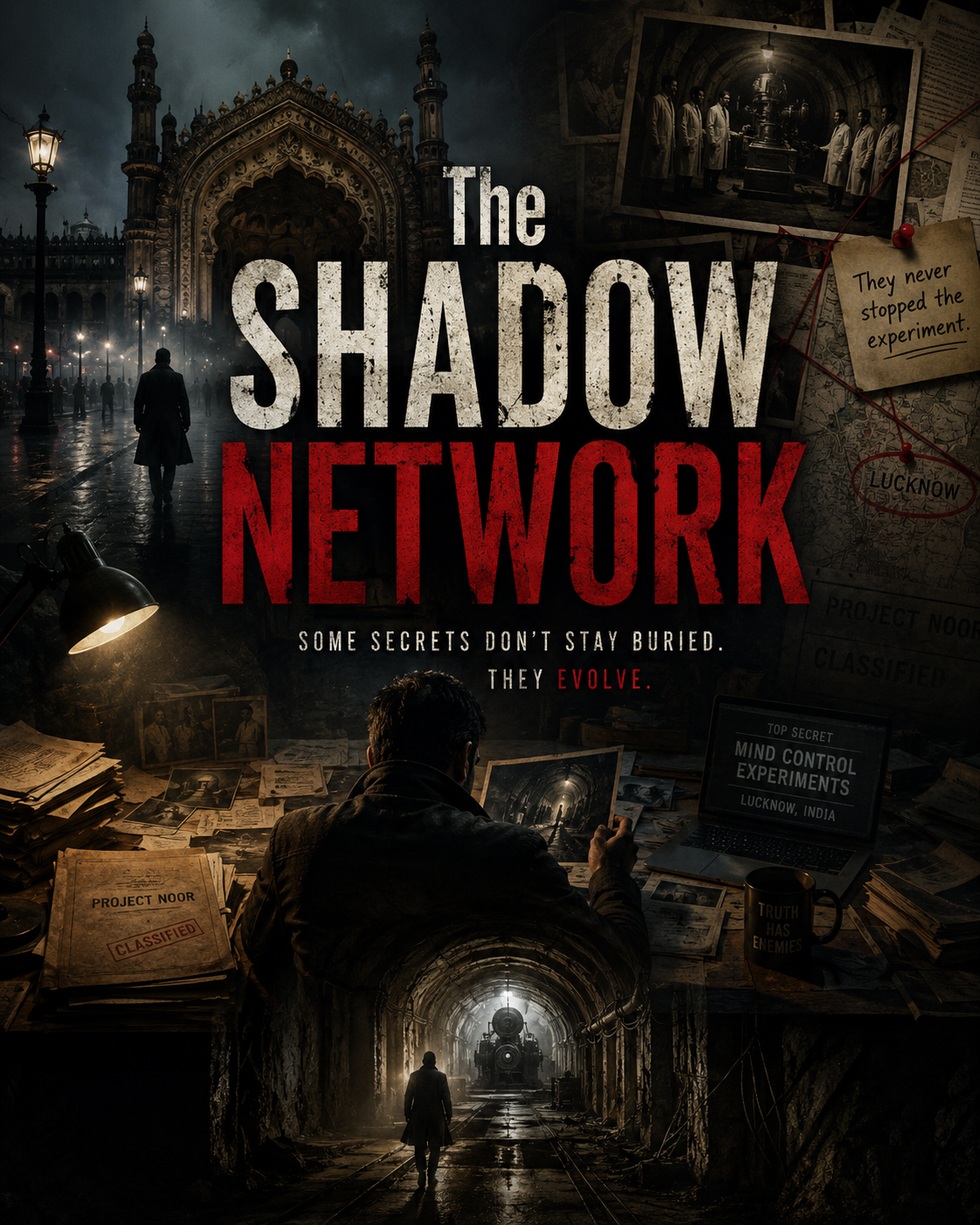
Inside was a black-and-white photograph.
Six men wearing laboratory coats stood inside what appeared to be an underground tunnel. Behind them loomed a strange metallic structure unlike anything Ayaan had ever seen. The machine was partially hidden in darkness, but even through the faded image it looked menacing.
On the back, written in hurried ink, were six words:
“They never stopped the experiment.”
Ayaan stared at the message.
A chill ran down his spine.
For years he had heard rumors about classified government experiments conducted beneath Lucknow during the Cold War. Most historians dismissed the stories as myths.
Yet here was proof.
Someone wanted him to find the truth.
Or wanted him dead trying.
The following morning, Lucknow awoke to disturbing news.
A retired scientist named Dr. Harish Verma had been found dead near the historic Rumi Darwaza.
Police called it a heart attack.
Ayaan did not believe them.
Dr. Verma’s name appeared on the back of the photograph.
His instincts screamed that the death was connected.
By noon he was sitting inside the dusty archives of an old library near Chowk, searching government records and forgotten newspapers.
Hours later, he discovered something strange.
In a newspaper clipping from 1989, Dr. Verma had worked on a secret project known only as Project Noor.
The article abruptly ended.
Entire sections had been blacked out.
Someone had censored history.
The mystery deepened.
For the next week, Ayaan plunged into the investigation.
He met retired bureaucrats who refused to speak.
Former intelligence officers abruptly ended interviews.
One elderly professor became visibly terrified when he heard the words “Project Noor.”
“You need to stop asking questions,” the old man whispered.
“Why?”
The professor leaned closer.
“Because they are still listening.”
Before Ayaan could ask more, the man hurried away.
That night, Ayaan noticed someone following him.
A tall figure dressed entirely in black.
A featureless white mask covered his face.
Whenever Ayaan turned, the stranger disappeared into the fog.
The journalist began seeing him everywhere.
Near Kaiserbagh.
Outside the State Archives.
Even standing motionless beneath the arches of Bara Imambara.
Watching.
Waiting.
A breakthrough arrived unexpectedly.
While examining a collection of old Urdu manuscripts, Ayaan found coded annotations hidden between verses of poetry.
The messages formed coordinates.
The coordinates led to an abandoned colonial-era railway warehouse on Lucknow’s outskirts.
Inside, hidden beneath rusted machinery, was a steel locker.
The locker contained dozens of classified files.
As he read through them, Ayaan felt the ground shift beneath his understanding of reality.
Project Noor had been created during the Cold War.
Officially, it was a psychological research program.
Unofficially, it was far more dangerous.
Scientists had attempted to develop methods of mass cognitive influence—ways to subtly shape human behavior, beliefs, and decisions without people realizing it.
The project combined neuroscience, propaganda, surveillance, and experimental technology.
It was mind control.
And according to the files, the project had never ended.
It had merely changed hands.
The deeper Ayaan dug, the darker the conspiracy became.
Several politicians appeared in recent documents.
Business tycoons funded secret operations.
Senior bureaucrats approved unexplained expenditures.
The network stretched across decades.
Every government that came to power had inherited it.
Protected it.
Expanded it.
The experiment had become part of the system itself.
Then Ayaan found a photograph that stopped him cold.
A young woman stood beside Dr. Verma.
Her name was handwritten underneath:
Sara Rizvi.
His mother.
Ayaan’s hands trembled.
His mother had supposedly died in a road accident thirty years ago.
He had been five years old.
Yet according to Project Noor records, she had worked as a research analyst until weeks before her alleged death.
The official story suddenly made no sense.
Why had she never spoken about the project?
Why was her file classified?
And most importantly—
Was she really dead?
The answer arrived the next day.
A USB drive appeared inside his apartment.
No note.
No explanation.
Only a single video file.
With shaking fingers, Ayaan pressed play.
The screen flickered.
A woman appeared.
Older.
Gray-haired.
But unmistakably his mother.
“Ayaan,” she said softly.
“If you’re watching this, they know you’ve found the truth.”
His breath caught.
Tears filled his eyes.
She was alive.
For thirty years, she had been alive.
The recording explained everything.
Sara had discovered that Project Noor was being weaponized against citizens.
Public opinion was being manipulated.
Election outcomes influenced.
Dissent monitored.
She had attempted to expose it.


Instead, the network erased her identity and forced her into hiding.
“I couldn’t risk contacting you,” she said.
“They would have killed you.”
The video ended with a location.
A set of coordinates beneath Bara Imambara.
Ayaan knew the final answers waited there.
But he also knew he was running out of time.
Through intercepted messages, he learned that a secret auction would occur within forty-eight hours.
Sensitive state documents connected to Project Noor would be sold to powerful buyers.
Once that happened, the evidence could vanish forever.
That evening, his phone began ringing continuously.
Unknown numbers.
Threatening messages.
Warnings.
The masked figure appeared again outside his apartment.
This time he did not disappear.
He simply stood in the fog and pointed toward the old city.
As if inviting Ayaan to follow.
Near midnight, Ayaan entered Bara Imambara.
The vast monument stood silent beneath the moonlight.
Tourists were gone.
The city slept.
Using coordinates from his mother’s video, he navigated through forgotten corridors until he reached a hidden iron door concealed behind centuries-old stonework.
The door groaned open.
A staircase descended into darkness.
The air smelled of rust and damp earth.
Step by step, Ayaan entered the underground world beneath Lucknow.
The tunnels stretched endlessly.
Ancient brick walls merged with modern concrete structures.
Old history intertwined with recent secrets.
Deep underground he discovered a vast chamber.
At its center stood the machine from the photograph.
It was enormous.
Still operational.
Lights flickered across its metallic surface.
Screens displayed streams of data.
The experiment had never stopped.
It had evolved.
Suddenly applause echoed through the chamber.
Ayaan turned.
Dozens of figures emerged from the shadows.
Politicians.
Business leaders.
Former officials.
The architects of Project Noor.
Standing among them was the masked man.
Slowly, he removed the mask.
Ayaan froze.
The face beneath belonged to Dr. Harish Verma.
The scientist supposedly found dead days earlier.
The death had been staged.
“You’ve done remarkably well,” Verma said.
“You were meant to find this place.”
“Why?”
“Because every experiment requires observation.”
Ayaan realized the horrifying truth.
Project Noor wasn’t merely influencing society.
It had been studying reactions to truth itself.
Investigating how individuals behaved when confronted with hidden realities.
And he had become their newest subject.
The room erupted into chaos.
Security personnel advanced.
Ayaan ran.
Through tunnels.
Across catwalks.
Past humming generators.
As alarms blared, he reached the central control room.
His fingers flew across keyboards.
He uploaded every file.
Every photograph.
Every recording.
Every secret.
To dozens of news organizations worldwide.
The data began transferring.
10 percent.
25 percent.
50 percent.
Behind him, footsteps thundered closer.
75 percent.
90 percent.
The chamber shook as security forces broke through the door.
100 percent.
Upload complete.
The truth was free.
Hours later, dawn broke over Lucknow.
The fog began to lift.
News channels erupted with explosive revelations.
Government agencies launched investigations.
Arrests followed.
Project Noor became the biggest political scandal in modern Indian history.
The underground network collapsed beneath the weight of exposure.
And yet, many questions remained unanswered.
Several key figures disappeared.
Documents remained missing.
Some secrets survived.
Weeks later, Ayaan stood alone near Rumi Darwaza.
The city looked different.
Lighter somehow.
But he knew darkness never vanished completely.
As he prepared to leave, he noticed something tucked beneath a nearby bench.
Another envelope.
Old.
Weathered.
Waiting.
Inside was a photograph.
Different tunnel.
Different machine.
Different city.
On the back were seven handwritten words:
“Lucknow was only the beginning.”
Ayaan stared into the distance.
Then smiled.
His next story had already found him.
And somewhere beneath India’s countless forgotten corridors, another secret waited to be uncovered.












 https://www.youtube.com/watch?si=RtToJsBhYBatUrym&v=mOuYNSdhjHA&feature=youtu.be