Kolkata: As dusk settles over Kolkata, the city begins its nightly transformation. Tram bells ring in the distance, tea stalls buzz with conversation, and the aroma of street food drifts through crowded avenues. Amid this familiar urban symphony, another sound has endured for nearly a century—the unmistakable language of jazz.
Improvisational, expressive, and endlessly adaptable, jazz has long occupied a unique place in Kolkata’s cultural identity. While Mumbai often receives recognition as the birthplace of Indian jazz, Kolkata’s contribution is equally profound. The city, then known as Calcutta, was one of Asia’s most cosmopolitan ports during the early twentieth century, attracting traders, artists, intellectuals, and musicians from around the world. Among them were pioneering jazz performers who helped establish a musical tradition that continues to resonate through the city today.

The modern jazz circuit of Kolkata is not confined to a single club, festival, or neighborhood. It is a living ecosystem composed of historic venues, dedicated musicians, passionate audiences, annual festivals, and contemporary touring initiatives. Together, they have preserved a musical culture that has survived changing tastes, economic upheavals, and shifting entertainment trends.
A City That Welcomed Jazz
Jazz arrived in Kolkata during the 1920s and 1930s, carried by touring African-American musicians seeking opportunities beyond the racial barriers of the United States. Artists such as Leon Abbey and Teddy Weatherford found enthusiastic audiences in colonial India, particularly in Calcutta’s grand hotels and dance halls.
The city’s unique social landscape made it fertile ground for the genre. Calcutta was a thriving commercial center with strong international connections, and its elite clubs eagerly embraced new cultural influences. During World War II, the presence of Allied troops further accelerated jazz’s popularity. American soldiers brought with them the latest sounds of swing and bebop, exposing local audiences to developments taking place thousands of miles away.
Much of the music’s growth depended on Goan and Anglo-Indian musicians who possessed strong foundations in Western classical music. These performers became the backbone of the emerging scene, mastering jazz standards while introducing their own sensibilities and interpretations. Over time, their influence extended beyond jazz itself, shaping film music, dance bands, and later fusion experiments.
What emerged was not merely an imported musical style but a distinctly Indian jazz culture—one capable of absorbing local influences while retaining its improvisational spirit.
Park Street: The Beating Heart of the Scene
No discussion of Kolkata jazz is complete without Park Street.
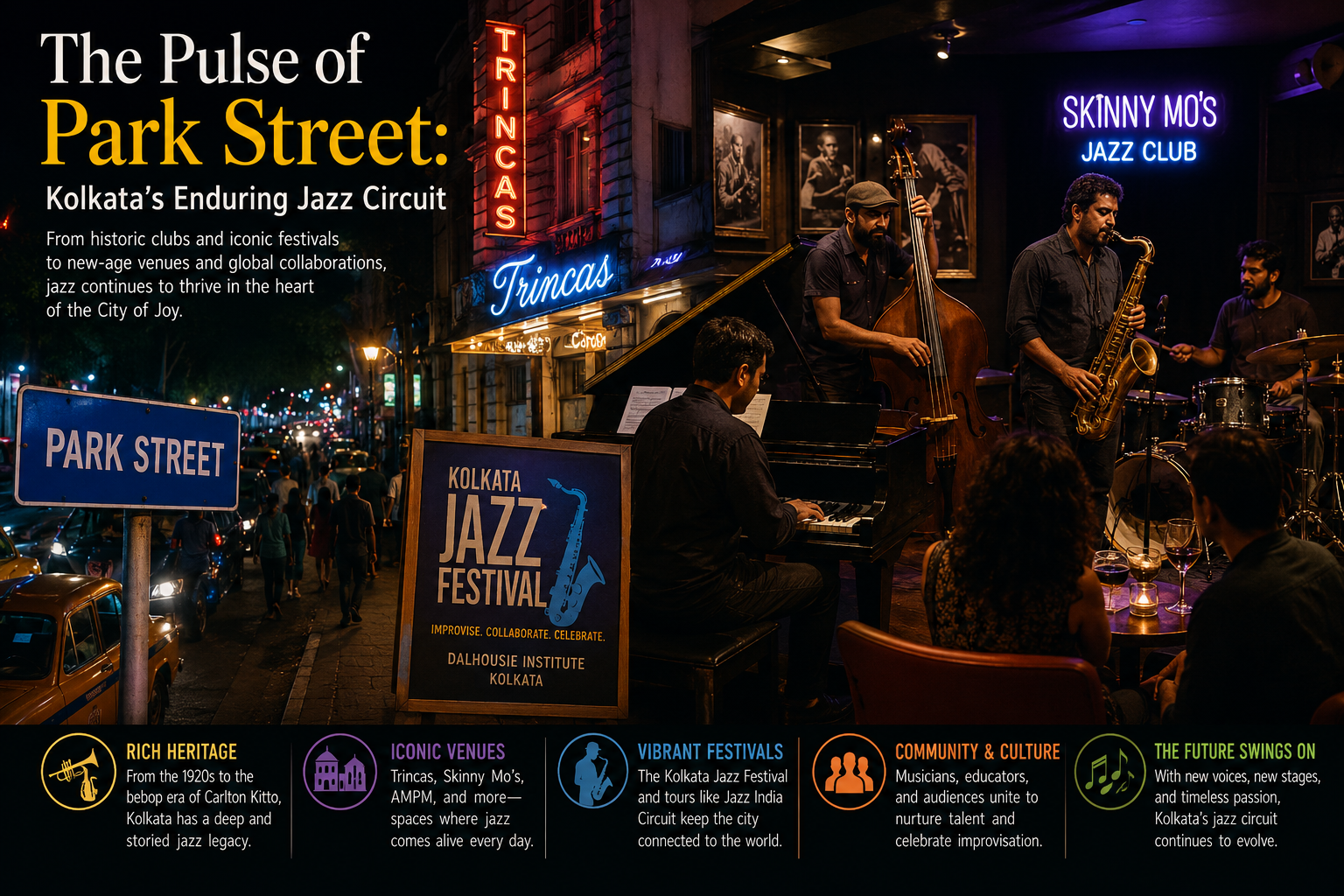
For decades, the iconic thoroughfare has served as the city’s musical artery. Lined with colonial-era buildings, restaurants, bars, and clubs, Park Street became synonymous with nightlife long before most Indian cities developed after-dark entertainment cultures.
Its most famous institution remains the legendary Trincas. Originally established in the colonial era, the venue evolved into one of India’s most recognizable live-music destinations. Generations of musicians have performed on its stage, and countless listeners experienced jazz there for the first time.
Throughout the second half of the twentieth century, Park Street hosted a remarkable collection of performers. Among the most influential was guitarist Carlton Kitto, often described as Kolkata’s uncrowned king of jazz. Largely self-taught and deeply inspired by bebop pioneer Charlie Christian, Kitto became a symbol of artistic dedication.
Unlike many musicians who pursued more lucrative opportunities in film music, Kitto remained committed to pure jazz. His performances became legendary among enthusiasts who gathered to hear his intricate improvisations and unwavering devotion to the genre.
For many, he embodied the spirit of Kolkata jazz itself: fiercely independent, deeply intellectual, and resistant to commercial compromise.
Surviving the Lean Years
The decades following Indian independence brought significant challenges.
As Bollywood music expanded its influence and popular tastes shifted toward rock, disco, and eventually electronic sounds, jazz lost much of its mainstream visibility. Economic realities made it increasingly difficult for musicians to sustain careers solely through performance.
Many clubs that once featured live bands reduced programming or closed altogether. Audiences shrank, and jazz became a niche pursuit rather than a dominant force in urban nightlife.
Yet the music never disappeared.
Dedicated musicians continued performing in small venues, hotel lounges, and private gatherings. Teachers passed on traditions to younger generations, ensuring that knowledge and technique survived even when public attention waned.
These years of persistence laid the groundwork for the revival that would emerge in the twenty-first century.
The Revival of a Tradition
The early 2000s marked a turning point.
A renewed interest in live music, combined with growing cultural curiosity among younger audiences, helped create new opportunities for jazz. Central to this revival was the re-emergence of the Kolkata Jazz Festival.
Held annually at the historic Dalhousie Institute, the festival has evolved into one of India’s most important jazz events. Over the years, it has hosted performers from dozens of countries, transforming Kolkata into a temporary global meeting point for musicians and enthusiasts.
The festival’s appeal lies in its diversity. Traditional jazz, contemporary fusion, experimental projects, Latin influences, and cross-cultural collaborations all find space within its programming. Workshops and educational sessions allow aspiring musicians to learn directly from international artists, creating opportunities that extend beyond performance.
Even during the disruptions caused by the COVID-19 pandemic, organizers adapted through digital programming and online engagement, demonstrating the resilience that has always characterized Kolkata’s jazz community.
Today, the festival serves not only as a celebration of music but also as a symbol of the city’s enduring commitment to artistic exchange.
New Stages, New Audiences
While heritage venues remain important, a new generation of clubs has brought fresh energy to the scene.
Among the most notable is Skinny Mo’s Jazz Club, which has quickly established itself as one of Kolkata’s premier live-music destinations. Housed in an elegant Art Deco setting, the venue combines intimacy with musical ambition. Jazz remains central to its identity, but audiences also encounter funk, soul, Latin grooves, rhythm and blues, and contemporary experimental sounds.

The club has become a gathering place for local musicians and touring artists alike. Its atmosphere encourages improvisation and collaboration, preserving one of jazz’s most essential traditions.
Elsewhere, venues such as AMPM Cafe & Bar, hotel lounges, cultural institutions, and independent performance spaces contribute to a growing network of stages. Together, they ensure that jazz remains visible within the city’s broader cultural landscape.
Importantly, these venues have attracted younger listeners who may not have grown up with the music but are drawn to its authenticity and spontaneity.
Connecting to a Global Network
Kolkata’s jazz circuit is no longer an isolated ecosystem.
Events such as the Jazz India Circuit have connected the city to a nationwide network of performances spanning Delhi, Mumbai, Bengaluru, and other cultural centers. These touring initiatives bring internationally acclaimed musicians alongside leading Indian artists, exposing local audiences to contemporary developments in the genre.
Recent editions have featured brass ensembles, funk collectives, fusion innovators, and experimental composers, demonstrating jazz’s remarkable ability to evolve while maintaining its core identity.
For emerging musicians in Kolkata, these events provide opportunities to interact with artists from around the world, fostering collaboration and expanding creative horizons.
In many ways, the city has reclaimed the cosmopolitan spirit that originally helped jazz flourish nearly a century ago.
The People Behind the Music
Ultimately, the survival of Kolkata’s jazz culture depends not on venues or festivals but on people.
The city’s musicians form a tightly connected community built around mentorship, collaboration, and shared passion. Veteran performers continue teaching younger artists, while students bring fresh influences and ideas into the tradition.
Audiences are equally important.
A typical jazz crowd in Kolkata may include retired professionals who remember Park Street’s golden age, university students discovering improvisation for the first time, expatriates seeking familiar sounds, and young professionals looking for alternatives to mainstream entertainment.
This diversity gives the scene a distinctive character. Jazz in Kolkata is not tied to a single demographic. It remains one of the few cultural spaces where generations regularly gather to share the same experience.
A Distinctly Kolkata Sound
What makes Kolkata jazz unique is its relationship with the city itself.
The music often carries a reflective quality that mirrors Kolkata’s literary and intellectual traditions. Collaborations frequently incorporate elements of Hindustani classical music, Baul folk traditions, and Rabindra Sangeet, creating hybrids that feel organic rather than manufactured.
These experiments have produced a distinctly local interpretation of jazz—one that respects tradition while embracing innovation.
During monsoon evenings, the atmosphere becomes especially evocative. Rain-soaked streets, dimly lit clubs, and extended improvisations create experiences that feel inseparable from the city’s identity.
Jazz here is not merely performed; it is lived.
Looking Ahead
As Kolkata moves further into the twenty-first century, its jazz circuit appears remarkably resilient.
Festivals continue attracting international talent. New venues are emerging. Educational initiatives are nurturing future performers. Digital platforms are helping artists reach wider audiences. Most importantly, younger generations are discovering the genre on their own terms.
Challenges remain. Economic pressures persist, and competition from more commercially viable forms of entertainment is intense. Yet jazz has always thrived through adaptation.
Kolkata’s jazz circuit stands today as both cultural memory and creative frontier. It preserves stories stretching back nearly a century while continuing to reinvent itself for new audiences.
Walk into a club on Park Street on any given evening and you may hear a saxophonist exchanging phrases with a tabla player, a veteran guitarist mentoring a young ensemble, or a familiar standard transformed through local influences.
In those moments, the city’s past and present converge.
Kolkata does not simply host jazz. It has absorbed it into its identity. The music’s pulse beats through historic clubs, festival stages, and intimate jam sessions alike—an enduring reminder that some traditions survive not because they resist change, but because they know how to improvise.
And in a city celebrated for its poetry, conversation, and cultural curiosity, jazz continues to find exactly what it has always needed: a willing audience and a place to belong.