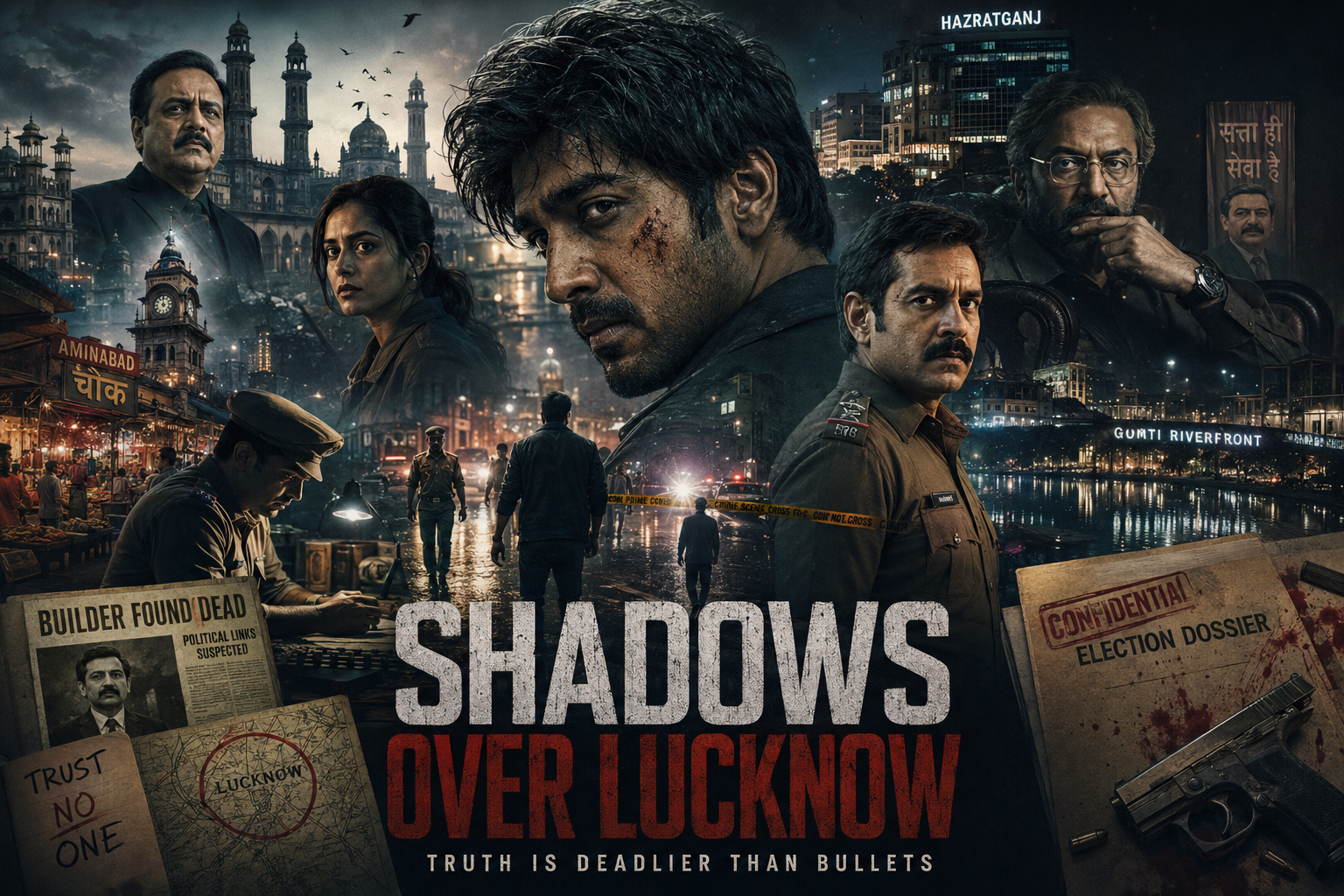
The winter fog rolled over Lucknow like a dirty secret.
At midnight, Hazratganj looked deceptively beautiful. White colonial buildings glowed under yellow streetlights, luxury cars purred outside cafés, and wealthy politicians laughed over expensive whisky while police sirens screamed somewhere far away. The city wore elegance like perfume. Beneath it rotted corruption, greed, and blood.

Aman Malik stood outside an old paan shop, smoking a cigarette down to the filter.
Suspended cop. Crime reporter. Failed son.
Three years earlier, he had led an encounter operation near Barabanki. Intelligence claimed dreaded gangster Faizan Qureshi would be transporting weapons. Instead, the police team opened fire on the wrong SUV. Two college students died instantly.
The government called it a tragic mistake.
The public called it murder.
Aman’s seniors vanished from the investigation. Politicians distanced themselves. The media tore him apart. His wife left within months, taking their six-year-old daughter to Delhi. The uniform he once worshipped became a curse hanging in his wardrobe.
Now he worked for a dying digital news portal called CityLine Crime.
He survived on cigarettes, black coffee, and unfinished guilt.
His phone vibrated.
“Builder Shahid Mirza is dead,” said editor Ravi Saxena. “Farmhouse near Sultanpur Road. Political pressure already building. Reach there before the vultures.”
Aman crushed the cigarette beneath his shoe.
Something about the name made his stomach tighten.
Shahid Mirza wasn’t just another builder. He was one of the invisible kings of Lucknow. Construction contracts, land grabbing, hawala money, election funding—his fingerprints existed everywhere.
And men like Shahid never died accidentally.
The farmhouse stood isolated beyond the city limits, surrounded by mango orchards and armed guards pretending not to panic.
Luxury SUVs crowded the driveway.
Inside, Shahid Mirza lay beside the swimming pool.
Half his skull was blown apart.
Blood mixed with blue pool water like spilled paint.
Senior officers barked orders while politicians whispered in corners. Aman noticed fear behind their polished smiles.
A familiar voice interrupted his thoughts.
“You still chase corpses like a hungry dog?”
Aman turned.
Deputy Commissioner Vikram Sethi.
Perfect uniform. Expensive watch. Calm predator eyes.
Years ago, Vikram had been Aman’s mentor inside the police force. He was brilliant, politically connected, and dangerously ambitious. During the failed encounter case, Vikram had disappeared before inquiries began.
Aman never forgot that.
“Funny,” Aman replied. “You taught me how.”
Vikram smirked.
“Be careful with this one. Big people are nervous.”
“Who killed him?”
“Depends,” Vikram said softly. “Who are we blaming this week?”
Their eyes locked.
Something unspoken passed between them.
Fear.
The postmortem report vanished within hours.
Witnesses changed statements overnight.
The official theory claimed Shahid was murdered during a robbery.
Nobody believed it.
Especially not Aman.
He began digging through Shahid’s empire. The deeper he went, the darker Lucknow became.
In Chowk’s narrow lanes, jewelers laundered black money through fake invoices. In Aminabad’s tea stalls, gangsters exchanged information between sips of chai. Local corporators worked directly with land mafias. Police officers collected monthly envelopes like salaries.
The city functioned like a living organism.
Crime was its bloodstream.
One evening Aman met gangster-turned-informant Chunnu Pehelwan inside a smoky tea stall.
Chunnu leaned closer.
“Mirza bhai was funding elections.”
“Everyone funds elections.”
“Not like this,” Chunnu whispered. “This time there’s foreign money too.”
Aman narrowed his eyes.
“How much?”
“Enough to buy ministers.”
A motorcycle stopped outside.
Two masked men entered.
Chunnu’s face turned pale.
“Run,” he whispered.
Gunshots exploded.
The tea stall erupted into chaos.
Aman flipped a table as bullets shattered glass behind him. Chunnu fell first, blood spraying across steel kettles. Customers screamed and crawled beneath benches.
Aman grabbed a broken bottle and lunged at one shooter. The man fired wildly before Aman smashed the bottle into his neck.
The second attacker fled into the crowded lane.
By the time police arrived, Chunnu was dead.
In his pocket Aman found a pen drive stained with blood.
That night he sat alone in his apartment near Aliganj, staring at the files inside the drive.
Land deals.
Offshore accounts.
Political donations.
Call recordings.
And one video.
The footage showed Shahid Mirza meeting several powerful politicians at a luxury farmhouse. Sitting among them was DCP Vikram Sethi.
They discussed election manipulation.
Fake riots.
Booth capturing.
Cash movement through construction companies.
Aman’s pulse quickened.
Then Shahid said something that froze him.
“What about Aman Malik? He still asks questions.”
Vikram laughed.
“Broken dogs bark the loudest. Leave him to me.”
The recording ended.
Aman poured himself whisky with trembling hands.
Someone had orchestrated everything.
And Vikram was standing at the center.
The next morning, Aman’s apartment was ransacked.
Laptop smashed.
Documents missing.
The pen drive gone.
Only one message remained, written on the wall in black paint:
STOP DIGGING
Aman stood silently for several minutes.
Then he laughed.
Not because it was funny.
Because fear had finally disappeared.
He went to meet investigative journalist Naina Kapoor at Gomti Riverfront.
Naina worked for a national news network and had once been Aman’s lover during his police days. Their relationship collapsed after the encounter scandal consumed him.
She arrived wearing a long black coat, eyes sharp as knives.
“You look terrible,” she said.
“You always start with romance?”
“What did you find?”
Aman explained everything.
Naina listened carefully.
“You understand what this means?” she asked quietly.
“It means politicians are buying the election.”
“No,” she replied. “It means Shahid Mirza was killed by his own partners.”
Cold wind swept across the river.
Aman looked toward the glowing skyline.
“If Vikram is involved, why kill Shahid?”
“Because Shahid became dangerous.”
Naina hesitated before speaking again.
“There’s another rumor.”
“What?”
“A secret intelligence file disappeared months ago. Names of officers, businessmen, ministers. Black money trails. Foreign links.”
“You think Shahid had it?”
“I think someone is desperate to recover it.”
That evening, Aman received a call from an unknown number.
A distorted voice spoke.
“Come to Kaiserbagh cemetery alone.”
The line disconnected.
Rain began falling as Aman drove through the old city.
The cemetery looked abandoned except for one figure standing beneath a crumbling archway.
Inspector Javed Ansari.
Aman’s former colleague.
His face was bruised badly.
“They’re watching everyone,” Javed whispered nervously.
“Who?”
“Vikram’s people. Politicians too.”
“What do you know?”
Javed handed him a file.
“The encounter case three years ago—it wasn’t an accident.”
Aman felt the ground shift beneath him.
“What?”
“The students in that SUV…” Javed swallowed hard. “They were witnesses. They had accidentally recorded a minister meeting gangsters. Orders came from above to eliminate them before the video leaked.”
Aman’s chest tightened violently.
“No…”
“You were used, Aman.”
Rain hammered the graves.
“You led the operation because you were honest,” Javed continued. “They knew you’d never question official intelligence.”
Aman staggered backward.
Every nightmare. Every guilt. Every sleepless night.
Manufactured.
Before he could speak, headlights illuminated the cemetery.
Black SUVs.
Javed panicked.
“They found me.”
Gunfire erupted instantly.
Javed was torn apart before Aman’s eyes.
Aman dove behind tombstones as bullets shattered marble. He fired back using Javed’s revolver and sprinted through the graveyard under relentless fire.
The chase spilled into Lucknow’s drenched streets.
Engines roared behind him.
Aman hijacked a biker near Lalbagh crossing and sped through traffic while SUVs pursued him. Bullets smashed mirrors and shattered shop windows. Vendors screamed and scattered.
The city became a blur of rain, blood, and neon lights.
Finally Aman disappeared into the labyrinth of Chowk.
Only then did he realize one horrifying truth.
Someone inside the police knew his every move.
For two days he hid inside an abandoned haveli owned by an old informer.
Elections were now seventy-two hours away.
Television channels screamed political slogans while behind closed doors criminals finalized power deals.
Naina arrived late at night carrying food and burner phones.
“You can still leave,” she said softly.
Aman shook his head.
“I spent three years believing I killed innocent kids.”
“You didn’t know.”
“But Vikram did.”
Silence filled the room.
Then Naina spoke carefully.


“There’s something else.”
“What?”
“I checked Shahid’s financial trails. Someone above Vikram controls everything.”
Aman frowned.
“Who?”
Naina hesitated.
“Your editor. Ravi Saxena.”
Aman stared at her.
Impossible.
Ravi had given him work when nobody else would. Ravi had defended him publicly during the encounter scandal.
“He owns CityLine Crime as a front,” Naina continued. “Information brokerage, blackmail, political leaks. Shahid financed him.”
“No.”
“Yes. Ravi isn’t a journalist anymore. He’s a fixer.”
Aman felt sick.
Another betrayal.
Another lie.
Lucknow was peeling away layer by layer, revealing rot underneath.
Aman confronted Ravi the next night inside the newsroom office.
Rain battered the windows.
Television screens flashed election coverage while generators hummed in darkness.
Ravi sat calmly, drinking tea.
“You figured it out,” he said.
Aman pointed a gun at him.
“Why?”
Ravi smiled sadly.
“Because truth is expensive.”
“You destroyed lives.”
“I survived,” Ravi replied sharply. “Do you know what this city does to honest men? It buries them.”
“You framed me.”
“Vikram handled the encounter. I only cleaned the media narrative.”
Aman’s finger tightened on the trigger.
“Shahid wanted out,” Ravi continued. “He planned to leak everything after elections. Foreign funding. political assassinations. Intelligence operations. He became a liability.”
“So you killed him?”
“No.” Ravi looked directly into Aman’s eyes. “Vikram did.”
Aman’s breathing grew heavier.
“But the mastermind?” Ravi whispered. “You still haven’t reached him.”
Before Aman could react, newsroom lights switched off.
Darkness swallowed everything.
Gunshots exploded.
Aman rolled behind desks as masked shooters stormed the office. Computer screens shattered. Sparks flew everywhere.
Ravi screamed.
Then silence.
Emergency lights flickered on.
Ravi Saxena lay dead across the newsroom floor, throat slit open.
On the wall, written in blood:
TRUST NO ONE
Aman realized something terrifying.
The mastermind was still watching.
Still ahead of him.
Election night arrived like a storm over Lucknow.
Political rallies flooded the streets.
Police checkpoints stood everywhere.
Rumors spread about riots being planned in old city areas.
The atmosphere crackled with fear.
Aman finally received the missing piece through an anonymous message.
Farmhouse. Midnight. Come alone if you want the truth.
The same farmhouse where Shahid Mirza died.
The city felt unnaturally silent as Aman drove through empty roads.
Inside the farmhouse ballroom, candles flickered in darkness.
And standing there was Naina Kapoor.
A gun in her hand.
Aman froze.
“No…”
Tears glistened in her eyes.
“I’m sorry.”
The truth crashed into him all at once.
Not Ravi.
Not Vikram.
Naina.
“You used me,” Aman whispered.
“I needed someone relentless enough to expose them.”
“You killed Shahid?”
“He ordered my brother’s murder during riots five years ago.”
Aman remembered.
Naina’s younger brother had died during communal violence officially blamed on mob clashes.
But now he understood.
The riots had been engineered.
Funded.
Manipulated.
“I infiltrated them as a journalist,” she continued. “Shahid trusted me. Vikram desired me. Ravi feared me. And you…” Her voice broke slightly. “You were the only decent thing left in my life.”
“You murdered people.”
“I ended monsters.”
“You turned me into bait.”
Naina lowered the gun slowly.
“You were never supposed to survive this long.”
Suddenly applause echoed through the ballroom.
Vikram Sethi emerged from the shadows with armed officers.
Elegant as ever.
“Beautiful ending,” he said calmly.
Aman looked between them.
“You two worked together?”
Naina’s face hardened.
“No.”
Vikram smiled.
“She really believed she was controlling the game.”
Then he pointed his pistol at her.
“But everyone is replaceable.”
The betrayal hit Naina visibly.
“You promised immunity,” she whispered.
Vikram laughed softly.
“You recorded ministers discussing assassinations. Did you honestly think they’d let you live?”
Gunfire erupted instantly.
Naina shot first, hitting one officer in the throat.
Chaos consumed the ballroom.
Aman tackled Vikram behind a table as bullets shredded chandeliers overhead. Officers exchanged fire blindly while smoke filled the room.
Naina moved like fury itself, firing with terrifying precision.
But numbers overwhelmed her.
A bullet ripped through her shoulder.
Another through her stomach.
She collapsed beside the shattered dance floor.
Aman fought Vikram brutally across broken glass and overturned furniture. Years of rage exploded between them.
“You ruined my life!” Aman roared.
Vikram slammed a knife into his side.
“You were weak enough to ruin yourself.”
They crashed through glass doors onto the poolside where Shahid Mirza had died.
Rain poured heavily now.
Blue water turned crimson again.
Vikram aimed his pistol.
“You know the tragedy of this city, Aman?” he said. “People don’t want truth. They want stability. Fear keeps order.”
Aman stared at him silently.
Then he noticed police sirens approaching in the distance.
Media vans too.
Naina had planned everything.
She had leaked the location before coming.
Vikram realized it a second later.
For the first time, panic appeared in his eyes.
“You bitch…”
Aman attacked instantly.
The gun fell into the pool.
They fought savagely in rainwater and blood until Aman finally forced Vikram underwater.
The powerful officer struggled violently.
Then slowly stopped moving.
Silence returned.
Only rain remained.
Aman crawled toward Naina.
She was dying.
“You should hate me,” she whispered weakly.
“I probably do.”
A faint smile touched her lips.
“That means you’re still human.”
Her hand slipped from his fingers.
Gone.
Dawn rose slowly over Lucknow.
Television channels exploded with scandal.
Election funding leaks.
Fake encounters.
Political conspiracies.
Dead officers.
Arrests began immediately.
Ministers denied involvement.
Police blamed rogue elements.
The city carried on exactly as before.
Tea stalls reopened.
Traffic returned.
Politicians smiled before cameras.
And somewhere beneath the elegance of Lucknow, new predators already prepared to inherit the darkness left behind.
Aman stood alone at Gomti Riverfront watching morning sunlight touch the water.
For the first time in years, the ghosts inside him felt quieter.
Not gone.
Never gone.
But quieter.
Behind him, the city whispered once more through crowded streets, ancient havelis, and bloodstained corridors of power.
Lucknow survived everything.
Because cities like Lucknow were not built merely on history or culture.
They were built on secrets.












 https://www.youtube.com/watch?si=RtToJsBhYBatUrym&v=mOuYNSdhjHA&feature=youtu.be