Lucknow: To study any subject in a systematic manner, we must first understand the language well and also the method of logical reasoning on which any scientific enquiry is based. To read an advanced text book in any subject today, for example, a good command of English language and grasp of logical methodology would be essential.
Thus the popular dictum “Kāṇādaṃpāṇinīyaṃ ca sarvaśāstropakārakam”, serves to remind us that Sanskrit grammar (Vyakarana) as expounded by Panini along with epistemology as expounded by Kanada in Vaisesika Darshana, form the foundational subjects essential to understand any further science or sastra. The logical reasoning of Nyaya is also understood as included since Nyaya and Vaisesika go together.
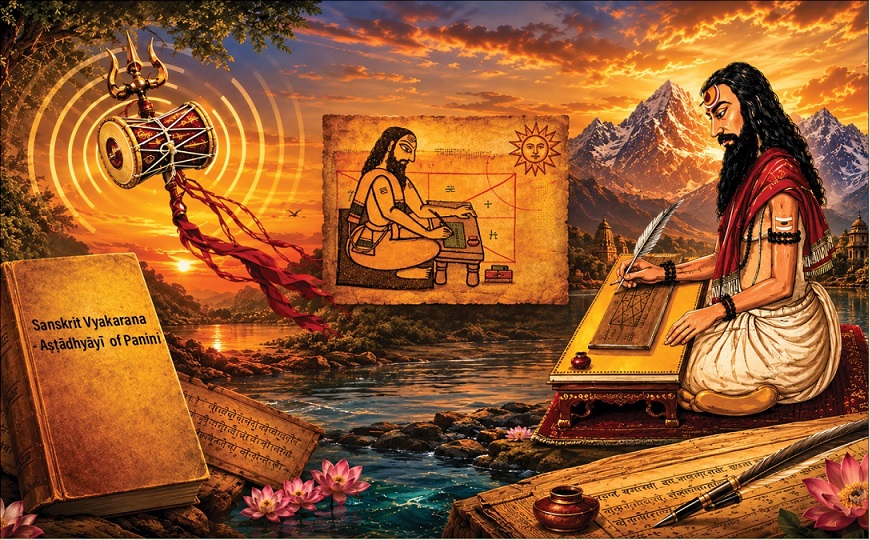
The Aṣṭādhyāyīof Pāṇini dating to the Fifth century BCE serves as the ideal for formulating and characterising the systematic procedures that are expounded in the variousśāstrasin Indian tradition. With about 4,000 sutras or short, pithy aphorisms, this remarkable unsurpassed work gives a complete description of the Sanskrit language used in ordinary parlance and literature of the time, as different to Vedic usage, for which Panini has given a separate treatment. The modern world continues to marvel at the organisation of the Aṣṭādhyāyīwith its use ofanagrams to denote set of phonemes, symbolic techniques and sophisticated conventions governing rule-formulations.
Pāṇini gives a complete derivational system for deriving all the valid utterances of Sanskrit language through the use of general rules and numerous exceptions. Noting patterns in the use of language that reflect the manner of thought process, the formations are arranged mostly according to concept by means of suffixes or syllabic additions. The interaction of phonemes is covered under the Sandhi rules, which operate to give smooth pronunciation of the language.
Patterns of logical thought can be seen in all languages: in English, for example, we can derive the words ‘sadness’ and ‘sadly’ from ‘sad’; ‘happiness’ and ‘happily’ from ‘happy’. It is easy to see the logic behind deriving noun forms and adverbs from the adjective form. In Sanskrit, most words are derived from verb roots that Panini has identified. In general, words are classified as nouns and verbs in the main, suffixes and particles forming the other types. Suffixes and prefixes serve to modify the meanings of words, lending great richness and variety to the lexicon, for which Sanskrit is well known.
In English, we can say – “The boy who is sleeping, wake him up.” It can also be stated as – “Wake up the sleeping boy” – here, “sleeping” serves as a participle. In Sanskrit also we have a rich choice of participle formations to choose from, whether in past, present or future tense, in active and passive voice. Thus identifying the idea behind the formation, words are grouped according to the grammatical derivation and this makes the complex Sanskrit language easy to understand. We may note here that advanced grammars of most Indian languages follow the Sanskrit texts.
Panini’s workhas four components:
- Aṣṭādhyāyī: a system of about 4,000 grammatical rules called sutras. The sutras begin by explaining the metalanguage by which they can be understood. It is often said that the ashtadhyayi operates much like a software program, with the structure of the rules giving a clue as to what order they are to operate in, that is, the later rules do not impede earlier ones in word formation and there is no confusion.
- Śivasūtras: a string of fourteen phonological segments separated by markers that enable formation of pratyāhārasor short labels to include the phonemes within them. These are well known as the Mahesvara sutras that Lord Shiva imparted to Panini by sounding His damaru fourteen times, at each of which dropped out a sutra. These are considered the foundation of Sanskrit language.
- Dhātupāṭha: a list of about 2,000 verbal roots, grouped in ten ganas or types, indicating their morphological and syntactic properties that come into play in the verbal word forms.
- Gaṇapāṭha: a list of 261 lexical items that have peculiar formations subject to special rules. Some of the lists are open ended, and (like the Dhātupāṭha) they have to some extent been modified by later grammarians.
Panini is admittedly the greatest grammarian the world has ever seen. His precise scientific method structured way back in the Fifth century BCE continues to amaze modern scholars to this day. His pioneering work has nurtured a vast and deep study of language and linguistic that made India the leader in this analysis of human communication process. To enable easier understanding of the Ashtadhyayi,

Katyayana or Vararuchi added some addendums known as vaartikas to the sutras, believed to have been in the Third century BCE. Patanjali, believed to have lived in the Second century BCE, wrote an extensive commentary known as the Vyakarana Mahabhashya on the Ashtadhyayi. Together, these three stalwarts are revered as the ‘Muni-traya’ of Sanskrit Vyakarana.
Team Siddhanta Knowledge Foundation