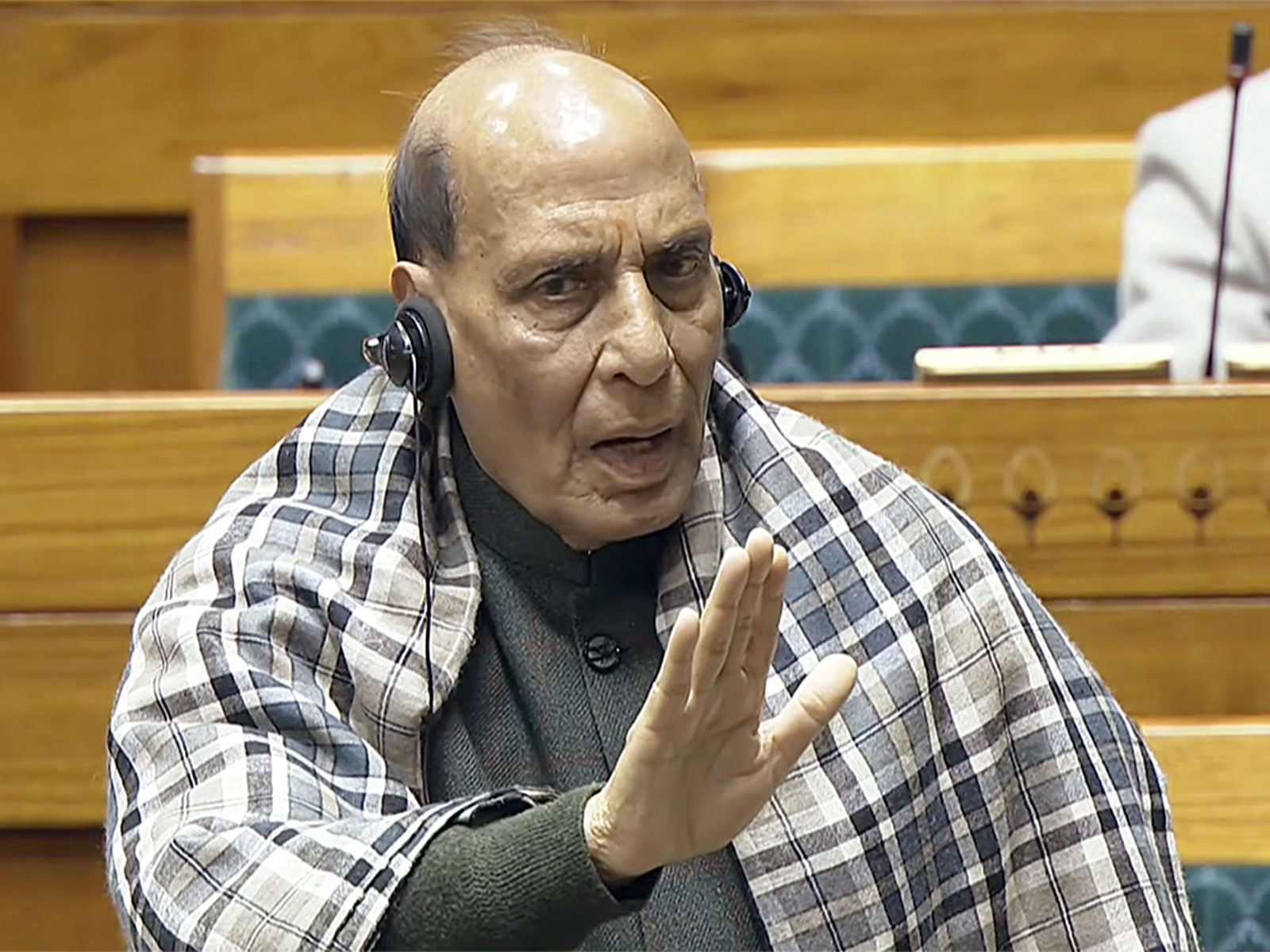
New Delhi: Defence Minister Rajnath Singh said India has undergone a remarkable transformation over the past 12 years, progressing from an era of scarcity to self-reliance, from self-reliance to self-confidence, and now towards becoming a developed nation. Addressing a media organisation’s event in New Delhi, he said the government under Prime Minister Narendra Modi has laid a strong foundation for a “Viksit Bharat” through a policy of “Reform, Perform and Transform.”
The Defence Minister said the government’s first term focused on removing shortages, expanding opportunities and improving work culture, while the second term converted aspirations into achievements and accelerated the country’s journey towards self-reliance. He expressed confidence that the current term would strengthen the foundations of a developed India and that the world would witness the emergence of a fully developed nation in the next phase.
Highlighting India’s economic and industrial achievements, Rajnath Singh said the Make in India initiative, launched in 2014 despite initial scepticism, has emerged as a major success story. He noted that India’s global standing has undergone a significant transformation, with the country’s views now receiving serious attention on major international issues.
Speaking about technological progress, the Defence Minister said India has successfully entered semiconductor manufacturing under the India Semiconductor Mission launched in 2021. He added that semiconductor parks based on the plug-and-play infrastructure model enabled the country to manufacture its own semiconductor chips last year.
Rajnath Singh also highlighted the rapid growth of India’s defence sector, stating that defence production reached an all-time high of ₹1.78 lakh crore in FY 2025-26, nearly three times the level recorded in 2014-15. Defence exports, he said, have crossed ₹38,000 crore, a nearly 57-fold increase from ₹686 crore in FY 2013-14, reflecting global confidence in India’s indigenous defence manufacturing capabilities.
He cited significant advances in mobile manufacturing, automobile exports, indigenous locomotive production and digital infrastructure. Referring to India’s digital revolution, he said the country recorded 22.35 billion UPI transactions worth ₹29 lakh crore in April, while indigenous 5G technology has expanded rapidly across the country and efforts are already underway to develop 6G technology.
On welfare delivery, the Defence Minister said the government addressed corruption and leakages through the JAM Trinity—Jan Dhan, Aadhaar and Mobile—facilitating direct benefit transfers worth ₹51 lakh crore and preventing the diversion of nearly ₹4.3 lakh crore. He also described the Goods and Services Tax (GST) as a successful example of cooperative federalism that has strengthened coordination between the Centre and the states.


Referring to national integration and internal security, Rajnath Singh said the abrogation of Article 370 in Jammu and Kashmir and sustained efforts to eliminate Left Wing Extremism demonstrate the government’s resolve to tackle issues once considered impossible to resolve. He added that initiatives such as Jan Vishwas reforms have improved the ease of doing business, contributing to India’s emergence as one of the world’s fastest-growing economies.
The Defence Minister said India has become the world’s third-largest startup ecosystem, with the number of startups rising from around 500 in 2014 to over two lakh today, while the number of unicorns has increased from four to 125.
Emphasising the importance of India’s cultural heritage, he said projects such as the Kashi Vishwanath Dham Corridor, Mahakal Lok and Maa Kamakhya Divya Lok are reviving the country’s civilisational legacy alongside broader developmental initiatives.
Addressing the evolving role of the media, Rajnath Singh said journalism has become even more important in an age of information overload, where the greatest challenge is ensuring accuracy and credibility rather than access to information. While acknowledging the growing influence of Artificial Intelligence, he stressed that AI cannot replace human creativity, judgment and empathy.
“The future of journalism will depend on how effectively it balances the capabilities of AI with human sensitivity,” he said, adding that AI can make journalism faster and more accurate, but emotional intelligence will ensure it remains humane and trustworthy.
The Defence Minister concluded by underlining that journalism’s real strength lies not merely in disseminating information but in guiding society, upholding truth and strengthening democracy. He cautioned that misinformation can adversely affect society as well as the morale of the armed forces, urging media organisations to prioritise accuracy, fairness and impartiality, especially while reporting on national security and defence-related matters.













 https://www.youtube.com/watch?si=RtToJsBhYBatUrym&v=mOuYNSdhjHA&feature=youtu.be