As the sun dipped below the horizon, casting long, bleeding shadows over the modern city of Lucknow, a sharp chill enveloped the remnants of the British Residency. The crumbling brick walls, pitted with the jagged scars of cannon fire, whispered tales of a bygone era—a time of blood, fire, and desperate revolt. Yet, among the bustling throngs of university students on the nearby campus, the evening air buzzed with excitement over an official archaeological dig taking place at the historic site. Among them was Aarav, an ambitious master’s student with a fervent, almost consuming interest in local history, particularly the tumultuous events of the Siege of 1857.
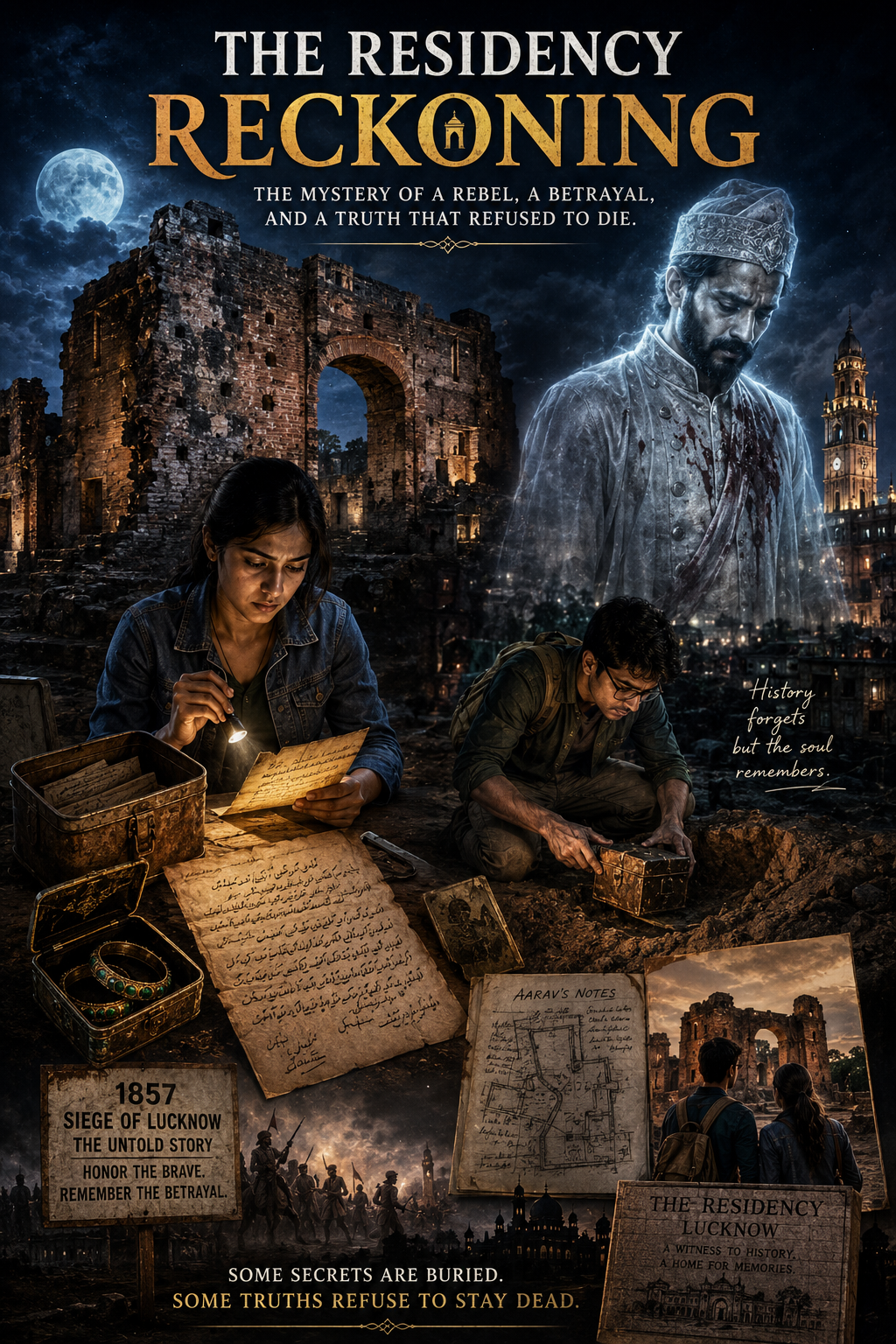
Aarav’s discovery was serendipitous. While excavating near the ruined, roofless main block of the Residency, his trowel struck a hollow metallic object buried deep beneath layers of compacted red soil. Clearing away the earth, he unearthed a sealed iron tin, its brass latch rusted shut. Inside lay a collection of parchment letters written in faded, iron-gall ink.

The letters, penned in elegant Persianized Urdu by a high-ranking rebel leader during the height of the siege, revealed a shocking historical anomaly: the leader had not perished in the heroic final charge recorded in colonial archives. Instead, he had fallen victim to a treacherous insider—an ally who had murdered him in cold blood and stolen a colossal cache of royal Awadhi jewelry intended to fund the rebellion’s artillery supply.
The implications of the letters reverberated through Aarav’s mind, igniting a dangerous mix of curiosity and obsession. As news of his find spread in hushed whispers across the university campus, Aarav withdrew into isolation. He spent his days in his dimly lit room, poring over the documents, mapping the rebel leader’s final movements.
However, with each passing day, a heavy sense of foreboding settled over him. Aarav began to experience strange, terrifying occurrences. Flitting shadows danced at the edges of his vision. Sudden, bone-chilling drafts swept through his closed dormitory room, carrying the distinct, sulfurous stench of black powder. Night after night, restless, blood-soaked dreams plagued his sleep, dragging his mind into the violent, smoke-chilled memories of the 1857 siege.
Two weeks after unearthing the tin, Aarav vanished without a trace. His room was left open, his books strewn across the desk, and his bed untouched.
His sudden absence sent shockwaves through the campus. His roommate, Riya, found herself caught in a whirlwind of fear and mounting suspicion. Riya had always admired Aarav’s fierce passion for history, but as days turned into a agonizing week with no police leads, she faced a chilling reality: she was left alone with only the whispers of the past and the heavy burden of unraveling the mystery of his disappearance.
Driven by a desperate need for answers, Riya began her search in the quiet, dusty archives of the university library. She delved into dusty regional accounts, British siege journals, and maps of old Lucknow. The missing letters, caught between the realms of historical record and dark superstition, seemed to pulse with an unholy life of their own. Riya felt an unexplainable, magnetic draw toward them, as though a voice from the nineteenth century were calling out directly to her, demanding to be heard.
Her investigation inevitably led her back to the sprawling, silent grounds of the Residency. As she stepped past the iron gates and into the crumbling ruins after visiting hours, an oppressive silence enveloped her. The distant hum of Lucknow’s modern traffic melted away, replaced by an air so thick with static tension that it made the small hairs on her arms stand on end.
Riya wandered through the shattered archways, tracing her fingers along the pitted brickwork. But it was not long before the same unsettling phenomena that had tormented Aarav began to target her.
Whispers—frantic, agonized, and spoken in archaic Urdu—echoed in her ears. Shadows detached themselves from the ancient trees and flitted across the sun-baked lawns. The temperature dropped abruptly, freezing her breath into mist in the middle of a warm Lucknow evening.
That night, back in her room, the haunting escalated into full-scale visionary torment. Whenever she closed her eyes, she was dragged into the siege. In nightmarish, photorealistic loops, she witnessed the blinding flashes of musket fire, the thundering roar of cannons shattering marble pillars, and the anguished screams of dying soldiers. Crucially, she saw the betrayal replay like a macabre play: a shadowy figure driving a talwar into the rebel leader’s back inside a dark, vaulted cellar beneath the Residency, dragging away heavy wooden chests while the leader gasped his last breath.
It became clear to Riya that this was no ordinary haunting. The spirit of the murdered rebel leader was bound to the earth by an unavenged injustice, seeking not malice, but a witness to rectify the historical record—a quest that had already driven Aarav over the brink of sanity.

Determined to find her friend and lay the tragic spirit to rest, Riya returned to the Residency under the silvery light of a full moon. Armed with a flashlight and Aarav’s field notes, she made her way to the precise spot near the main block where the tin had been unearthing.
The ruins loomed ominously against the night sky, their jagged silhouettes resembling giant, broken teeth. The very air around her crackled with raw, spiritual energy. As she stepped closer to the excavation pit, the shadows pooled together, and the ambient temperature plummeted.
A figure emerged from the darkness. Translucent and shimmering with an ethereal, pale light, the ghost of the rebel leader stood before her. He wore a blood-stained achkan, his chest bearing the fatal phantom wound of his assassination. His eyes were not filled with rage, but with a profound, crushing sorrow.
Riya froze, a rush of paralyzing fear surging through her veins. Yet, as she looked into the spirit’s grief-stricken eyes, the terror receded, replaced by a deep wave of human empathy. Before her stood a man who had sacrificed everything for his homeland’s freedom, only to be butchered by greed and erased by history.
The specter raised a luminous hand, pointing not at the ground, but toward the massive, twisted roots of an ancient banyan tree anchored near the cellar entrance.
Riya dropped to her knees and began to dig frantically through the loose damp earth between the root tendrils. Her fingers struck something soft—a canvas satchel. She pulled it free and opened it. Inside lay Aarav’s dropped flashlight, a small velvet box containing a few remaining emerald-encrusted bangles left behind by the murderer, and a final, sealed parchment letter that had remained hidden for over a century and a half.
Beside the tree, slumped inside a hidden structural hollow beneath the roots, lay Aarav. He was pale, unconscious, and severely dehydrated, but his chest rose and fell with a steady breath. He had been trapped in the hidden architectural cavity, swept into a trance-like state by the spirit’s overpowering grief.
Riya unrolled the final parchment. Written in the rebel leader’s final moments as his life faded, the letter was not a curse, but a testament. It detailed the identity of his killer, but more importantly, it contained a stirring plea for unity, resilience, and courage for future generations of Indians fighting for self-determination.
As Riya read the words aloud into the quiet night air, a soft, warm breeze swept through the ruins, dispelling the freezing gloom. The specter of the rebel leader offered a slow, dignified salute. A look of serene peace washed over his spectral features, and he slowly faded into the moonlight, his long vigil finally ended.
Emergency services arrived shortly after Riya managed to drag Aarav out into the open courtyard. Aarav recovered in the hospital over the following days, the dark clouds of obsession lifting from his mind as he recalled his ordeal.
Together, Riya and Aarav presented the final letter and the recovered artifacts to the Archaeological Survey and the University. The discovery rewritten local history, restoring the rebel leader’s honor and exposing the historical crime.
In the heart of modern, vibrant Lucknow, where traffic surges past ancient monuments and street vendors call out into the evening, the Residency stands quiet once more. But it is no longer a place of restless terror. Riya and Aarav had walked into the shadows of 1857, served as witnesses to a forgotten tragedy, and brought a long-lost truth into the light.