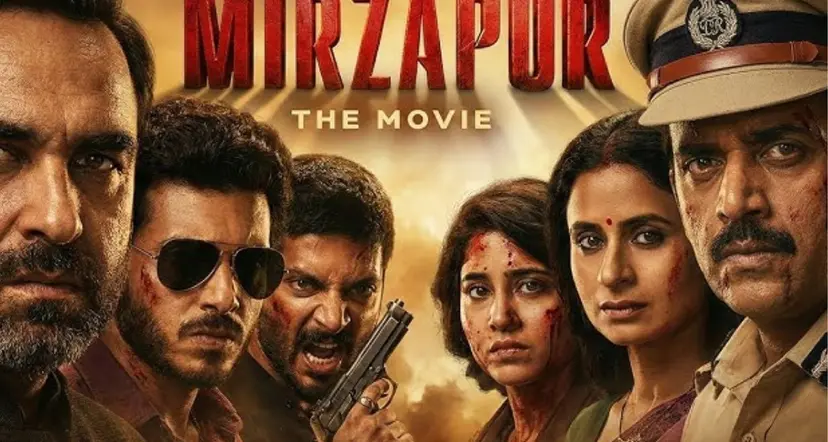
Mumbai: Mirzapar The Movie arrives in theatres with an unusual advantage: it does not have to introduce its world, its characters or its brand of chaos to the audience. For fans of the hit Amazon Prime Video series, the names Kaleen Bhaiyya, Guddu and Munna are already enough to trigger memories of violence, ambition, betrayal and the ever-present threat of a loaded gun.
Directed by Gurmmeet Singh and written by Puneet Krishna, the film, released on September 4, 2026, works as a theatrical companion to the original series rather than a conventional sequel. Set alongside the timeline of the first season, around 2018 and between episodes six and seven, it brings back several familiar faces, including characters whose later fate in the series is already known to viewers.

That decision is both the film’s biggest strength and its biggest limitation.
The story returns to the power struggle surrounding Mirzapur’s criminal empire. Akhandanand “Kaleen” Tripathi, played with characteristic restraint by Pankaj Tripathi, remains at the centre of the storm. His authority is challenged by family tensions, internal rivals and new external threats, including a dangerous drug lord and elements connected to Rajasthan.
The film does not attempt to reinvent the Mirzapur formula. Instead, it doubles down on it.
There is the familiar combination of goli, gaali and bhaukaal, accompanied by greed, revenge, betrayal and dysfunctional family relationships. What changes is the scale. The theatrical format allows the filmmakers to expand the action, move beyond the familiar streets of Mirzapur and introduce larger set pieces, including striking desert sequences.
Pankaj Tripathi once again proves why Kaleen Bhaiyya remains one of the most memorable characters in contemporary Indian crime drama. He does not need to shout to establish dominance. His silences, expressions and measured delivery often carry more menace than the film’s gunshots.
Ali Fazal and Divyenndu slip comfortably back into their respective characters as Guddu and Munna. Their swagger and volatile chemistry remain among the film’s biggest attractions. For fans who have missed seeing these characters together, the film provides plenty of nostalgia.
However, it is Ravi Kishan who frequently walks away with the scene. As the flamboyant and dangerous Babban, or Babua Yadav, Kishan brings an infectious unpredictability to the proceedings. His performance adds another layer of eccentricity to an already colourful criminal universe.
Jitendra Kumar also deserves attention for taking over the role of Bablu Pandit, previously played by Vikrant Massey. Rather than simply imitating his predecessor, Kumar gives the character his own personality and succeeds in making the role feel distinct.
Rasika Dugal, Shweta Tripathi and Shriya Pilgaonkar return in supporting roles, but the film remains predominantly driven by its male characters. The women, despite being important to the emotional and narrative fabric of the Mirzapur universe, receive comparatively less room to develop.
Where the film scores heavily is in its entertainment quotient. The dialogues are designed for whistles, the action is unabashedly massy and the background score amplifies the atmosphere. The climax and epilogue, in particular, are clearly engineered with the existing fan base in mind.
And that is precisely where Mirzapur: The Movie understands its audience best.

This is not a film attempting to convert sceptics. It is a celebration of a universe that already has a devoted following. For fans, familiar characters appearing in an earlier timeline provide an additional emotional hook. Knowing what eventually happens to some of them creates an interesting sense of dramatic irony.
Yet the film’s biggest weakness is impossible to ignore: the runtime.
At approximately 197 minutes, Mirzapur: The Movie runs for more than three hours and 15 minutes. There is enough material here for a compelling theatrical experience, but the film occasionally struggles to justify its length. The first half moves with considerably more energy, while the second half becomes comparatively stretched.
Several subplots and character arcs appear to have been retained in the interest of fan service, even when they do not substantially advance the central narrative. The result is an uneven rhythm that could have benefited considerably from tighter editing.
The predictability is another issue. Long-time viewers know the characters and their motivations intimately, and therefore some developments lack the surprise that a completely new crime drama might offer. The film occasionally chooses spectacle and nostalgia over narrative freshness.
Still, dismissing it simply as an extended episode of the series would be unfair. The theatrical presentation gives the Mirzapur universe a broader canvas, while the performances and action sequences ensure that the film rarely loses its pulse completely.
Ultimately, Mirzapur: The Movie knows exactly what its core audience wants—and gives them plenty of it.
It is violent, loud, irreverent, dramatic and occasionally excessive. It has memorable performances, punchy dialogue, a strong background score and enough fan service to keep followers of the series engaged. But it is also overlong and could have been considerably more effective with a sharper screenplay and tighter editing.
For existing Mirzapur fans, the film is a nostalgic big-screen reunion and a chance to experience the franchise’s trademark bhaukaal in a theatre. For newcomers, however, the absence of familiarity with the characters may make the sprawling narrative less accessible.
Verdict: 3/5
Mirzapur: The Movie is a fun, ferocious and fan-driven theatrical companion that delivers bullets, betrayal and bhaukaal in abundance. It does not reinvent the franchise, but it successfully brings its familiar madness to the big screen. The only thing more dangerous than Kaleen Bhaiyya’s enemies may be the film’s 197-minute runtime.
Worth a theatre watch—especially for die-hard Mirzapur fans.