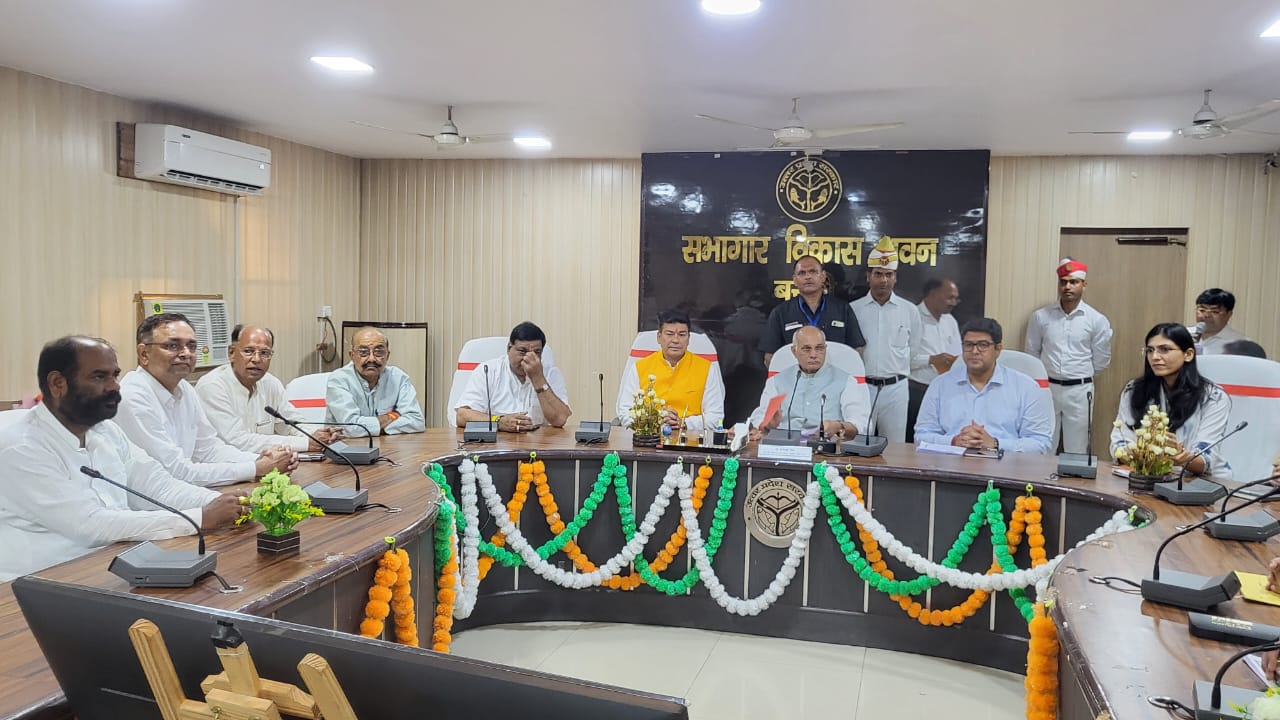
Bareilly: Uttar Pradesh Livestock and Dairy Development Minister Dharampal Singh chaired a divisional-level review meeting of the Animal Husbandry Department at the Development Bhawan auditorium in Bareilly on Monday, taking stock of livestock protection, cattle shelters, fodder availability, disease prevention and measures to make gaushalas self-reliant.
During the meeting, the minister reviewed the department’s work across all districts of the Bareilly division. Bareilly’s Chief Development Officer informed him that boundary walls had been constructed around large cattle shelters and that a CCTV control room was being established at Development Bhawan to monitor gaushalas across the district. Proposals have also been included in the action plan to improve roads leading to cattle shelters where access remains a problem.

The CDO also informed the minister that a large-scale goat fair would soon be organised in Bareilly to create additional income opportunities for farmers.
The Budaun administration reported that additional sheds were being constructed at cattle shelters wherever space was available, while proposals had been prepared for boundary walls. Green fodder had been sown over 136 hectares, and arrangements for solar lighting were also being made.
Pilibhit officials reported that green fodder had been planted across 53 hectares. The minister was also briefed about the Benipur gaushala, where cow dung is being used to prepare Panchgavya products for sale.
Officials said Shahjahanpur has 145 gaushalas, with green fodder grown over 52 hectares. Pilibhit has 66 gaushalas sheltering 8,259 cattle, while Budaun has 223 gaushalas sheltering 36,886 cattle, with four more under construction. Bareilly has 106 gaushalas where 16,361 cattle are currently sheltered.
Focus on Self-Reliant Gaushalas
Minister Dharampal Singh said more than 13 lakh cattle are being sheltered in around 7,500 gaushalas across Uttar Pradesh and stressed the need to transform these facilities into self-reliant institutions.
He suggested involving women’s self-help groups in producing items such as cow-dung cakes and lamps from cattle waste, thereby generating income while promoting sustainable management of gaushalas.
The minister said the Chief Minister had constituted a committee comprising six departments to work jointly towards cattle protection. He also directed officials to take action against people who abandon cattle after they stop yielding milk.
Fodder, Disease Prevention and Flood Preparedness
The minister directed officials to ensure that cattle receive FMD vaccinations in view of the spread of infectious diseases. He also stressed the need to prevent waterlogging in gaushalas during the monsoon.
He instructed officials to ensure that platforms are constructed in flood-prone gaushalas through the Viksit Bharat-Viksit Gram (VB-G RAM) mechanism so that cattle can remain on dry ground during flooding. Adequate green fodder should also be maintained, while green fodder should be cultivated on grazing land that has been freed from encroachment.
Dharampal Singh also directed officials to work towards curbing the use of single-use plastic, warning that plastic waste damages soil health and adversely affects agricultural productivity.
He asked officials to participate in area panchayat meetings and educate people about the complementary relationship between agriculture and animal husbandry. He said the goal of creating a one-trillion-dollar economy could not be achieved through agriculture alone and that animal husbandry must also be promoted.
Support for Farmers and Breed Improvement
The minister said agriculture and livestock play an important role in increasing farmers’ incomes. He described the milk of indigenous cattle breeds as highly valuable and said efforts were underway to improve cattle breeds.
He said semen of breeds such as Sahiwal and Gangatiri was being provided to farmers free of cost. The price of sex-sorted semen, which is intended to increase the likelihood of female calves, has been reduced from ₹300 to ₹100.
The maintenance allowance for cattle has also been increased from ₹30 to ₹50, he said. Under another scheme, farmers purchasing two cows from another state can receive a subsidy of ₹40,000.

The minister directed officials to organise goat fairs in other districts on the lines of Bareilly and promote piggery and poultry farming. He said annual egg production in the state has increased from around one crore before 2017 to four crore at present.
He added that proposals could be submitted for large cattle shelters wherever required, with gaushalas costing up to ₹1.60 crore eligible for approval.
The minister instructed Chief Veterinary Officers to arrange training for veterinary doctors so that farmers do not face difficulties in cattle artificial insemination. He also directed officials to undertake castration of male calves where required.
Public Representatives Urged to Support Gaushalas
The minister appealed to elected representatives to support the construction of boundary walls around gaushalas. He also encouraged the practice of celebrating occasions such as birthdays at cattle shelters and urged public representatives to take the initiative.
Bareilly Mayor Dr Umesh Gautam said the Municipal Corporation’s gaushalas were producing manure that was being supplied to rural areas. Work was also underway with Indian Oil Corporation towards setting up a CBG plant. A 600-capacity Nandi Gaushala was nearing completion and was expected to become operational next month.
He suggested that Nandi gaushalas should be established alongside regular cattle shelters to ensure the protection of male cattle as well.
Legislative Council Member Kunwar Maharaj Singh stressed the use of sex-sorted semen and said male calves should be castrated before being released where necessary. He also pointed out the difficulties farmers face in getting Sahiwal cows artificially inseminated and suggested that shade-giving trees be planted at gaushalas.
Bithari Chainpur MLA Dr Raghavendra Sharma suggested using land along the Ramganga river that remains vacant for most of the year for growing fodder and establishing cattle shelters nearby.
Nawabganj MLA Dr M.P. Arya suggested greater utilisation of vacant Gram Samaj land for growing Napier grass. He also advocated collecting cow dung, converting it into manure and selling it as a source of income for gaushalas, along with setting up biogas plants.
Cantt MLA Sanjeev Agarwal emphasised the need for boundary walls and solar lighting to improve the security and functioning of cattle shelters and said elected representatives could contribute to such works.
Divisional Commissioner Shambhu Kumar thanked the public representatives and officials present at the meeting and assured that all directions issued by the minister would be implemented. He said special attention would be given to fodder availability, preventing waterlogging during the monsoon and developing self-reliant gaushalas.
The administration would also work to encourage farmers to adopt agriculture and animal husbandry together as complementary sources of livelihood, he added.
The meeting was attended by Bareilly Mayor Dr Umesh Gautam, Legislative Council Member Kunwar Maharaj Singh, Cantt MLA Sanjeev Agarwal, Nawabganj MLA Dr M.P. Arya, Bithari Chainpur MLA Dr Raghavendra Sharma, BJP district president of Aonla Adesh Pratap Singh, Divisional Commissioner Shambhu Kumar, Chief Development Officers of Bareilly, Pilibhit and Budaun, City Superintendent of Police Manush Pareek, Additional Director of Animal Husbandry, Chief Veterinary Officers of all four districts, District Panchayati Raj Officer, Deputy Commissioner MGNREGA and other concerned officials.
Report from Bareilly by Akhilesh Chandra Saxena