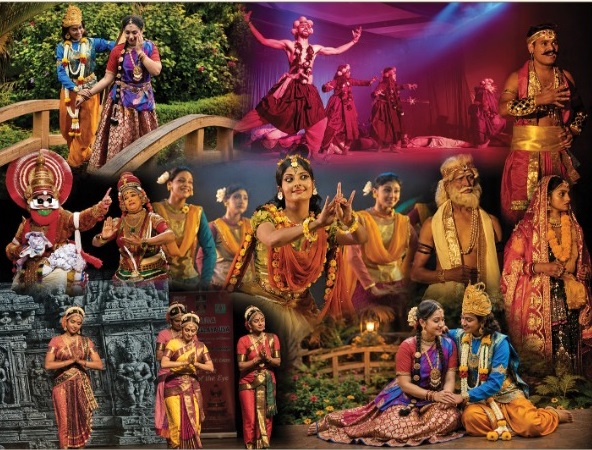
Lucknow / New Delhi: Drama touches upon all aspects of human activity – poetry, musical instruments, singing, rhythm, dance, gestures, dancing, ornaments, costumes, acting and literature. It depicts different groups in society with their peculiar manners, style of dress and speech. As art mirrors reality, drama was called upon to depict society in all its variety in a true albeit artistic representation. It draws its material from the ways of the world, reflecting the norms and aspirations of society. The staging of a play also called upon the skills of almost every group of artisans such as carpenters, weavers, musical instrument makers, ornament makers and others.
Our ancient dramatic tradition offers a window into the society of those times. Alongside vast strides in technology in today’s world, we can still relate to the emotional content of the performing arts from our hoary past.
Ancient Indian culture considered all dedicated activity as a sacrificial offering, a yajña. This underlying concept is found repeated in many important contexts of life as well as artistic endeavour. A stage presentation of dance and drama was regarded as an offering to the gods, a celebration, as well as spiritual nourishment for the audience. The aesthetic theory of rasa gives an underlying unity to all the fine arts. Drama utilizes all the arts and sciences known to society and involves a large number of artisans to come together for a grand stage presentation.
Prior to every performance, a worship ritual known as the Pūrvarańga was conducted. Begun backstage, the rituals continued on the stage too, the entire troupe participating in it along with the musicians and assistants. Once the auditorium was constructed, the images of the deities were to be duly installed in positions specified in the Nāṭyaśāstra on the stage, in the passageways and even behind the curtain. Offerings of lamps, flowers, cloth, sandal paste, garlands, incense, fruits, leaves, meats, sweetmeats and rice cooked with ghee, jaggery or molasses were made with the chanting of mantras. The purpose was to consecrate the performance to delight the gods for the well-being of society and to invoke their blessings for its successful completion. Bharata states that this helps the dancers and actors achieve a state of calm that will help them perform to their best ability.
From the 3rd Chapter in Nāṭyaśāstra–
The worship rituals with dance to sanctify the stage was sometimes called the Nāndī, after the invocatory song or verse. The term ‘Nāndī’ implies that it was meant to delight the gods as well as people. This was performed by a group of skilled dancers who went around the stage, pausing at each of the eight quarters to offer worship to the respective deity of that quarter with the corresponding mudras, motifs, poses and stances, offering flowers and worship through abhinaya. The stage or rańgabhumi was regarded as theyajñabhūmi and this piece was to consecrate the stage, propitiate the deities of the various directions to protect the space to ensure smooth and successful completion. The Nāndīritual could employ intricate karaņasof nŗtta or pure dance which were not only wonderful to view but also sacred in their significance, gaining adŗṣṭa-phala. This was accompanied with rich instrumental music and perhaps chanting and singing of ślokas. Improper worship or skipping the propitiation to the gods was looked down upon severely.
The music and elaborate dancing indicated to the audience that the play was about to begin and helped them settle down in anticipation.
The play began with the director, known as the Sūtradhāra, reciting the invocatory verse or Nāndī, often written by the playwright himself and then announcing the title of the play as well as the name of the playwright. It is very likely that he acknowledged the place, occasion and sponsors of the event, although these are not required to be recorded in the manuscripts of the plays. To help the audience understand the context in which the play opened, he also announced the names of the characters and described the scene that was about to begin. This was usually done through a small exchange of dialogue between the Sūtradhāra and his assistant or any minor character in the play. This constituted the Prologue, a small scene before the main play began. After this the first act opened with the major characters participating in it.

An act was generally understood to take place in a single location and time frame, with some major event defining it. Every act was preceded by a short interlude in which minor characters conveyed the events of the story to take the plot forward. By using slang, local dialects and comic relief, the interludes helped to liven the action and to convey events that were difficult to dramatize, such as war, travel or passage of time. The Nāṭaka, which was the most elaborate and refined form of drama had up to seven main Acts. The play was required to have a wide variety of characters with their movements, costume and language reflecting their diverse positions in society.
The Nāṭyaśāstra is very clear that good drama should have a well-defined plot that unfolds through the hero stating his avowed goal, the development of obstacles to that goal, his overcoming all the obstacles and then the ultimate triumph. Whereas in real life, an enterprise may or may not succeed, drama should always end on a positive note of victory. Upon achieving the goal, there is rejoicing and one of the actors recites the Bharatavākyam, a verse of benediction for all – the actors, musicians, the king and everybody in the audience. Thus the people disperse after a performance with a sense of collective well-being.
Team Siddhanta Knowledge Foundation













 https://www.youtube.com/watch?si=RtToJsBhYBatUrym&v=mOuYNSdhjHA&feature=youtu.be