New Delhi | In global discussions on climate change, the spotlight usually falls on industries, transport, and energy production. Governments promise net-zero targets, activists demand accountability, and scientists warn of irreversible damage. Yet one of the most powerful drivers of environmental destruction continues to remain in the shadows—war.
Armed conflict does not only destroy human lives and economies. It leaves deep and long-lasting scars on the planet itself. Despite its massive environmental footprint, the climate cost of war is rarely acknowledged in mainstream climate debates. This silence raises an uncomfortable question: why does no one seem to care?
The hidden carbon footprint of conflict
Modern warfare is intensely energy-driven. Military operations depend heavily on fossil fuels to run fighter jets, tanks, naval fleets, and logistics networks. A single combat mission can consume thousands of litres of fuel, while supply convoys burn diesel continuously over long distances.
When combined, these emissions form a significant but underreported source of global greenhouse gases. In many cases, military emissions are excluded from international climate reporting or are only partially disclosed under national security exemptions. This creates a major blind spot in global climate accountability.
When ecosystems become casualties
The environmental damage of war extends far beyond carbon emissions. Entire ecosystems are often wiped out within hours. Forests, wetlands, farmland, and wildlife habitats are destroyed by bombings and artillery strikes, leading to sudden biodiversity collapse.
Toxic chemicals from explosives seep into soil and groundwater, leaving land polluted for decades. Oil spills from damaged infrastructure contaminate rivers and oceans, disrupting marine ecosystems and food chains.
Even after conflicts end, unexploded ordnance and landmines continue to make large areas unsafe, preventing ecological recovery and human resettlement.
Cities turned into environmental disaster zones
Urban war zones often become long-term environmental hazards. Collapsed buildings release hazardous materials such as asbestos and heavy metals into the air. Massive piles of debris overwhelm waste systems, while destroyed water and sanitation infrastructure leads to widespread contamination and disease.
Reconstruction, though necessary, adds another layer of environmental pressure. Cement and steel production for rebuilding are highly carbon-intensive, meaning that repairing war damage can itself contribute significantly to climate change.
The nuclear dimension of environmental risk
The environmental consequences become even more severe when nuclear weapons are considered. Even a limited nuclear exchange could trigger a “nuclear winter,” where soot and smoke block sunlight, drastically lowering global temperatures and disrupting agriculture worldwide.
Beyond catastrophic scenarios, nuclear testing, maintenance, and accident risks continue to pose ongoing ecological threats that rarely enter mainstream climate discussions.
Displacement and ecological stress
War forces millions of people to flee their homes, creating large refugee populations. These displaced communities often settle in fragile environments, placing additional pressure on forests, water sources, and waste systems.
Over time, temporary camps can turn into semi-permanent settlements, accelerating deforestation and resource depletion in already vulnerable regions.
Why is this ignored?
There are several reasons why the environmental cost of war remains under-discussed.

National security concerns often override environmental transparency. Governments are reluctant to disclose military emissions or restrict defence activity.
Climate discourse also tends to focus on civilian industries, leaving military pollution outside the mainstream narrative.
In addition, media coverage prioritises immediate human suffering and political developments, while environmental damage is slower, less visible, and harder to quantify.
There is also a psychological divide: war is seen as an urgent crisis, while climate change is viewed as a gradual one. When both overlap, urgency often overshadows long-term ecological consequences.
The need for accountability
If the world is serious about tackling climate change, military emissions cannot remain outside the framework of accountability. Defence-related carbon output must be included in national and global climate reporting.
International agreements need to recognise the environmental impact of conflict, set guidelines for ecological protection during warfare, and promote greener reconstruction practices.
Public awareness is equally important. War is not only a political and humanitarian issue—it is also a major environmental crisis.
A cycle that connects war and climate
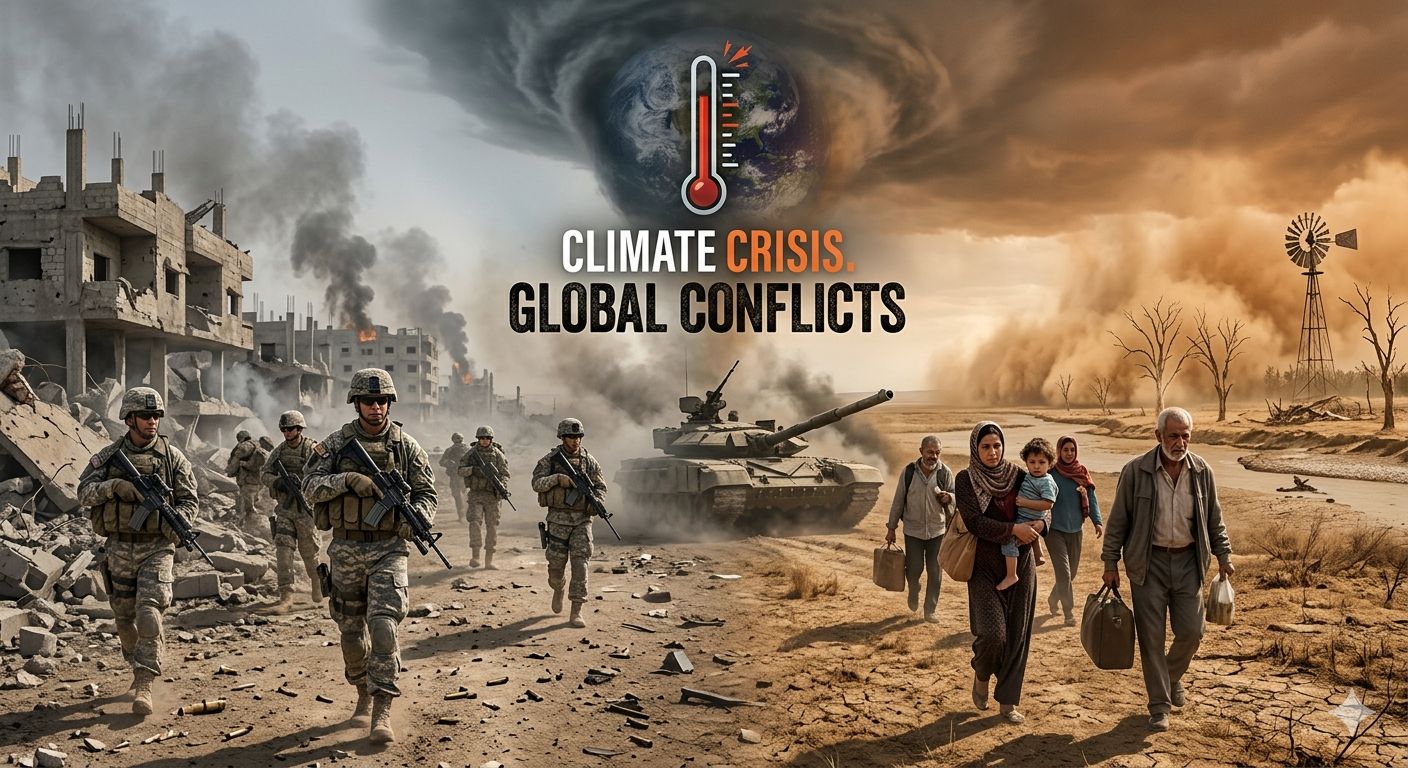
Climate change and conflict are deeply interconnected. Resource scarcity caused by environmental stress can fuel tensions and trigger wars. In turn, war accelerates environmental degradation, creating a vicious cycle.
Breaking this loop requires integrated thinking—where peacebuilding and climate action are treated as interconnected goals rather than separate agendas.
War remains one of the least acknowledged drivers of environmental damage, even though its impact is vast and long-lasting. The silence around its climate cost reflects a broader failure to address the full scale of ecological crisis.
As the world faces rising temperatures, resource stress, and increasing instability, ignoring the environmental footprint of conflict is no longer sustainable.
The real question is not just why no one cares—but how long the world can continue not to.