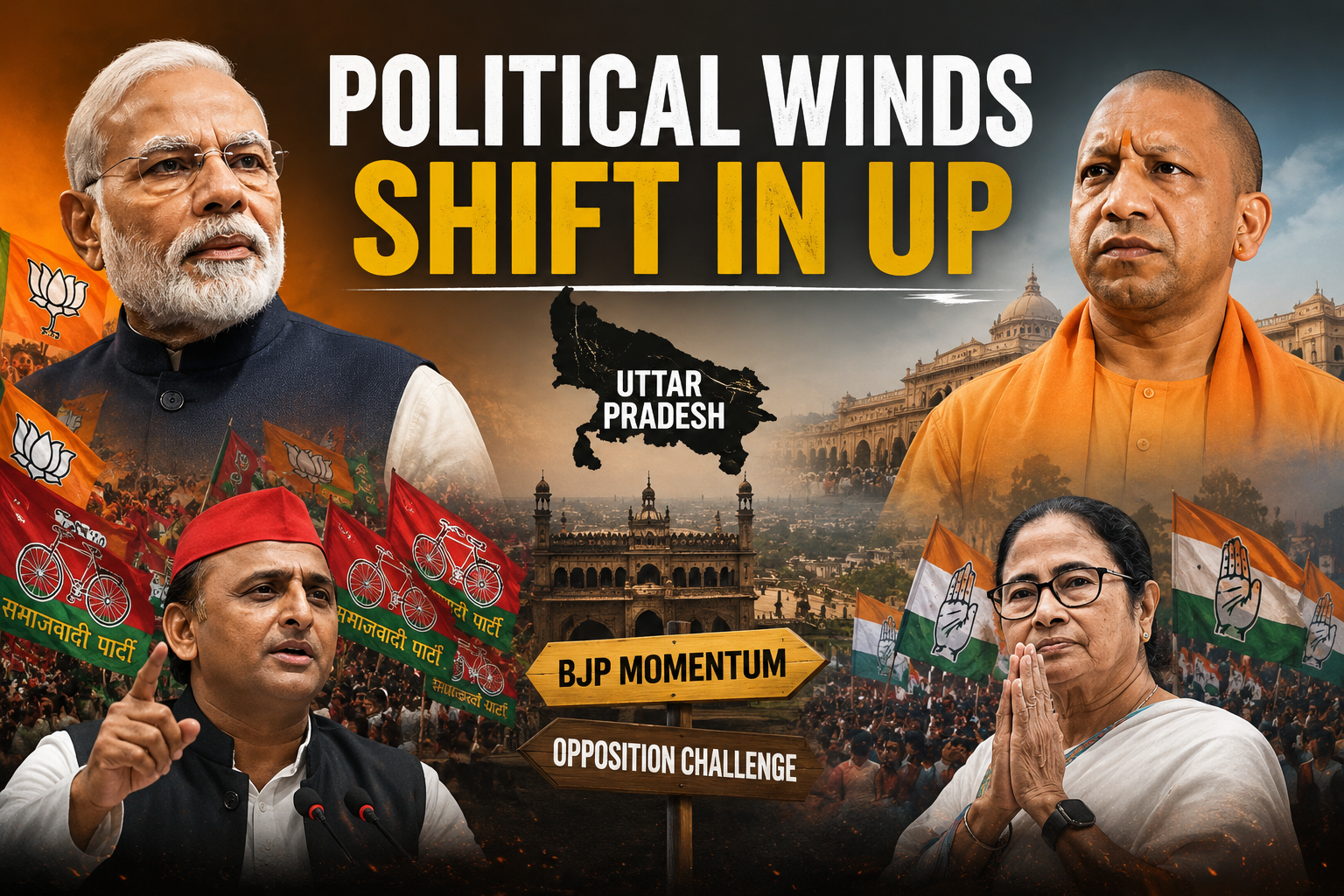
Lucknow / Kolkata: The Bharatiya Janata Party’s emphatic victory in the West Bengal Assembly elections has sent ripples through the political landscape of Uttar Pradesh, intensifying preparations on both sides ahead of the crucial 2027 Assembly elections. While the BJP sees the Bengal triumph as a morale-boosting breakthrough, the Samajwadi Party and its allies are reassessing their political strategy with renewed urgency.
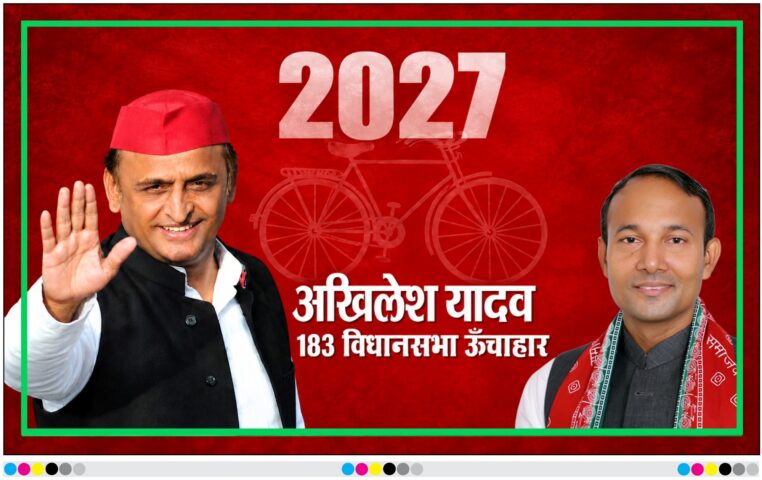
The changing mood became evident soon after the election results when Akhilesh Yadav posted a sharply worded message on social media platform X, writing, “Every deceptive victory has an expiry date; that is the very foundation of truth.” Political observers viewed the statement as more than just a reaction to Bengal’s outcome. It reflected growing anxiety within the opposition camp about the BJP’s expanding momentum ahead of the Uttar Pradesh battle.

The BJP’s rise in West Bengal — a state where the party had never ruled before — has significantly energized its cadre across northern India, especially in Uttar Pradesh, the country’s most politically significant state. For the opposition alliance led by the Samajwadi Party and the Indian National Congress, the Bengal verdict has become both a warning and a political lesson.
Opposition Reworks Strategy After Bengal Shock
Within opposition circles, there is a growing realization that defeating the BJP in 2027 will require far more than relying on anti-incumbency sentiment alone.
Senior SP leader Kiranmoy Nanda openly acknowledged that anti-incumbency, corruption allegations, and public dissatisfaction with the previous government contributed significantly to the Trinamool Congress defeat in Bengal. He indicated that similar concerns could eventually emerge in Uttar Pradesh, where the BJP government would have completed nearly a decade in power by the time the next Assembly elections are held.
However, opposition leaders also recognize that voter fatigue alone may not be sufficient to counter the BJP’s formidable election machinery.
The SP-Congress alliance drew confidence from its improved performance in the 2024 Lok Sabha elections, where the alliance secured 43 parliamentary seats in Uttar Pradesh. The alliance believes that if the parliamentary-level momentum is effectively converted into Assembly-level support, it could emerge as a serious challenger in 2027.
Yet Bengal’s results have complicated that calculation by revitalizing BJP workers and strengthening the perception that the party remains politically resilient despite setbacks in previous elections.
Modi’s Focus Shifts Toward Uttar Pradesh
Prime Minister Narendra Modi made Uttar Pradesh a central focus during his post-election address at the BJP headquarters after the Assembly results.
In his speech, Modi sharply criticized the Samajwadi Party and strongly hinted that the BJP’s “Mission UP 2027” had effectively begun.
Akhilesh Yadav had already been cautioning party workers for weeks that once the Bengal elections concluded, the BJP’s full organizational strength would shift toward Uttar Pradesh. Following the Bengal victory, that concern appears even more real for the opposition.
One of the biggest challenges before the SP now is maintaining worker morale and preventing political complacency.
Akhilesh Yadav has maintained cordial political ties with Mamata Banerjee over the years, and the West Bengal Chief Minister had even campaigned in Uttar Pradesh during previous elections. Her defeat has reportedly caused disappointment among opposition workers who had viewed Bengal as a symbolic resistance point against the BJP’s expansion.
BSP Faces Shrinking Political Space
The situation appears even more difficult for the Bahujan Samaj Party and its leader Mayawati.
As Uttar Pradesh politics increasingly moves toward bipolar contests between the BJP and the SP-led alliance, the BSP is struggling to retain political relevance. Critics and rival parties have repeatedly labeled the BSP as a “B-team,” a perception that has weakened its independent voter base.
Political analysts believe a section of Dalit and backward caste voters who once supported the BSP are gradually shifting toward the Samajwadi Party as a stronger anti-BJP alternative.
SP leaders argue that the party has successfully expanded beyond its traditional Yadav-Muslim base and gained traction among non-Yadav OBC communities, Dalits, and other social groups. The alliance with Congress is also being carefully preserved to consolidate anti-BJP votes.
At the organizational level, the SP has intensified efforts to strengthen booth-level networks and grassroots mobilization ahead of 2027.
Soft Hindutva and Controlled Messaging
The Bengal results have also reinforced the opposition’s belief that communal polarization and fragmentation of minority votes played a major role in the BJP’s victory.
To prevent similar dynamics in Uttar Pradesh, Akhilesh Yadav has reportedly instructed party leaders and workers to avoid provocative statements or actions that could politically benefit the BJP.
Interestingly, the SP appears to be simultaneously attempting a calibrated “soft Hindutva” approach.
On Tuesday morning, Akhilesh Yadav’s social media accounts shared lines from the Hanuman Chalisa, a move widely interpreted as part of an effort to reshape the party’s broader public image.
The party is also preparing for the grand inauguration of the Kedareshwar Temple in Etawah during the month of Shravan, reflecting an attempt to balance social justice politics with cultural symbolism.
At the same time, the SP continues to attack the BJP on issues such as women’s reservation, unemployment, inflation, and governance.
The opposition strategy now seems focused on preventing polarization while strengthening caste-based and social coalition politics.

BJP Sees Bengal as a Psychological Turning Point
For the BJP, the Bengal victory has come at a crucial moment.
The party’s performance in Uttar Pradesh during the 2024 Lok Sabha elections had triggered concern within its ranks. The BJP managed to win only 33 seats in the state, with its vote share falling to around 41.37 percent. Even with allies included, the NDA tally stopped at 36 seats.
Compared to the BJP’s dominant performance in 2014, when it won 71 seats in Uttar Pradesh, the decline was politically significant.
The Assembly election numbers also reflected a gradual reduction in the BJP’s dominance. The party’s tally fell from 312 seats in the 2017 Assembly elections to 255 in 2022.
Despite these setbacks, the BJP organization has spent the past two years aggressively rebuilding its political structure across Uttar Pradesh.
State General Secretary (Organisation) and senior party strategists have conducted extensive region-wise and constituency-level reviews. Booth committees are being restructured, inactive office bearers removed, and district units reorganized.
After becoming state BJP president, Pankaj Chaudhary has undertaken continuous statewide tours to energize workers and strengthen coordination between the party and government machinery.
The Bengal campaign itself involved several BJP ministers and leaders from Uttar Pradesh, making the victory emotionally and politically significant for the state unit.
Internal Challenges Continue for BJP
Despite the fresh enthusiasm, the BJP still faces serious internal challenges in Uttar Pradesh.
Caste-based lobbying within the party has reportedly become a growing concern. Different communities, including Rajputs, Brahmins, Kurmis, and Lodhs, have increasingly sought greater political representation and influence.
Recent controversies involving issues such as the UGC debate and disputes involving religious leaders also revealed underlying caste tensions within political discourse.
There have also been periodic complaints about coordination gaps between the government and the party organization.
Another challenge for the BJP leadership has been maintaining regional balance, particularly because many influential party leaders currently belong to eastern Uttar Pradesh.
To address these issues, the BJP is attempting to ensure wider representation across caste groups and regions within district and mandal committees. Discussions regarding cabinet expansion and organizational reshuffles are also reportedly aimed at creating broader social balance.
Regular coordination meetings between the government and organizational leadership are being held to prevent political disconnects ahead of the 2027 elections.
The Road to 2027 Begins
With less than a year remaining before the next Uttar Pradesh Assembly elections, political preparations have already entered an aggressive phase.
The Samajwadi Party is banking on social coalition building, anti-incumbency sentiment, and alliance arithmetic to challenge the BJP. Akhilesh Yadav’s emphasis remains on maintaining organizational discipline, avoiding unnecessary polarization, and sustaining worker morale.
The BJP, meanwhile, hopes to convert the Bengal victory into a broader narrative of national expansion and political confidence.
For both camps, the battle ahead is no longer just about votes and seats. It is increasingly becoming a contest of momentum, perception, organization, and psychological advantage.
The Bengal verdict has effectively opened a new political chapter for Uttar Pradesh.
Whether the opposition can effectively counter the BJP’s renewed confidence, or whether the BJP can overcome its recent electoral decline in the state, will shape the future direction of India’s most influential political battleground.
As the countdown to 2027 accelerates, Uttar Pradesh once again stands at the center of national politics — where caste equations, development narratives, identity politics, and electoral strategy are all set to collide in what promises to be one of the country’s most consequential political contests.
Based on political analysis by Sanjay Saxena.












 https://www.youtube.com/watch?si=RtToJsBhYBatUrym&v=mOuYNSdhjHA&feature=youtu.be