Translated from an article first published on Ravivar Delhi
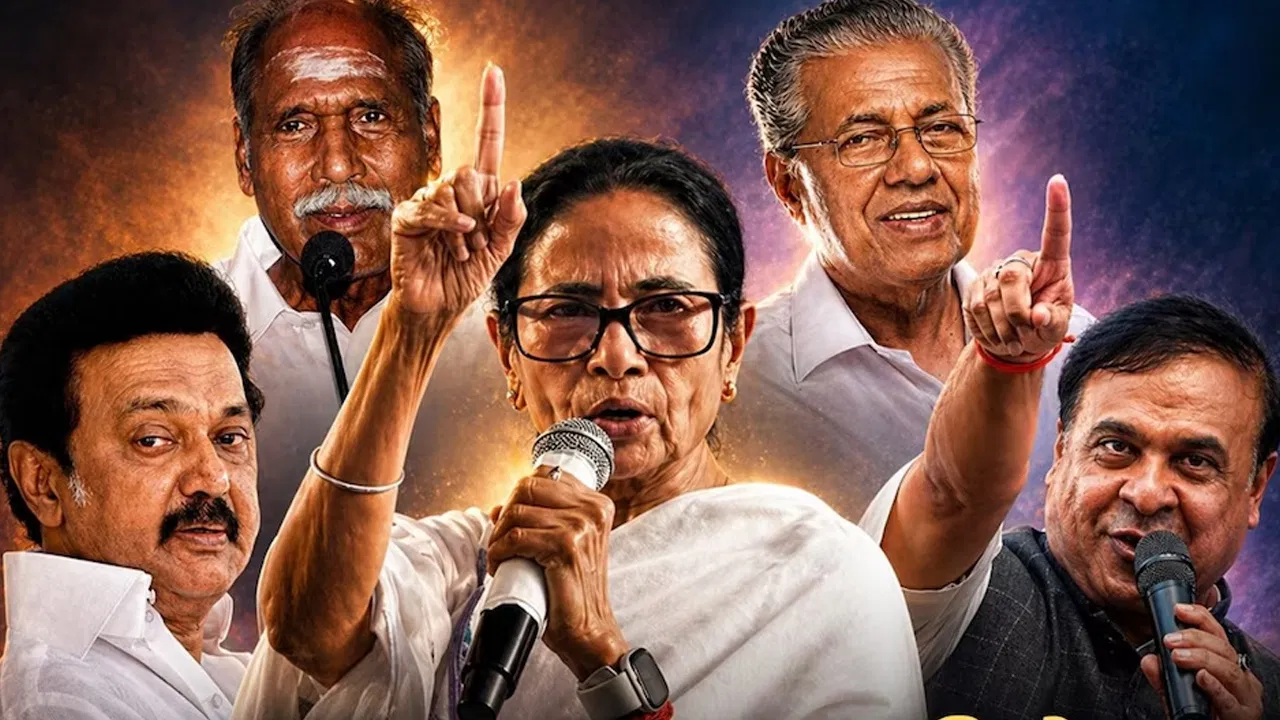
New Delhi: The recently concluded Assembly elections across five Indian states and one Union Territory have triggered intense political debate and nationwide analysis, with the results widely being viewed as an indicator of changing political equations ahead of the 2029 General Elections.

The elections, held in West Bengal, Assam, Kerala, Tamil Nadu and the Union Territory of Puducherry, witnessed participation from millions of voters and produced results that could significantly reshape the national political balance in the coming years.
Political observers believe the outcomes have strengthened the national footprint of Bharatiya Janata Party and reinforced the leadership position of Prime Minister Narendra Modi ahead of future parliamentary battles. At the same time, regional parties, opposition alliances, and emerging political formations also registered important gains, making the overall electoral picture more layered and complex.
BJP’s Major Breakthrough in West Bengal
The fiercest contest unfolded in West Bengal, where the BJP achieved a major political breakthrough by defeating the ruling All India Trinamool Congress after nearly 15 years of TMC rule in the state.
The victory was particularly significant because the BJP had never governed West Bengal before. Prime Minister Narendra Modi and Union Home Minister Amit Shah had invested enormous political energy into the campaign, turning Bengal into the central battleground of the election season.
Political analysts attributed the BJP’s success to multiple factors, including anti-incumbency sentiment, concerns over law and order, organizational expansion, and the consolidation of voter support across different regions.
Election analyst Pradeep Gupta, founder of Axis My India, observed that public dissatisfaction with governance and concerns surrounding women’s safety played a significant role in influencing voters.
Several incidents involving crimes against women, including the widely discussed 2024 RG Kar Medical College case involving a trainee doctor, had generated strong public reaction and intensified criticism of the state government.
The BJP also highlighted issues related to governance, development, and political violence during its campaign, promising stability, employment generation, and improved law and order.
Following the victory, Narendra Modi addressed party workers wearing a traditional Bengali dhoti and described the result as a historic moment for Indian democracy. He thanked party workers for their discipline and hard work and stated that the people had voted for development, stability, and good governance.
The Prime Minister said the BJP remained committed to public service and emphasized that citizens trust governments that deliver development and transparent governance. He also appealed to all political parties to end political violence and work toward a peaceful democratic environment.
Mamata Banerjee Rejects Defeat Narrative
Despite the defeat, West Bengal Chief Minister Mamata Banerjee refused to concede politically and stated that she would not resign.
Banerjee, who reportedly lost her own Bhabanipur seat to BJP leader Suvendu Adhikari, accused the BJP of “stealing the election” and questioned the role of central security forces deployed during polling.
The TMC leadership also raised concerns over the Election Commission’s “Special Intensive Revision” (SIR) process used for voter verification and electoral roll revision. According to TMC leaders, the exercise disproportionately affected sections of their support base, particularly minority voters.
The revision process reportedly led to the removal of nearly 90 lakh voter names across states including West Bengal, Kerala, and Tamil Nadu. BJP leaders, however, defended the exercise as a fully constitutional and legal process intended to remove ineligible names from electoral rolls.
BJP national spokesperson Guru Prakash Paswan stated that many migrant workers returned home to cast their votes and asserted that the revision process strengthened electoral integrity.
The political battle over voter lists and polling procedures has since become one of the most debated aspects of the election aftermath.
Assam Delivers Historic Third Term for NDA
In Assam, the BJP-led National Democratic Alliance registered a decisive victory, securing a historic third consecutive term in power.
The alliance won 102 out of 126 seats, while the BJP alone crossed the majority mark with 82 seats — an important political milestone for the party in the northeastern state.
The election also witnessed a record voter turnout of nearly 86 percent, reflecting exceptionally high public participation.
Political observers noted that constituency delimitation conducted in 2023 significantly altered electoral dynamics. The restructuring reportedly reduced the number of seats where minority voters, especially Bengali-origin Muslims, held decisive influence.
While Congress managed to consolidate support in Muslim-majority constituencies, the NDA dominated Upper Assam and tribal regions.
The defeat of senior Congress leader Gaurav Gogoi in Jorhat was viewed as a major setback for the opposition.
According to data released by Association for Democratic Reforms, the financial profile of winning candidates also changed significantly. The average declared assets of victorious MLAs reportedly rose to ₹8.82 crore compared to ₹4.59 crore in 2021.
The report further indicated that around 85 percent of winning candidates were crorepatis, while the proportion of elected candidates with declared criminal cases fell from 27 percent in 2021 to 17 percent in 2026.
Analysts also observed that traditional linguistic and regional divides in Assam increasingly appeared to have transformed into sharper religious and community-based electoral polarization.
Kerala Witnesses Political Shift
Kerala delivered another major political shift as the Congress-led United Democratic Front returned to power, ending the rule of the Left government.


The result marked a historic development because it effectively removed the last remaining Communist-led government from power in any Indian state after nearly five decades.
Congress leaders credited organizational unity and coordinated campaigning for the victory. The outcome was viewed as a major morale boost for the opposition nationally.
Senior Congress leader Shashi Tharoor described Kerala as a continuing model of communal harmony and social coexistence.
In a social media post, Tharoor highlighted how voters in Muslim-majority Thanavanur elected Christian candidate V.S. Joy, while Hindu-majority Kalamassery elected Muslim candidate Muhammad Shiyas.
According to Tharoor, these results demonstrated that Kerala continued to prioritize humanity and social harmony above caste and religious divisions.
The BJP managed to increase its representation in Kerala to three seats, reflecting gradual expansion despite the state remaining resistant to the party’s larger political dominance.
Tamil Nadu Sees Surprise Rise of TVK
One of the most surprising developments emerged in Tamil Nadu, where actor-turned-politician Joseph Vijay Chandrasekhar, popularly known as Vijay, led his relatively new party Tamilaga Vettri Kazhagam to a stunning performance.
Founded barely two years ago, TVK emerged as a major force, disrupting pre-poll alliances and reshaping Tamil Nadu’s political equations.
Vijay criticized traditional political parties for relying excessively on welfare handouts rather than creating sustainable employment opportunities and economic growth.
The rise of TVK added a fresh dimension to Tamil Nadu politics and demonstrated the continuing influence of cinema personalities in the state’s political culture.
Although the BJP made modest gains in Tamil Nadu, the state still remains a challenging political landscape for the party.
Puducherry and the Expanding BJP Footprint
In Puducherry, the BJP and its allies succeeded in retaining power, further strengthening the NDA’s southern political presence.
The broader election results underscored the BJP’s remarkable geographical expansion across India over the past four decades.
From winning just two parliamentary seats in 1984, the party now holds power in 22 states and Union Territories and governs regions representing nearly 78 percent of India’s population.
Political analysts noted that the BJP has increasingly succeeded in expanding beyond traditional Hindi-speaking regions into linguistically and culturally diverse states.
A National Shift Before 2029?
The Assembly election results are now being viewed through the larger prism of the 2029 Lok Sabha elections.
A stronger presence in states like West Bengal could increase the BJP’s influence in the Rajya Sabha, helping the party advance its legislative agenda more effectively at the national level.
At the same time, the elections also revealed that regional politics in India remains deeply dynamic and unpredictable. While the BJP expanded significantly, opposition victories in Kerala and the rise of TVK in Tamil Nadu demonstrated that alternative political narratives continue to hold ground.
The elections also reopened wider debates around electoral processes, governance models, welfare politics, polarization, voter mobilization, and the role of centralized leadership in Indian democracy.
For supporters of the BJP, the results represent public endorsement of governance focused on direct benefit delivery, welfare inclusion, and national leadership under Narendra Modi.
Critics, however, argue that issues such as political polarization, aggressive campaigning, electoral management controversies, and concentration of political power require deeper scrutiny.
Democracy’s Continuing Test
The 2026 Assembly elections ultimately reflected the evolving nature of Indian democracy — vibrant, competitive, emotional, and deeply consequential.
From Bengal’s high-voltage political battles to Kerala’s message of communal harmony, from Assam’s decisive mandate to Tamil Nadu’s cinematic political disruption, the elections showcased the extraordinary diversity of India’s political landscape.
While parties celebrate victories and analyze defeats, the larger question remains how effectively these mandates translate into governance, development, employment generation, social harmony, and improved quality of life for ordinary citizens.
As India moves closer to the 2029 General Elections, the message from these state results is clear: the country’s political landscape is changing rapidly, and every regional battle now carries national significance.
Based on political analysis and commentary by Prof. Neelam Mahajan Singh, senior journalist, political analyst, international affairs expert, Doordarshan personality, and solicitor for human rights.












 https://www.youtube.com/watch?si=RtToJsBhYBatUrym&v=mOuYNSdhjHA&feature=youtu.be