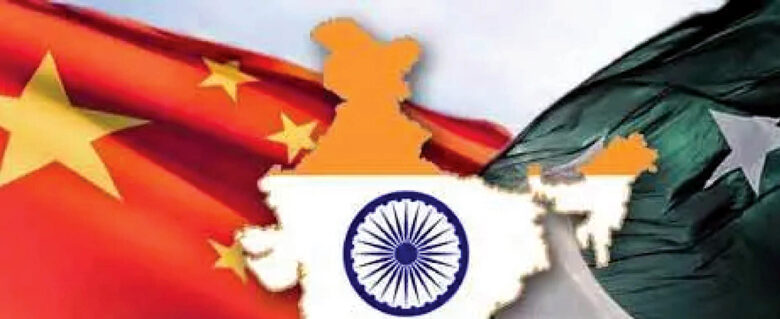
New Delhi: Growing defence cooperation between China and Pakistan is emerging as a significant strategic consideration for India, particularly amid reports of advanced Chinese fighter aircraft being offered or supplied to Pakistan and increasing military cooperation between the two countries.
The developments come at a time when the Indian Air Force is dealing with a shortage of operational fighter squadrons while preparing for the possibility of a two-front security challenge involving China and Pakistan.

India has traditionally maintained a qualitative military advantage over Pakistan, with platforms such as the Rafale strengthening its air combat capabilities. However, the possible introduction of Chinese fifth-generation aircraft into Pakistan’s inventory could alter the regional air-power equation, according to defence analysts.
Fifth-generation fighters are designed around low observability, advanced sensors, electronic warfare capabilities and integrated avionics. Their effectiveness, however, depends not only on the aircraft itself but also on pilot training, weapons, communications, radar coverage and command-and-control networks.
India’s immediate challenge is therefore broader than acquiring another fighter aircraft. The country needs to strengthen its overall air-combat architecture, including airborne early-warning systems, integrated air defence, electronic warfare and counter-stealth surveillance capabilities.
The fighter squadron shortage remains a major concern. The Indian Air Force has long faced a gap between its authorised strength and the number of operational squadrons available. The retirement of ageing platforms has increased pressure on the induction of new aircraft, while delays in indigenous fighter production have complicated the modernisation process.
The Tejas Mk1A programme is expected to play an important role in rebuilding India’s fighter strength. At the same time, the proposed 114-aircraft Multi-Role Fighter Aircraft programme could provide an additional avenue for expanding the fleet, although its acquisition process remains subject to government decisions and procurement timelines.

India is also pursuing the Advanced Medium Combat Aircraft (AMCA), its indigenous fifth-generation fighter programme. The project is intended to combine stealth, advanced avionics, sensor fusion, internal weapons carriage and sophisticated flight-control systems. Accelerating the programme while maintaining rigorous testing and systems integration will be critical to its eventual success.
India’s ground-based air defence network provides another layer of protection. Systems such as the S-400, along with indigenous radar and missile programmes, are expected to contribute to a layered air-defence architecture. Counter-stealth detection and networked surveillance will become increasingly important as low-observable aircraft proliferate in the region.
The changing regional environment also places greater emphasis on industrial capacity. Faster aircraft production, reliable supply chains, domestic engine and subsystem development, and greater participation by private-sector companies will be essential if India is to close the capability gap over the coming decade.
The China-Pakistan defence relationship therefore presents India with a complex challenge rather than one that can be addressed through a single procurement decision. A combination of faster acquisitions, indigenous development, stronger air defence, technological investment and closer integration of military networks will determine how effectively India responds to the evolving security environment.
For Indian defence planners, the emerging air-power balance underlines the need to align long-term self-reliance with immediate operational requirements. The central challenge will be maintaining credible deterrence while ensuring that modernisation programmes move forward at a pace consistent with the rapidly changing strategic landscape.