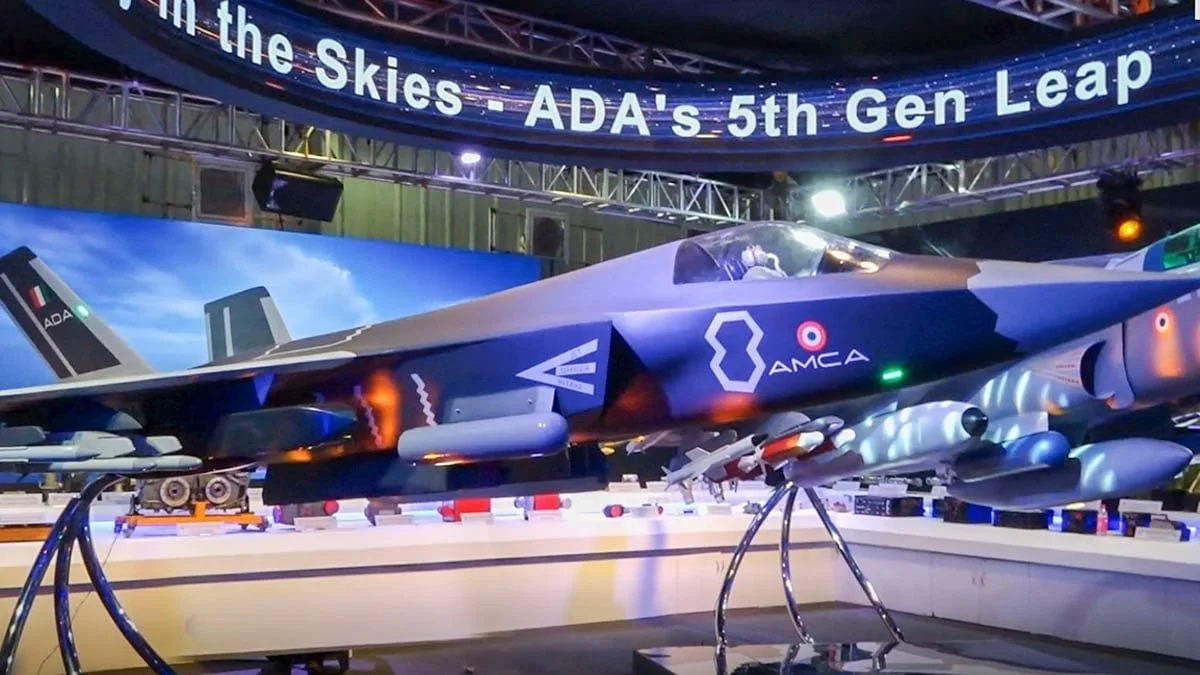
New Delhi: India’s ambitious Advanced Medium Combat Aircraft (AMCA) programme is approaching a decisive stage, with the government targeting September 2028 for the maiden flight of the country’s indigenous fifth-generation stealth fighter. Meeting that deadline, however, could prove challenging given the programme’s development schedule, engine-related uncertainties and the complexity of integrating advanced combat systems.
The Ministry of Defence has extended the deadline for private-sector companies to submit bids for the AMCA development and production contract to October 30, 2026. Tender conditions provide the selected development-cum-production partner up to 30 months from contract signing to complete ground taxi trials and conduct the aircraft’s first flight. If the contract is finalised in late 2026 or early 2027, that provision could place the maiden flight closer to 2029 unless substantial preparatory work is undertaken in parallel.
The AMCA is intended to combine low-observable design, advanced avionics, sensor fusion, sophisticated flight-control systems and internal weapons carriage. Integrating these technologies into a functional fifth-generation platform is considerably more demanding than developing a conventional fighter aircraft.
Strategic affairs analyst Abhijit Iyer-Mitra has also cautioned against setting timelines that may not reflect the engineering realities involved. He has argued that detailed design and systems architecture will require considerable work before prototype construction can proceed, with a comprehensive design freeze potentially taking several years.
Propulsion remains another critical variable. Initial AMCA Mk1 prototypes are planned around General Electric’s F414 engine. Reports of continuing commercial discussions concerning pricing and technology transfer have added uncertainty, although some defence sources have rejected suggestions of a complete impasse. Since the aircraft’s configuration, including its air intakes and internal architecture, has been developed around the F414, a late propulsion change could require extensive aerodynamic, structural and software modifications.


The programme also marks a significant shift towards private-sector participation. HAL is not competing for the prototype manufacturing phase. Three private-sector groupings have been shortlisted: Tata Advanced Systems; an L&T-led consortium involving BEL and Dynamatic Technologies; and a Bharat Forge-led consortium with BEML and Data Patterns.
The selected partner is expected to build five flying prototypes and one structural test aircraft, followed by an extensive flight-test programme involving around 1,800 sorties over 84 months.
India is simultaneously expanding the infrastructure needed to support the project. In May 2026, the foundation stone was laid for ADA’s proposed ₹2,000-crore Aircraft Integration and Flight Testing Centre at Puttaparthi in Andhra Pradesh. The facility is intended to support prototype assembly, systems integration, flight testing and certification.
For the September 2028 target to remain achievable, procurement, tooling, subsystem development and prototype assembly will have to progress on overlapping timelines. The challenge for the programme will be to balance speed with the demanding testing and integration requirements of a fifth-generation fighter, ensuring that the aircraft’s long-term capability and reliability are not compromised by schedule pressures.













 https://www.youtube.com/watch?si=RtToJsBhYBatUrym&v=mOuYNSdhjHA&feature=youtu.be