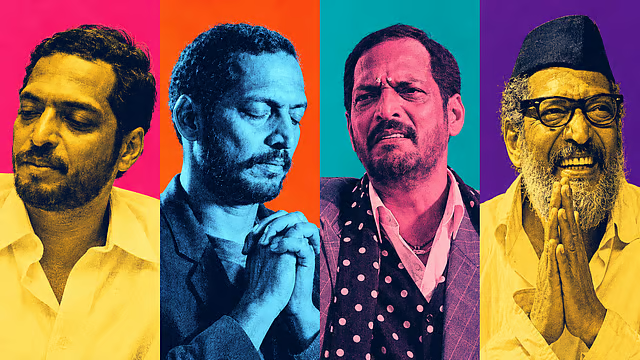
From the menacing gangster in Parinda to the fiery crusader in Krantiveer and the tragic thespian in Natsamrat, Nana Patekar leaves behind a legacy defined by intensity, conviction and an unmistakable individuality.
Mumbai: Indian cinema has lost one of its most distinctive performers with the passing of Nana Patekar, the actor whose piercing gaze, explosive dialogue delivery and extraordinary command of silence made him an institution in his own right. Known for his refusal to conform to conventional ideas of stardom, Patekar carved out a place in Hindi and Marathi cinema through performances that were raw, unpredictable and deeply human.

Born Vishwanath Patekar on January 1, 1951, in Murud-Janjira, Maharashtra, Nana’s journey to cinematic prominence was far removed from the glamour associated with the film industry. His early life was shaped by financial hardship after his family’s textile business collapsed. To support his family, he painted film posters and took up odd jobs while pursuing commercial art at Mumbai’s Sir J.J. Institute of Applied Art.
Theatre became his creative training ground. It helped him develop the discipline, timing and emotional precision that would later distinguish his screen performances. Unlike actors who relied on elaborate mannerisms, Patekar could communicate anger, vulnerability, menace and despair through a fleeting expression or a measured pause.
His film career began with Gaman in 1978. He subsequently appeared in a series of films that gradually established his reputation as a performer capable of elevating even a supporting role. International attention followed with Mira Nair’s Salaam Bombay! (1988), but it was Vidhu Vinod Chopra’s Parinda (1989) that firmly announced his arrival.
As Anna, the ruthless underworld figure at the centre of the film’s dark criminal landscape, Patekar delivered a chilling performance that earned him the National Film Award and the Filmfare Award for Best Supporting Actor. His portrayal was disturbing not because of exaggerated villainy, but because he gave the character a frightening psychological depth.
The 1990s brought some of the defining performances of his career. In Krantiveer (1994), he played Pratap, an angry and disillusioned man who becomes a voice against injustice. His impassioned performance won him the National Film Award for Best Actor and the Filmfare Award for Best Actor. Two years later, Agni Sakshi (1996) earned him another National Film Award for Best Supporting Actor, further demonstrating his ability to inhabit morally complicated characters.
Patekar’s achievement was not simply a matter of winning awards. He repeatedly challenged the boundaries between leading and supporting roles, between heroism and villainy, and between mainstream entertainment and serious dramatic cinema. His Filmfare recognition across the Best Actor, Best Supporting Actor and Best Villain categories reflected the breadth of his performances.
His versatility was particularly evident in the contrast between his films. In Angaar and Apaharan, he explored the darker worlds of crime and power. In Prahaar: The Final Attack, which he also wrote and directed, he brought his commitment to discipline, duty and the armed forces to the screen. The film reflected his interest in stories that examined personal responsibility and the moral consequences of violence.
In Ab Tak Chhappan, Patekar portrayed a police officer navigating the brutal realities of an encounter-specialist’s world. In Raajneeti, he became part of a sprawling political drama in which ambition, loyalty and power shaped human relationships. Across such films, his presence remained unmistakable without depending on conventional glamour.
Yet Nana Patekar was never confined to intense dramas. His performance as Uday Shetty in Welcome introduced audiences to another dimension of his talent. With impeccable comic timing, expressive reactions and an instinctive understanding of absurdity, he helped turn the gangster character into a memorable figure of popular comedy. The role demonstrated that the same actor who could unsettle audiences in a psychological thriller could also make them laugh through a carefully timed glance.
Marathi cinema offered him another opportunity to explore the depths of human experience. In Natsamrat (2016), he portrayed an ageing theatre legend confronting the pain of fading relevance, family conflict and the loss of dignity. Adapted from the celebrated Marathi play, the film demanded emotional exposure and theatrical command. Patekar’s performance brought the tragedy of an artist’s final act to audiences who recognised the universal vulnerability beneath the character’s grandeur.

His work across Hindi and Marathi cinema reflected a commitment to the craft rather than to any single industry’s conventions. He could be uncompromising on screen, but his characters were rarely one-dimensional. Even when playing men of extraordinary aggression, he allowed glimpses of fear, loneliness and wounded pride to emerge.
Patekar’s relationship with the armed forces extended beyond cinema. He served as an Honorary Lieutenant Colonel in the Territorial Army’s Maratha Light Infantry, reflecting his longstanding respect for military service and discipline.
His engagement with society also extended to rural Maharashtra. Through the Naam Foundation, which he co-founded, he supported efforts to assist drought-affected farmers and communities facing agrarian distress. The initiative brought attention to the struggles of people whose lives remained far removed from the glamour and commercial success of the entertainment industry.
In recognition of his contribution to cinema and the arts, the Government of India conferred the Padma Shri on him in 2013. The honour acknowledged a career built not on a carefully manufactured public image, but on the strength of performances that audiences found difficult to forget.
Patekar was widely known for his outspoken nature, personal simplicity and fierce independence. He did not always seek to make himself agreeable, nor did he appear interested in fitting neatly into the familiar machinery of celebrity culture. That independence became part of his public identity, just as his distinctive voice and intense screen presence became part of his artistic signature.
His legacy, however, rests most securely in his body of work. Few actors could move so effortlessly between the menace of a criminal, the anger of a betrayed citizen, the discipline of a soldier, the comic eccentricity of a gangster and the anguish of a declining artist. He approached each role with a physical and emotional commitment that made his performances feel lived rather than merely enacted.
For audiences, Nana Patekar was an actor who demanded attention without necessarily demanding admiration. He could provoke, disturb, amuse and move viewers, often within the same performance. His characters did not always offer comfort or easy answers; they confronted audiences with contradictions that made them compelling.
His influence will endure in the performances he leaves behind and in the example of an artist who built a remarkable career by trusting his instincts and refusing to be reduced to a formula. For aspiring actors, his journey remains a reminder that screen presence is not measured by glamour alone, but by the capacity to make a character impossible to ignore.
Nana Patekar’s story was one of hardship, artistic discipline, professional reinvention and an unwavering commitment to individuality. The applause may have faded, but the characters remain: angry, flawed, funny, wounded and unforgettable.
Indian cinema will continue to revisit his performances, discovering new layers in familiar scenes and hearing fresh meaning in dialogue delivered with that unmistakable intensity.
The actor may be gone, but the force of his performances will remain.