NEW DELHI — For most of India’s post-independence history, defence policy was largely about one thing: securing the country’s borders. That framing has changed substantially over the past decade. Today, defence has become one of the central pillars of how India tells its own story as a rising global power — tied as much to industrial growth, technological ambition and diplomatic leverage as it is to military security itself.
The shift is closely bound up with the government’s twin push toward self-reliance, branded as Atmanirbhar Bharat, and the longer-term goal of a developed India by 2047, known as Viksit Bharat. Within that framework, defence manufacturing isn’t treated as a niche security function anymore — it’s positioned as a strategic industry central to the country’s broader economic and technological rise.

Breaking a Decades-Long Import Habit
For much of its modern history, India has ranked among the world’s largest arms importers, a status that carried real strategic costs — dependence on foreign suppliers, exposure to shifting geopolitics, and a steady drain of foreign exchange. That picture has been changing quickly. Domestic defence production has climbed from roughly ₹40,000 crore around 2014 to somewhere between ₹1.5 and ₹1.8 lakh crore in recent years, with indigenous content in defence equipment now running at around 65 percent. Close to three-quarters of the military’s modernisation budget is now earmarked specifically for Indian industry, while a series of “Positive Indigenisation Lists” have phased out imports of thousands of components, effectively forcing local supply chains into existence.
The platforms emerging from this push have become symbols in their own right: the Tejas light combat aircraft, the Akash air-defence system, BrahMos cruise missiles, the indigenously developed ATAGS artillery system, and naval assets including the Arihant-class nuclear submarines and the aircraft carrier INS Vikrant. New defence industrial corridors in Uttar Pradesh and Tamil Nadu, relaxed foreign investment rules allowing up to 74 percent automatic approval, and startup-focused schemes like iDEX are all aimed at building a genuine domestic defence-industrial base rather than simply assembling imported components. Private companies, once bit players in an industry historically dominated by state-run manufacturers, now account for a meaningfully larger share of output.
This industrial buildout functions as a form of economic statecraft as much as military policy. It generates high-skill employment, drives research and development, draws in investment, and reduces the foreign-exchange outflow associated with buying weapons abroad. Defence exports tell a similar story — negligible a decade ago at under ₹1,000 crore, they have since surged past the ₹20,000-38,000 crore range, with a government target of ₹50,000 crore by the late 2020s. Sales of systems like BrahMos and the Pinaka rocket system to countries across the Global South and the Indo-Pacific are increasingly framed not just as commercial transactions but as tools for building long-term strategic relationships.
Modernising for a Two-Front Reality
India’s strategic planners have long had to reckon with pressure on two fronts simultaneously: a militarily powerful China along the disputed Line of Actual Control, and a persistent threat from Pakistan, including cross-border terrorism. The response has combined new capability with a harder posture. Border infrastructure has expanded substantially through the Border Roads Organisation, while the push toward theatre commands and joint doctrines aims to better integrate operations across land, air, sea, cyber and space domains. A 15-year technology roadmap has put artificial intelligence, drones, unmanned systems, directed-energy weapons and networked warfare at the center of future planning.
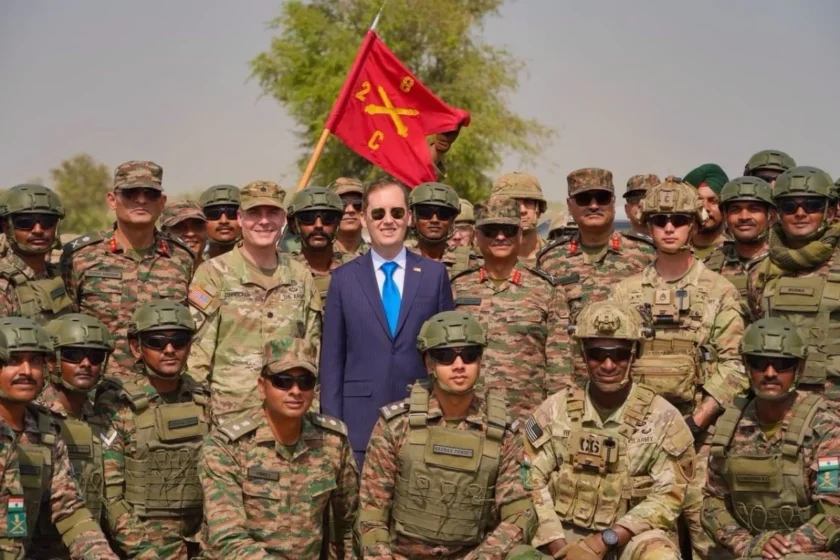
Recent military responses to provocations have reinforced what officials describe as a doctrine of measured but decisive retaliation — a signal that India intends to impose costs rather than simply absorb attacks. Plans for a 200-warship navy, continued strengthening of the nuclear triad, and investment in long-range precision-strike capability are aimed at reinforcing deterrence and extending India’s reach across the Indian Ocean and wider Indo-Pacific region. None of this has come at the expense of outside partnerships — cooperation through the Quad and bilateral defence ties with the United States, France, Japan and others continues to run alongside, rather than in place of, the push for domestic capability.

Security as National Storytelling
Officials and analysts increasingly describe defence policy as feeding into India’s broader national narrative along several distinct lines. A self-reliant defence-industrial base reduces India’s vulnerability to external pressure or supply disruptions in a crisis, giving New Delhi more room to maintain its multi-alignment approach — engaging the United States, Russia, Europe and others without being tied to any single supplier’s geopolitical preferences.
On the economic side, defence manufacturing is explicitly treated as a lever for raising manufacturing’s share of GDP, creating skilled jobs, and fostering technologies with both civilian and military applications — a link the Viksit Bharat narrative draws directly, connecting military modernisation to the country’s broader industrial and technological rise. Internationally, the ability to export credible, combat-tested systems and to participate in regional security arrangements is helping position India as what officials call a “responsible net security provider” — a credible alternative supplier for countries wary of depending too heavily on any single major power. Successes on both the military and industrial fronts feed into perceptions of India as an emerging major power in Asia.
There’s also a domestic dimension. Successful indigenous platforms and demonstrated operational readiness are increasingly woven into a public narrative of national confidence and resurgence — proof, in the government’s telling, of a country capable of protecting its own interests while aspiring to a larger leadership role on the world stage.
The Gaps That Remain
The picture isn’t without friction. Production timelines have slipped in places, quality consistency across programs remains uneven, and some of the government’s more ambitious quantitative targets are proving difficult to hit on schedule. Balancing the military’s immediate operational readiness against the slower, more patient work of building indigenous capability requires careful trade-offs, and budgetary pressure alongside the challenge of achieving genuine “jointness” across the army, navy and air force continue to test institutional reforms.
Even so, the overall direction has remained consistent across successive budgets — India’s defence allocation for 2026-27 reached a record high — and procurement rules that increasingly prioritize what officials call “Buy Indian – Indigenously Designed, Developed and Manufactured” over foreign purchases.
Taken together, the trajectory suggests defence policy in India has outgrown its traditional boundaries. It is no longer simply about weapons and borders, but has become one of the clearest expressions of how the country wants to be seen — converting security requirements into industrial capacity, technological ambition, diplomatic leverage and a broader sense of national self-belief. As India works toward its stated goal of major-power status by 2047, its ability to design, build and, when necessary, use its own military power looks set to remain one of the defining threads in that larger story.