New Delhi: As political equations continue to evolve and discussions over leadership changes gain momentum, New Delhi has once again become the center of intense political speculation. In Indian politics, signals often carry as much significance as formal announcements, and recent developments within the ruling establishment have sparked widespread debate about possible changes in both government and party organization.
With Prime Minister Narendra Modi leading the National Democratic Alliance (NDA) government into the early phase of its third term, attention is increasingly turning toward long-term political planning. Political observers believe that the Bharatiya Janata Party (BJP) has already begun laying the groundwork for key electoral battles, including the 2027 Assembly elections in several states and the 2029 Lok Sabha elections.
Recent Rajya Sabha elections have further fueled discussions about a potential reshuffle. By nominating leaders from diverse social, regional and professional backgrounds to the Upper House, the BJP has signaled its intent to broaden leadership representation and prepare a new generation of national faces. Historically, the Rajya Sabha has often served as a platform for emerging leaders who later assume important responsibilities within the Union government.
Speculation has also intensified around leaders who joined the BJP from other political parties in recent years. As the party expands its political footprint, balancing the aspirations of long-time party workers, newly inducted leaders and regional interests remains a crucial challenge. Political analysts view any future cabinet expansion or organizational restructuring as part of a broader effort to maintain this balance.
Adding to the intrigue, the recent acceptance of a Union Minister of State’s resignation by the President has prompted fresh political discussions. While officially treated as a routine constitutional process, observers believe such developments often become indicators of larger political realignments.
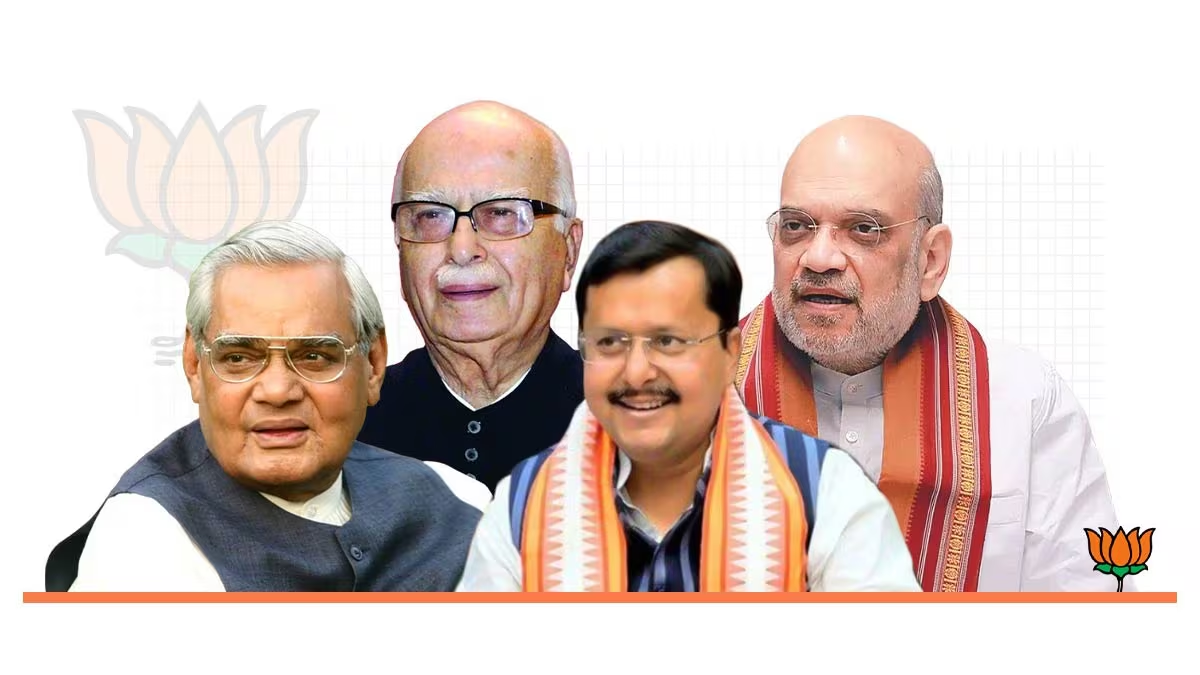
One of the BJP’s defining characteristics has been its emphasis on both governance and organization. From the era of former Prime Minister Atal Bihari Vajpayee to the present leadership under Narendra Modi, the party has regularly rotated leaders between government and organizational roles. This has led to speculation that some current ministers could be assigned party responsibilities, while organizational leaders may be inducted into the government.
The possibility of a cabinet reshuffle also raises questions about performance evaluation. Governments routinely assess ministers on administrative effectiveness, political influence and public outreach. Given the BJP’s emphasis on both governance and electoral strategy, analysts believe that some ministers could receive expanded responsibilities, others may see portfolio changes, and new faces could be brought into the cabinet.

Representation is expected to remain an important factor. Any future expansion may seek to strengthen the participation of youth, women, Scheduled Castes, Scheduled Tribes and leaders from strategically significant regions. Such considerations often play a key role in shaping both governance priorities and electoral strategy.
The role of NDA allies is equally significant. Coalition politics requires not only numerical support but also meaningful participation and political trust. Therefore, any changes within the government may also take into account the expectations and influence of alliance partners.
Political observers note that Prime Minister Modi has consistently maintained a culture of confidentiality around major decisions. Previous cabinet reshuffles have demonstrated that many political predictions remain speculative until official announcements are made. As a result, while discussions are widespread and signals are numerous, definitive information remains limited.
What appears clear, however, is that both the BJP and the central government are preparing for the next phase of political competition. Whether through organizational restructuring, leadership adjustments or cabinet expansion, the focus seems to be on strengthening the party’s position for future electoral challenges.
As Delhi’s political circles closely watch every development, the coming months may reveal new faces, new responsibilities and new political messaging. In India’s dynamic democracy, governance is not merely about administration—it is also about constant adaptation, renewal and strategic realignment. Current developments suggest that another phase of that process may already be underway.