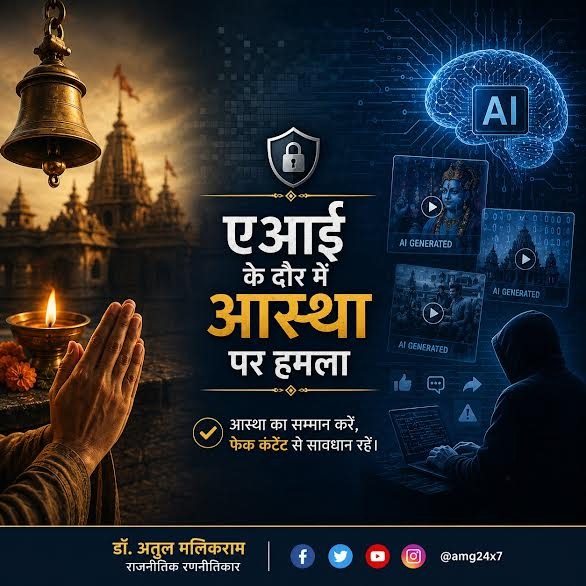
New Delhi: As Artificial Intelligence (AI) continues to transform sectors ranging from healthcare and education to industry and entertainment, concerns are growing over its misuse in matters related to religion and faith. Political strategist Dr. Atul Malikram has warned that AI-generated content is increasingly being used to manipulate religious sentiments, spread misinformation and exploit public trust.
In a recent commentary, Dr. Malikram noted that social media platforms have witnessed a surge in AI-generated images and videos depicting deities, religious sites and spiritual figures in fabricated scenarios. Many such posts are designed to appear authentic and are often accompanied by messages urging users to like, share or forward content to avoid bad luck or divine displeasure.
According to him, this trend goes beyond misinformation and enters the realm of psychological exploitation of faith. He cited several recent examples, including a viral AI-generated video allegedly showing a crane pouring milk over Lord Jagannath at the revered Jagannath Temple. Temple authorities later clarified that no such ritual had taken place and that the video was entirely fabricated.
He also referred to an AI-generated image linked to the Mahakaleshwar Temple, which falsely portrayed an individual seated inside the sanctum sanctorum, despite strict access restrictions permitting entry only to authorized priests.
Dr. Malikram emphasized that the challenge is not limited to any one religion. Similar concerns have emerged within the Sikh community regarding fake AI-generated content related to the Golden Temple. Internationally, he pointed to cases where AI-generated religious figures have gained significant online followings despite having no real-world existence.
The strategist cautioned that the most serious threat arises when AI-generated religious content is used to inflame sentiments or create social divisions. False images and videos linked to temples, mosques, churches or gurdwaras can spread to millions of users within minutes, potentially fueling mistrust and communal tensions.
From a political and social perspective, he argued, the manipulation of religious symbols through AI is no longer a harmless prank. Instead, it has the potential to influence public opinion, deepen polarization and shape collective emotions on a large scale.

Dr. Malikram welcomed the growing attention being paid to the issue by courts and regulatory bodies, noting that legal institutions have begun taking a stricter stance against deepfakes and misleading AI-generated content. However, he stressed that legal action alone will not be sufficient.
He called on social media platforms to strengthen mechanisms for detecting and removing deceptive content, while also emphasizing the need for greater digital literacy among citizens. Users, he said, must learn to verify information before accepting viral videos and images as genuine.
“Faith should never be driven by fear,” he observed, adding that no religion asks followers to prove devotion through likes, shares or forwards on social media. Content that attempts to exploit belief through intimidation, he argued, is not an expression of spirituality but a form of deception.
Concluding his remarks, Dr. Malikram said AI remains a powerful tool for human progress, but society must remain vigilant against its misuse. He stressed that safeguarding both technological innovation and the integrity of faith will require responsible use of digital tools, stronger public awareness and collective commitment to truth.
“If the challenge is not addressed in time,” he warned, “the line between truth and falsehood may become increasingly blurred, posing risks not only to religious trust but also to social harmony and unity.”













 https://www.youtube.com/watch?si=RtToJsBhYBatUrym&v=mOuYNSdhjHA&feature=youtu.be