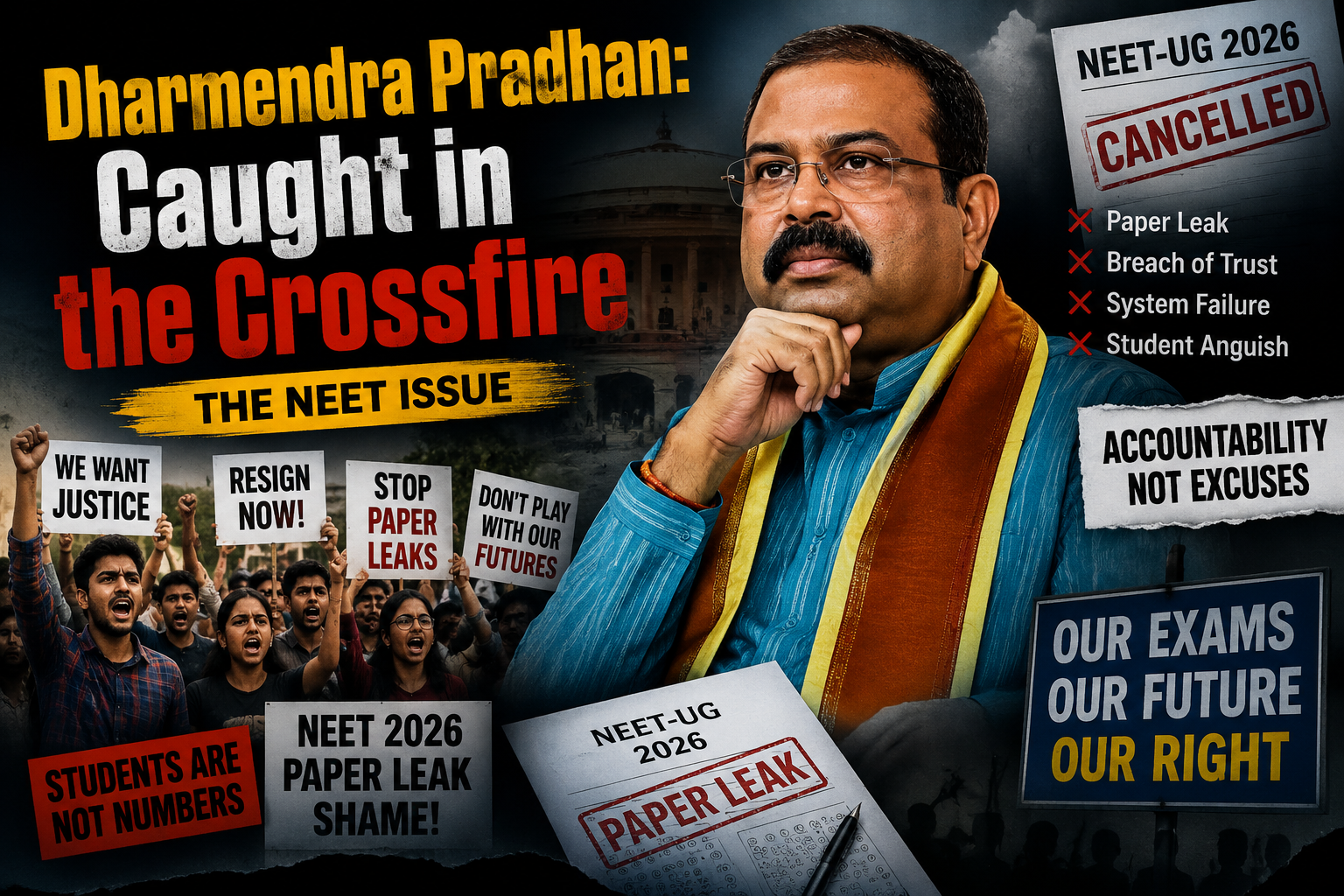
New Delhi: Union Education Minister Dharmendra Pradhan is facing perhaps the most challenging phase of his tenure as India’s education chief. A wave of student anger, fueled by examination controversies and amplified by social media, has culminated in public protests demanding accountability and reform. At the centre of the storm stands the Cockroach Janata Party (CJP), a youth-driven movement that has transformed online satire into real-world activism, placing Pradhan under unprecedented scrutiny.
The movement’s first major demonstration at Jantar Mantar on June 6 has intensified national debate about examination integrity, educational governance, and the responsibilities of leadership in one of the world’s largest education systems. For Pradhan, a politician who has built his reputation on administrative reforms and grassroots engagement, the controversy represents a defining leadership challenge.

From Student Activist to Cabinet Minister
Dharmendra Pradhan’s political journey has long been associated with youth engagement and organizational politics.
Born in Odisha in 1969, he grew up in a politically active family and entered public life through student activism. Beginning his career in the Akhil Bharatiya Vidyarthi Parishad (ABVP), he steadily rose through the ranks of the Bharatiya Janata Party, developing a reputation as an effective organizer and consensus builder.
Over the years, he held several key positions, including Minister of Petroleum and Natural Gas, Minister of Steel, and Minister for Skill Development and Entrepreneurship. His tenure in the petroleum sector was marked by major initiatives aimed at expanding access to clean cooking fuel and improving subsidy delivery systems.
When he took charge of the Education Ministry in 2021, expectations were high. The implementation of the National Education Policy (NEP) 2020, modernization of educational institutions, digital learning expansion, and examination reforms became central priorities of his agenda.
Supporters viewed him as a reform-minded leader capable of steering India’s vast education system through a period of transformation. However, recent events have placed those ambitions under intense public scrutiny.
The Examination Crisis
The immediate trigger for the current controversy was the NEET-UG 2026 examination scandal.
The national medical entrance examination, taken by millions of aspiring doctors, became the subject of widespread concern after allegations emerged that confidential questions had been leaked before the test. Reports suggesting that a circulated document closely matched a large portion of the actual examination raised serious questions about security mechanisms and administrative oversight.
The controversy quickly escalated. Investigative agencies launched inquiries, arrests were made, and the examination was ultimately cancelled, forcing authorities to schedule a fresh test.
For students who had spent years preparing for one of India’s most competitive examinations, the cancellation was devastating. Many described feelings of frustration, uncertainty, and emotional exhaustion.
The issue gained even greater significance because it followed earlier concerns surrounding competitive examinations in recent years. Critics argued that recurring controversies pointed to deeper structural weaknesses within the examination ecosystem.
CBSE Evaluation Concerns Add to Pressure
The situation became more complicated when concerns emerged regarding the evaluation of Class 12 board examinations.
Parents, students, and educators reported difficulties linked to digital assessment systems, including technical glitches and inconsistencies in the evaluation process. Social media platforms quickly became forums for students sharing experiences and seeking clarification about their results.
Although education authorities moved to address complaints and review procedures, the timing amplified public frustration. For many families, the combination of examination controversies and evaluation concerns created a perception that confidence in key educational processes was being eroded.
The result was a growing sense of anxiety among students already navigating an intensely competitive academic environment.
Enter the Cockroach Janata Party
Into this atmosphere stepped the Cockroach Janata Party.
Initially emerging as an online satire movement, the CJP adopted humor, memes, and digital storytelling to highlight issues affecting young Indians. Its unusual mascot—a cockroach—was transformed into a symbol of resilience and survival against adversity.
What started as internet commentary quickly evolved into something larger.
Millions of young people engaged with the movement’s content, finding in it a relatable expression of frustrations surrounding education, employment, and governance. Examination controversies became a focal point, allowing the movement to channel widespread public dissatisfaction into a coherent campaign.
The June 6 protest at Jantar Mantar marked a turning point. Hundreds of students and supporters gathered peacefully, carrying books and flowers as symbols of education and non-violent protest.

The movement’s central demand was clear: accountability for repeated examination failures and systemic reforms to restore public trust.
While the protest focused heavily on Pradhan as the minister responsible for the education portfolio, participants also emphasized broader concerns about transparency and institutional credibility.
Pradhan’s Response
Unlike some political controversies driven primarily by rhetoric, the government’s response has focused largely on corrective action.
Pradhan publicly acknowledged the seriousness of the examination breach and described the incidents as unacceptable. He has repeatedly emphasized that those responsible will face consequences and that structural reforms are being accelerated.
One major proposal involves expanding computer-based testing systems to reduce vulnerabilities associated with traditional examination formats. Security reviews, coordination with investigative agencies, and enhanced monitoring mechanisms have also been announced.
The ministry has conducted multiple high-level meetings aimed at ensuring that the re-examination process is conducted smoothly and securely.
Supporters of the minister argue that his willingness to acknowledge problems and pursue reforms demonstrates responsible leadership during a crisis. They point to his broader record in education and skill development as evidence of a long-term commitment to systemic improvement.
Critics Demand Greater Accountability
Critics, however, remain unconvinced.
Many student groups and opposition leaders argue that repeated examination controversies require more than administrative fixes. They contend that accountability must extend to the highest levels of governance if public confidence is to be restored.
Social media discussions have reflected this divide. While some users support Pradhan’s reform efforts and caution against assigning blame prematurely, others view the controversies as evidence of deeper administrative shortcomings.
The debate has become a broader conversation about ministerial responsibility, institutional trust, and the expectations citizens place on public officials.
More Than One Minister’s Challenge
The significance of the current situation extends beyond Dharmendra Pradhan’s political future.
India’s education system serves hundreds of millions of students and remains one of the largest and most complex in the world. Competitive examinations influence career trajectories, economic mobility, and social aspirations for vast sections of society.
Any disruption to that system has consequences that extend far beyond administrative headlines.
The protests highlight the growing expectations of a generation that is highly connected, politically aware, and increasingly willing to voice its concerns publicly. Unlike previous generations, today’s students possess powerful digital tools capable of transforming individual frustrations into nationwide conversations.
A Defining Moment Ahead
As preparations continue for upcoming examinations and corrective measures are implemented, the coming weeks are likely to be crucial.
For Dharmendra Pradhan, the challenge is not merely conducting a successful re-examination. It is restoring trust among millions of students who depend on the credibility of educational institutions.
His supporters see an experienced administrator confronting a difficult crisis with determination and reform-minded solutions. Critics see a minister who must answer for failures that have shaken confidence in the system.
Whichever view prevails, one fact is undeniable: the education debate has moved beyond examination halls and ministry offices. It has become a national conversation about fairness, accountability, and opportunity.
How effectively that conversation is addressed may ultimately determine not only the legacy of Dharmendra Pradhan’s tenure but also public confidence in India’s educational future.