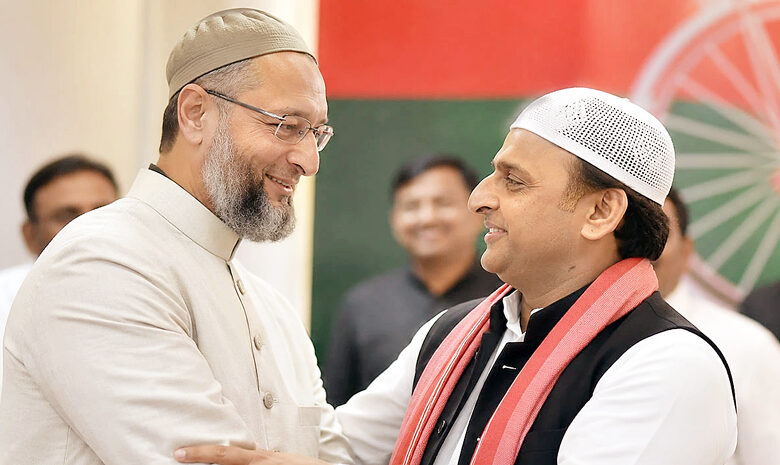
Lucknow: Uttar Pradesh’s political landscape is shifting once again. The talk of the town in political circles right now is the possibility of AIMIM chief Asaduddin Owaisi and Samajwadi Party leader Akhilesh Yadav drawing closer together. Owaisi, who has been trying to expand his party’s footprint beyond Hyderabad into the Hindi heartland — especially India’s largest state — has openly floated the idea of an alliance with Akhilesh, and in doing so has thrown the state’s old electoral arithmetic into disarray.
At a rally in Moradabad, Owaisi said his party was ready to join hands with the Samajwadi Party to stop the BJP, provided AIMIM gets its fair share. That statement was more than just a political soundbite — it was an attempt to give a new platform to the ambitions and anxieties simmering among Muslim voters in Uttar Pradesh.

The development has handed the BJP a fresh opportunity to sharpen its polarization narrative, while triggering a strategic headache within the opposition INDIA bloc. And no party within that bloc appears more unsettled than the Congress. Having struggled for several election cycles to reclaim lost ground in Uttar Pradesh, Congress now finds itself in a genuinely awkward spot as the SP and AIMIM edge closer. The question on everyone’s mind: will Akhilesh Yadav actually take Owaisi’s hand? And if he does — or even if the speculation alone persists — how will Congress respond to this new challenge?
Owaisi’s Calculated Play
Those who follow Owaisi’s politics closely know he rarely makes a move without calculation. Muslims make up roughly 19–20% of Uttar Pradesh’s population, a share large enough to swing dozens of Lok Sabha and assembly seats. That voting bloc has traditionally leaned toward the Samajwadi Party, and to a lesser extent the BSP or Congress. The message Owaisi delivered from Moradabad was unambiguous: the Muslim community, he suggested, will no longer settle for being the ones who simply turn up to help others win power — it wants a proportionate share in that power itself.
That stance puts Akhilesh Yadav in a genuine bind. If he rejects Owaisi outright, Owaisi can brand him as indifferent to Muslim interests — or as a leader who merely exploits Muslim votes without empowering the community — and use that to chip away at the minority vote. In both Bihar and Uttar Pradesh, AIMIM hasn’t necessarily won many seats itself in recent elections, but it has played a significant role in denting the prospects of secular parties.
On the other hand, if Akhilesh does align with Owaisi, it hands the BJP a ready-made narrative of “appeasement” and “pandering to hardline politics.” That, in turn, risks pushing away the non-Muslim component of SP’s PDA (Backward classes–Dalit–Minority) coalition — particularly the OBC and upper-caste voters who might otherwise have drifted from the BJP toward SP — straight back into the BJP’s camp. Akhilesh is well aware that sharing a stage with Owaisi could carry a heavy political price, one his traditional non-Muslim support base may not be willing to pay.
Congress at a Delicate Crossroads
Of all the players in this unfolding drama, Congress finds itself in the most precarious position — and the stakes go well beyond Uttar Pradesh, touching national politics and the cohesion of the INDIA bloc itself. Congress strategists are said to be grappling with three major challenges.
First, Congress has long positioned itself as the country’s natural, largest secular party, presenting itself — through its alliance with SP in Uttar Pradesh — as a protector of minority interests. If Owaisi enters this triangle, that narrative comes under direct attack. Owaisi has repeatedly accused Congress of using Muslim voters for decades without ever handing them real leadership, and this line of attack, backed by concrete facts and figures, won’t be easy for Congress to counter.
Second, Congress wants to break out of its “junior partner” role in the SP alliance and expand both its seat share and political weight in Uttar Pradesh. But any tacit or open understanding between SP and AIMIM would upend the seat-sharing math within the alliance. Owaisi is certain to stake a claim to constituencies with sizeable Muslim populations — areas like western UP and Rohilkhand — the very belt where Congress is hoping to revive its own old base. Owaisi’s entry could well come at Congress’s expense.

Third, Congress’s national strategy currently revolves around soft-Hindutva positioning, a caste census, and social justice — an effort to win over a broader section of the majority community. But if headlines are dominated by talk of an SP-AIMIM friendship in a state as significant as Uttar Pradesh, the BJP will waste no time framing the entire election as “nationalism versus appeasement.” In that kind of environment, the bread-and-butter issues Congress has been raising — unemployment, inflation, farmer distress — risk fading into the background, and Congress stands to lose the most from that shift.
Congress’s Likely Counter-Strategy
Given all this, Congress is expected to send SP leadership a clear message: for the sake of the INDIA bloc’s unity, it’s essential to keep some distance from figures like Owaisi. Congress will argue that any alliance with AIMIM could damage the opposition coalition’s image nationwide, and will remind Akhilesh that if he wants to be taken seriously as a player beyond Uttar Pradesh — in states like Madhya Pradesh, Maharashtra, or Bihar — he needs to stay aligned with Congress’s secular, inclusive national framework rather than with a party seen as representing one community or region.
Simply criticizing Owaisi, however, won’t be enough. Congress will also need to actively counter his growing appeal within the Muslim community. To that end, the party is reportedly planning direct outreach to educated Muslims, religious leaders, and young people across Uttar Pradesh, pushing the argument that only Congress — not a regional outfit — can take on the BJP at the national level. Congress plans to lean on its track record on minority welfare, education, and security, betting that pragmatic politics, not emotionally charged rhetoric, will ultimately serve the community better.
The BJP Is Watching — And Smiling
Perhaps the most striking part of this whole episode is how closely the BJP is monitoring it from the sidelines. Even the mere possibility of an Owaisi-Akhilesh friendship is, for the BJP, something of a political gift — one it will use to sharpen its core messaging. The BJP will lose no time telling voters that both SP and Congress are willing to go to any lengths for power, even if it means tacitly backing Owaisi-style politics.
The calculation, from the BJP’s point of view, works either way: if Owaisi contests separately, he splits the opposition vote; if he aligns with SP, it risks consolidating the majority vote behind the BJP. Either scenario looks like a win for the saffron party.
The Road Ahead
Uttar Pradesh’s politics has long shaped the road to power in Delhi. Owaisi’s outreach to Akhilesh Yadav, and the anxiety it has triggered within Congress, shows that the electoral battle in the state is no longer just about development or caste arithmetic — it has become a far more intricate contest of ideology, identity politics, and strategic dominance.
For Congress, this is a moment to move past complacency and make hard decisions. It needs to recognize that Uttar Pradesh’s minority voters are no longer inclined to vote purely out of “fear of the BJP” — they want political identity and dignity, and Owaisi is trying to tap directly into that sentiment. If Congress fails to check Owaisi’s rise, or fails to talk Akhilesh Yadav out of what could prove a self-defeating move, the INDIA bloc’s future in Uttar Pradesh could be at real risk. The coming days will determine whether Congress can position itself as kingmaker in this high-stakes game of political chess — or finds itself pushed to the margins of Uttar Pradesh’s politics altogether












 https://www.youtube.com/watch?si=RtToJsBhYBatUrym&v=mOuYNSdhjHA&feature=youtu.be