Lucknow: In classrooms across Lucknow and Uttar Pradesh, education is undergoing a quiet but significant transformation. The familiar blackboard is increasingly sharing space with interactive digital panels, textbooks are being supplemented by multimedia resources, and conventional rote learning is gradually giving way to experimentation, problem-solving and hands-on learning.
This transition is being driven by a combination of digital infrastructure, teacher training, innovative teaching practices and specialised skill-development programmes. Smart classrooms, Information and Communication Technology (ICT) laboratories, artificial intelligence and robotics labs, coding programmes and innovation platforms are creating an academic environment designed not merely to improve learning outcomes but also to prepare students for a rapidly changing world of work.

At the centre of this transformation are teachers.
For educators, the arrival of technology has not meant the disappearance of the traditional classroom. Instead, it has expanded the possibilities of what can happen inside it. A science lesson that once depended largely on diagrams and verbal explanations can now involve animation, simulations and interactive models. Mathematics can be taught through visual demonstrations, while coding and computational thinking can be introduced through practical exercises.
Anjali Mehra, a science teacher at a composite school in the Sarojini Nagar area, has incorporated interactive smart boards into her daily lessons. She recalls how difficult it was earlier to explain abstract concepts such as planetary movement and eclipses using only hand-drawn diagrams.
Today, students can examine three-dimensional models, simulate astronomical phenomena and interact directly with digital content. According to Mehra, the technology has also changed classroom participation. Students who were once reluctant to speak are increasingly willing to ask questions and take part in discussions.
The change, however, has brought new responsibilities for teachers. Digital teaching requires preparation, content selection and familiarity with technology. Teachers must decide which digital resources genuinely improve understanding rather than simply add visual appeal to a lesson.
The expansion of smart classrooms and digital resources under Samagra Shiksha and state-level programmes has provided schools with an increasingly sophisticated teaching environment. In areas such as Sarojini Nagar, interactive classrooms and computer facilities are supporting digital learning, library resources and laboratory-based activities.
At the secondary level, ICT laboratories are becoming important spaces for interdisciplinary learning.
Vikram Singh, a mathematics and computer instructor at a government inter college near Gomti Nagar, says the laboratory is now being used beyond conventional computer periods. Students can explore geometry through simulations, understand mathematical concepts visually and experiment with introductory coding using block-based programming platforms.
The growing use of these facilities has also highlighted an important requirement: teacher capacity.
Infrastructure alone cannot transform education unless educators are confident about using it. To address this challenge, teacher-training programmes are being conducted through a cascade model in which master trainers receive specialised training before conducting sessions for teachers at the block level.
These programmes focus on practical classroom applications, including the use of interactive digital boards, projectors, computers, digital content and student-centred teaching techniques. Demonstrations and hands-on exercises are intended to help teachers move beyond simply knowing how to operate equipment towards using technology effectively as part of pedagogy.
Another significant development is the emergence of platforms that allow teachers to share their innovations with colleagues.
The Udgam digital platform, developed by the State Council of Educational Research and Training (SCERT), is designed to create a repository of classroom ideas and successful experiments. Its Idea Bank Depository enables teachers to upload short videos, presentations and images documenting innovative approaches to teaching, assessment, sports, environmental education, health, inclusive education, vocational learning, community participation and ICT.
The concept is simple but potentially powerful: an effective idea developed by one teacher should not remain confined to one classroom.
Priya Tiwari, an upper-primary teacher from the Aliganj area, has used locally available materials to develop story-based activities for foundational literacy. After documenting the activities and sharing them through the platform, she found that teachers elsewhere were able to adapt the approach to their own classrooms.
Such peer-to-peer exchange is particularly relevant to the vision of the National Education Policy (NEP) 2020, which places emphasis on creativity, critical thinking, experiential learning and problem-solving. Instead of innovation being limited to specialised institutions or technology companies, teachers themselves become creators of educational solutions.
The transformation is also moving beyond conventional academic subjects.
One of the most ambitious initiatives is the Dream Skill Labs programme, aimed at establishing advanced laboratories in 600 government secondary schools across all 75 districts of Uttar Pradesh. The initiative, being implemented in partnership with Nelco Network Products Ltd, a Tata enterprise, is structured around a hub-and-spoke model involving 150 hub schools and 450 spoke schools.

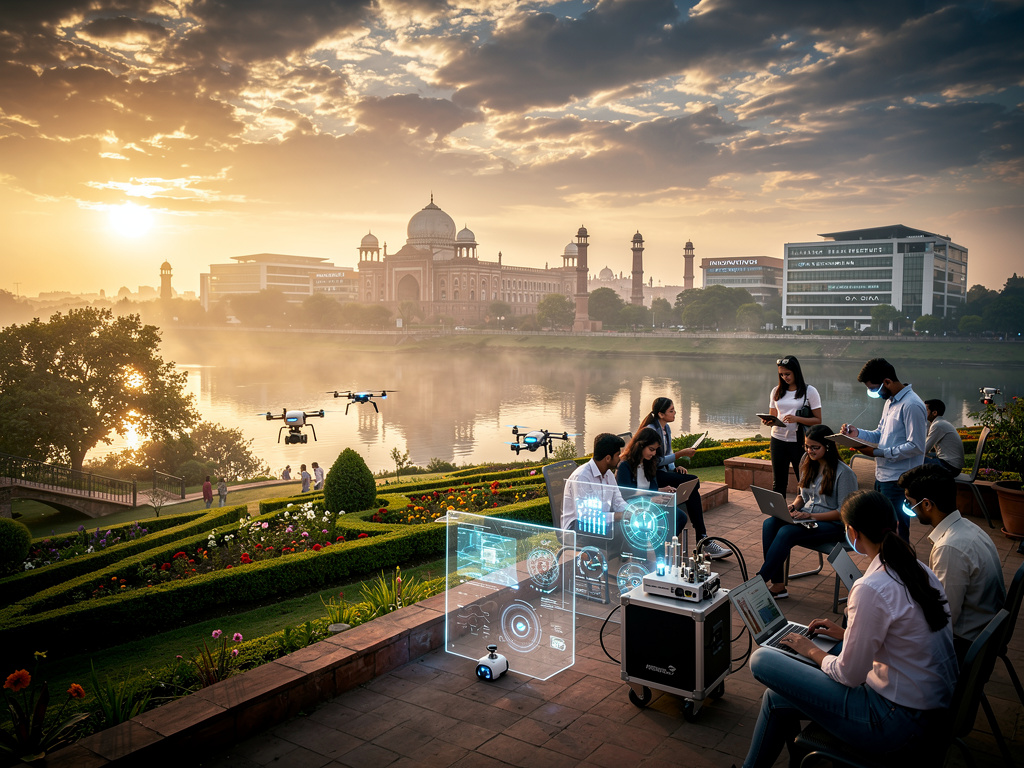
The laboratories are intended to give students in Classes 9 to 12 exposure to technologies and disciplines associated with Industry 4.0. These include artificial intelligence, robotics, Internet of Things, 3D printing, advanced manufacturing, electric vehicles, electronics, agricultural science, renewable energy, drones and design thinking.
The significance of such laboratories lies in their emphasis on learning by doing. Students can encounter technologies not simply as textbook concepts but as tools that can be explored, tested and applied.
The programme also reflects a broader change in the definition of education. Employability, innovation and technological awareness are increasingly becoming part of the school-learning ecosystem.
Teacher development is being strengthened alongside this infrastructure. SCERT, in collaboration with IIT Kanpur, is planning specialised training for teachers in areas such as digital literacy, computational thinking, coding, artificial intelligence and robotics. The programme builds upon earlier teacher-training efforts and is expected to create a wider network of educators capable of transferring these skills to colleagues and students.
Lucknow’s higher education institutions are also contributing to this emerging ecosystem.
The establishment of the Centre for Green Skills and Applied AI at the University of Lucknow, in collaboration with organisations including the 1M1B Foundation, Microsoft, MeitY Startup Hub and the state government, reflects the growing intersection between education, sustainability and emerging technology.
Such initiatives can create pathways linking classroom learning with internships, employment, entrepreneurship and innovation projects. They also provide students with opportunities to understand how technologies such as artificial intelligence can be applied to real-world challenges.
Yet technology is not being presented as a substitute for teachers.
Education officials have repeatedly stressed that the teacher remains central to the learning process. Digital tools can provide information, simulations and new methods of engagement, but they cannot replace the human relationship between teacher and student.
This distinction is important. The most successful smart classrooms are unlikely to be those with the largest number of devices. They will be those where teachers know when and how technology can improve understanding.
Challenges nevertheless remain. Some schools continue to face issues related to the functionality and maintenance of equipment, connectivity, specialised instruction and the availability of teachers with advanced technical skills. Ensuring that digital infrastructure is used regularly and meaningfully remains as important as installing it.
The experience of Lucknow suggests that smart education is ultimately not about replacing one teaching system with another. It is about expanding the educational toolkit.
Interactive boards can make abstract ideas visible. ICT laboratories can turn theoretical concepts into practical experiences. Skill labs can introduce students to technologies shaping future industries. Platforms such as Udgam can ensure that successful teaching practices travel from one classroom to another.
The emerging academic landscape is therefore defined by a combination of technology and human ingenuity.
Teachers are learning new tools while students are being encouraged to question, experiment and create. The classroom is becoming less about the one-way transmission of information and more about participation and discovery.
For Lucknow, this transformation carries significance beyond individual schools. If digital infrastructure, teacher training and grassroots innovation continue to develop together, the city can become a strong example of how government education systems can adapt to the demands of the 21st century.
The real measure of smart education, however, will not be the number of screens installed or laboratories inaugurated. It will be seen in the confidence of a student who asks a difficult question, the creativity of a child who builds a solution, and the willingness of a teacher to experiment with a better way of explaining an idea.
That is where the new era of academics is truly taking shape—in classrooms where technology opens the door, but teachers and students decide what lies beyond it.