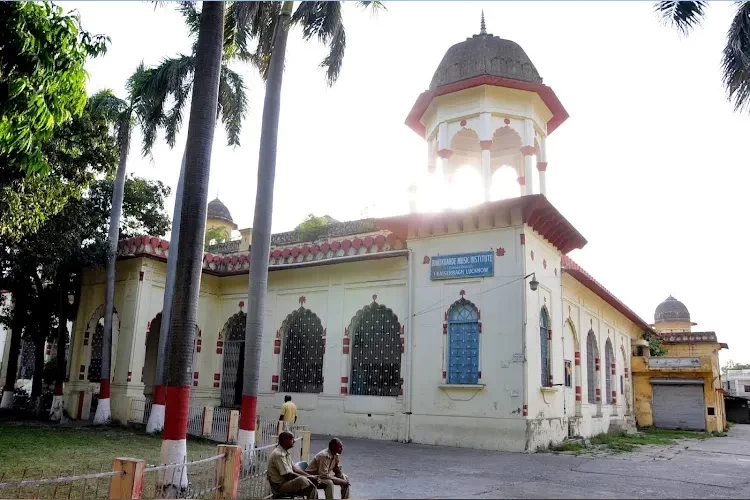
Lucknow: Every time the haunting strains of Rahein Na Rahe Hum, the soulful Jalte Hain Jiske Liye, Teri Aankhon Ke Diye, or the original rendition of Ek Chatur Naar from Jhoola (1941) fill the air, they carry with them a musical legacy that traces back to an unassuming institution tucked away in Lucknow’s Kaiserbagh. Marris College—today known as Bhatkhande Sanskriti Vishwavidyalaya—played a pivotal role in shaping the golden era of Bombay cinema, nurturing some of the greatest composers, singers and performers in Indian film history.
As the institution celebrates its centenary, its contribution to Indian cinema stands as one of Lucknow’s most remarkable cultural achievements. Marris College became a launchpad for extraordinary talent at a time when India’s talkie era was just beginning, offering structured music education that was revolutionary for its time.

The college’s influence reached Bombay in the early 1930s when filmmaker Himanshu Rai selected Khorshed Minocher Homji, later celebrated as Saraswati Devi, to head the music department at Bombay Talkies. She was among India’s earliest female music directors and composed memorable scores for films such as Achhut Kanya and Jawani Ki Hawa. Her work laid the foundation for enduring classics including Koi Humdum Na Raha and the original Ek Chatur Naar.
Joining her was S.N. Tripathi, who began as her assistant and violinist before establishing himself as one of Hindi cinema’s finest composers of mythological and historical films. His music enriched productions such as Lal Qila, Rani Roopmati and Sangeet Samrat Tansen, creating a distinctive orchestral style rooted in Indian classical traditions.
Another illustrious alumnus, Roshan, refined his musical skills under Pandit S.N. Ratanjankar at Marris College before training with Ustad Allauddin Khan. After working with All India Radio in Delhi, he entered films and composed unforgettable melodies for more than 60 movies, including immortal qawwalis such as Na To Karvan Ki Talaash Hai.
The institution also produced Pandit Raghunath Seth, whose mastery of classical music led him to compose scores for nearly 2,000 documentaries and several acclaimed films, including Phir Bhi, Kissa Kursi Ka, Damul and Mrityudand.

Marris College’s legacy extended equally to playback singing. Talat Mahmood, whose velvety voice became synonymous with romance and melancholy, trained at the college before launching a legendary career that saw him record over 750 songs in 12 languages. His classics such as Sham-e-Gham Ki Kasam continue to enchant listeners decades later.
Actor-singer Pahadi Sanyal emerged as another distinguished alumnus, excelling in both Hindi and Bengali cinema while remaining closely connected to Lucknow’s cultural traditions. The college also nurtured celebrated performers including Dilraj Kaur, Anup Jalota, Krishna Kalle, and Rajendra Mehta, each carrying forward its tradition of classical excellence into playback singing, devotional music, ghazals and regional cinema.
Beyond music, Marris College also influenced Indian cinema through its acting talent. Swaran Lata and Yashodhara Katju trained at the institution before embarking on successful film careers. Though not alumni, legendary composer Madan Mohan and broadcaster Kabban Mirza also shared strong creative ties with Lucknow through All India Radio, further strengthening the city’s contribution to Hindi film music.
The success of Marris College lay in its pioneering vision. At a time when music was largely passed down through the traditional guru-shishya system, the institution offered formal academic training under renowned maestros such as Pandit S.N. Ratanjankar. This unique blend of rigorous classical education and artistic freedom attracted students from across the subcontinent and helped shape the soundscape of Indian cinema.
A century later, the classrooms of Marris College continue to echo through the melodies of Bollywood’s golden age, reminding music lovers that some of India’s most unforgettable songs were born from the rich cultural soil of Lucknow.