Thiruvananthapuram | The 2026 Kerala Legislative Assembly election has delivered a decisive and politically significant verdict, bringing the Congress-led United Democratic Front (UDF) back to power after a decade in opposition. Held in a single phase on April 9, with results declared on May 4, the election marked the end of two consecutive terms of the Left Democratic Front (LDF) government led by Chief Minister Pinarayi Vijayan.
With a commanding majority in the 140-member Kerala Niyamasabha, the UDF’s victory reaffirms the state’s long-standing pattern of alternating governments, while also introducing new dynamics with the Bharatiya Janata Party (BJP)-led National Democratic Alliance (NDA) making modest but notable gains.

Electoral Context: A Decade of LDF Rule Meets Anti-Incumbency
The backdrop to the 2026 election was the LDF’s strong performance in 2021, when it secured 99 seats—an unprecedented consecutive victory in a state known for political alternation. That win had raised expectations of a possible third straight term under Pinarayi Vijayan, often framed as “LDF 3.0.”
However, ten years in power brought with it mounting anti-incumbency. While the LDF highlighted achievements in infrastructure, welfare delivery, and crisis management, critics pointed to governance fatigue, unemployment concerns, and dissatisfaction among sections of voters.
Kerala’s political culture—deeply competitive and ideologically vibrant—has historically resisted prolonged one-sided dominance. The 2026 results ultimately aligned with this pattern, restoring the UDF to power.
Election Schedule and Voter Participation
The election process began with the notification issued by the Election Commission of India on March 16, 2026. Nominations closed on March 23, followed by a single-phase polling on April 9 across all 140 constituencies. Counting took place on May 4.
Kerala recorded one of its highest voter turnouts in recent elections, with participation ranging between 78% and nearly 80%. Of the over 2.7 crore registered voters, women accounted for nearly half, and their strong turnout was widely noted as a defining feature of the election.
The high participation reflected intense public engagement and a clear desire for political change.
Results: A Clear and Decisive Mandate
The final tally delivered a sweeping victory for the UDF:
- UDF: 102 seats (majority mark: 71)
- LDF: 35 seats
- NDA: 3 seats
- Others/Independents: Minimal presence
Within the alliances:
- Indian National Congress emerged as the single largest party with 63 seats
- Indian Union Muslim League secured 22 seats
- On the LDF side, Communist Party of India (Marxist) won 26 seats, while Communist Party of India managed 8 seats
- The Bharatiya Janata Party won 3 seats, marking a modest but symbolically important breakthrough
The scale of the UDF’s gains—an increase of over 60 seats compared to 2021—underscored the depth of anti-incumbency sentiment.
Key Outcomes and Highlights
UDF’s Resurgence
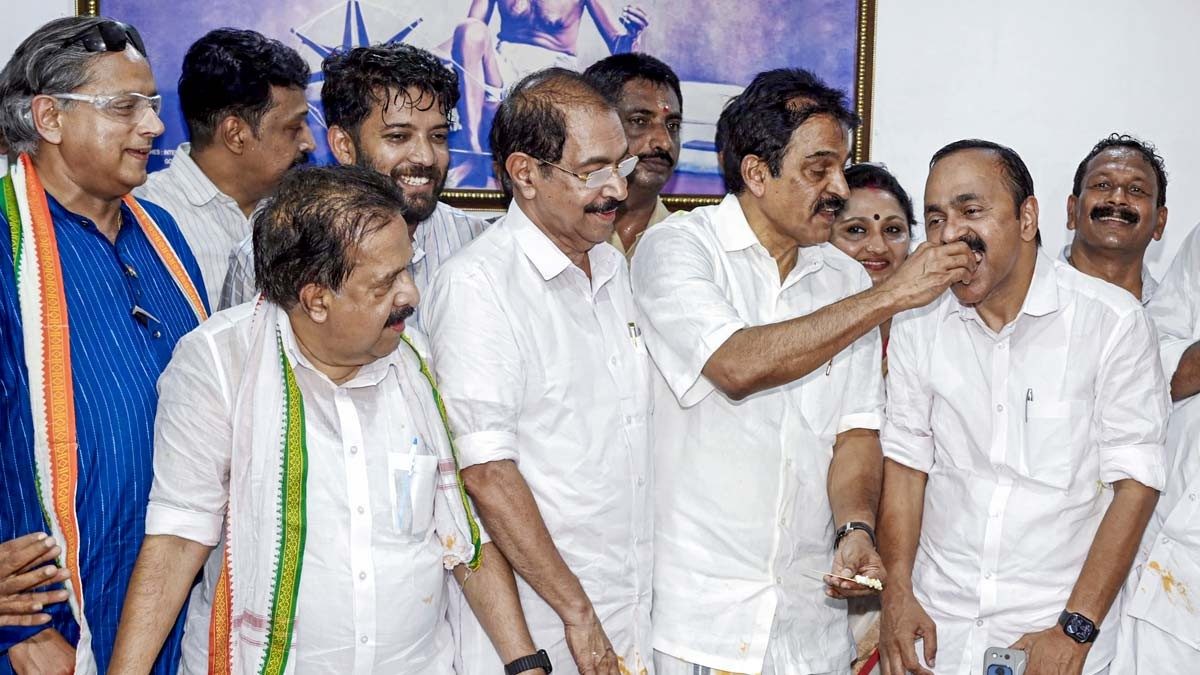
The UDF’s return to power was comprehensive, with strong performances across regions. It regained ground in central Kerala and made significant inroads in northern districts, including sweeping results in areas like Wayanad.
Leaders such as V. D. Satheesan, who played a central role in shaping the campaign narrative, emerged as key figures in the alliance’s revival.
LDF’s Setback
The LDF suffered heavy losses, including in traditional strongholds such as parts of Kannur. Anti-incumbency, combined with local-level dissatisfaction and internal challenges, contributed to the sharp decline from 99 seats in 2021 to just 35 in 2026.
A striking feature of the results was the defeat of several sitting ministers. Around 13 members of the outgoing cabinet reportedly lost their seats, including prominent figures like Health Minister Veena George and others.
Chief Minister Pinarayi Vijayan retained his Dharmadam constituency, though with a reduced margin—reflecting broader electoral headwinds.

NDA’s Limited but Notable Gains
The BJP-led NDA secured 3 seats, marking its first meaningful foothold in Kerala’s Assembly. One of the most high-profile victories came from Rajeev Chandrasekhar, who won the Nemom constituency.
While the numbers remain small, the result indicates a gradual expansion of the NDA’s vote base in a state traditionally dominated by two fronts.
Campaign Narratives: Competing Visions
LDF: Continuity and Development
The LDF campaigned on its governance record, emphasizing infrastructure projects, welfare pensions, and the “Nava Kerala” vision. Its slogan—“Who else but LDF?”—aimed to project stability and continuity.
UDF: Change and Relief
The UDF focused on anti-incumbency and economic concerns. It promised expanded welfare measures, including pension reforms, youth support programs, healthcare improvements, and free bus travel for women. The campaign also drew on broader national messaging linked to social guarantees.
NDA: Entry and Expansion
The NDA positioned itself as an alternative to both fronts, highlighting development, women’s empowerment, and central government schemes. Prime Ministerial outreach and targeted campaigning helped improve its visibility, even if seat gains remained limited.
Why the UDF Won
Several factors contributed to the UDF’s decisive victory:
- Anti-Incumbency: Ten years in power created fatigue, particularly at the local level
- Unified Campaign: The UDF presented a cohesive narrative centered on change and economic relief
- Leadership Strategy: Effective coordination between state and national leadership strengthened outreach
- Voter Turnout: High participation, especially among women, worked in favor of the opposition
- Localized Factors: Constituency-level issues and candidate selection played a significant role
Broader Significance
The 2026 verdict carries wider political implications:
Restoration of Alternation
Kerala’s traditional pattern of alternating between the UDF and LDF has reasserted itself, reinforcing the competitive balance in the state.
Congress Revival
For the Indian National Congress, the victory represents a major boost in a southern state, offering momentum amid broader national challenges.
Emergence of a Third Pole
The NDA’s modest gains suggest the gradual evolution of a three-cornered contest, potentially reshaping future electoral dynamics.
Voter Engagement
The high turnout reflects a politically aware electorate actively shaping governance outcomes.
The Road Ahead
With the results declared, attention has shifted to government formation. The UDF is expected to form the next government, with leadership discussions underway. Figures like V. D. Satheesan are widely seen as central to the new administration’s direction.
The incoming government faces key challenges:
- Managing fiscal pressures and welfare commitments
- Addressing unemployment and youth aspirations
- Strengthening healthcare and education systems
- Balancing development with environmental concerns
The 2026 Kerala Assembly election marks a decisive political shift—ending the LDF’s decade-long rule and restoring the UDF to power with a strong mandate. It reflects both continuity and change: continuity in Kerala’s alternating political rhythm, and change in the evolving dynamics of voter expectations and party competition.
As the new government prepares to take office, the message from the electorate is clear—performance, accountability, and responsiveness will define political success in the years ahead.












 https://www.youtube.com/watch?si=RtToJsBhYBatUrym&v=mOuYNSdhjHA&feature=youtu.be