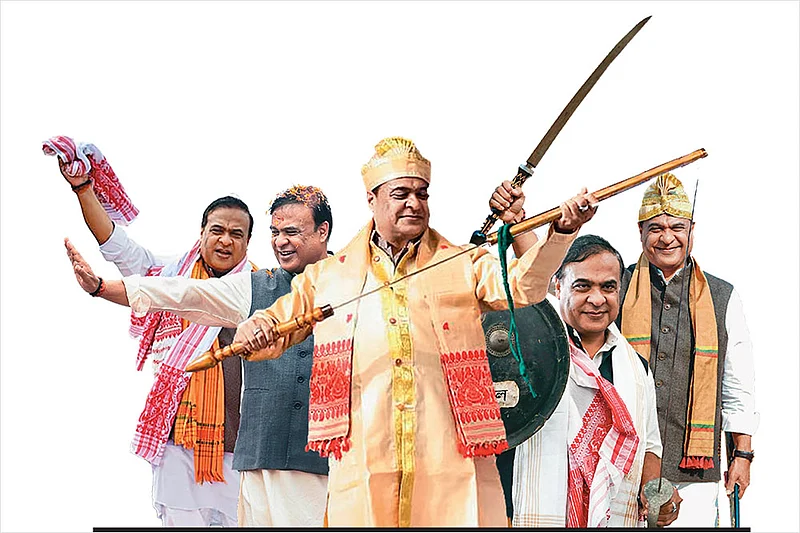
Guwahati |The 2026 Assam Legislative Assembly elections have delivered a decisive and historic mandate, reaffirming the political dominance of the Bharatiya Janata Party (BJP)-led National Democratic Alliance (NDA) in the state. Held on April 9 with results declared on May 4, the elections saw the NDA secure a resounding third consecutive term—an achievement widely described as a “hat-trick with a century.”
Led by Chief Minister Himanta Biswa Sarma, the alliance’s emphatic victory cements its hold over Assam’s political landscape, marking a significant consolidation of power since its initial breakthrough in 2016.

A Shift from Congress Dominance to NDA Consolidation
Assam’s 126-member Assembly has witnessed dramatic political shifts over the decades. For much of the post-independence period, the Indian National Congress dominated the state’s politics. This changed in 2016, when the Bharatiya Janata Party, in alliance with regional partners, came to power under Sarbananda Sonowal.
The 2021 elections saw the NDA retain power with a comfortable majority, after which Himanta Biswa Sarma took over as Chief Minister. The 2026 elections have now taken this trajectory further, making it the first time a non-Congress alliance has secured three consecutive terms in Assam.
Election Process and Voter Participation
The elections were conducted in a single phase across all 126 constituencies on April 9, following the notification issued by the Election Commission of India on March 16. With over 2.49 crore registered voters—including a near-equal gender split—the polls witnessed a remarkable turnout of 85.96%, significantly higher than in previous elections.
This surge in participation, particularly among women voters, was seen as a key factor in shaping the outcome. The high turnout also underscored strong voter engagement in a politically vibrant and diverse state.
Alliances and Political Contest
The NDA alliance comprised:
- Bharatiya Janata Party (BJP)
- Asom Gana Parishad (AGP)
- Bodoland People’s Front (BPF)
On the other side, the opposition landscape remained fragmented. The Congress-led alliance, known as the Asom Sonmilito Morcha, included parties like Raijor Dal and Assam Jatiya Parishad. Other players such as the All India United Democratic Front (AIUDF), Aam Aadmi Party (AAP), and All India Trinamool Congress contested independently, further dividing the anti-incumbent vote.
Key Issues That Defined the Campaign
The 2026 elections were fought on a mix of identity politics, development narratives, and welfare promises.
Identity and Immigration
Issues surrounding illegal immigration, the National Register of Citizens (NRC), and the Citizenship Amendment Act (CAA) remained central. The NDA highlighted measures such as eviction drives on encroached land, protection of indigenous rights, and efforts to curb social issues like child marriage.
Development and Governance
The ruling alliance emphasized infrastructure growth, economic development, and governance stability. Chief Minister Himanta Biswa Sarma projected a vision of a modernizing Assam with improved connectivity, investment, and administrative efficiency.
Welfare and Social Outreach
Schemes like Orunodoi Scheme, which provides financial assistance to women, played a crucial role in building grassroots support. Promises around healthcare expansion, employment opportunities, and empowerment of marginalized communities also featured prominently.
The opposition, meanwhile, focused on issues such as unemployment, alleged displacement due to eviction drives, and concerns over inequality and minority rights.
Results: NDA’s Overwhelming Mandate
The results delivered a clear and emphatic verdict:
- BJP: 82 seats
- AGP: 10 seats
- BPF: 10 seats
- Total NDA: ~102 seats
In contrast:

- Congress: 19 seats
- Raijor Dal: 2 seats
- AIUDF: around 2 seats
- Others: Marginal presence
The NDA comfortably crossed the majority mark of 64, securing a commanding position in the Assembly. BJP’s vote share hovered around 37–38%, while the Congress trailed at approximately 29%.
Chief Minister Himanta Biswa Sarma retained his Jalukbari seat with a massive margin, underscoring his personal popularity. Several senior leaders also held onto their constituencies, while prominent opposition figures—including Gaurav Gogoi—faced defeats.
Factors Behind the NDA’s Success
Strong Leadership and Organization
Himanta Biswa Sarma’s leadership, combined with BJP’s robust organizational machinery, played a decisive role. Effective booth-level management ensured voter mobilization across regions.
Impact of Delimitation
The 2023 delimitation exercise reshaped constituency boundaries, influencing electoral demographics in regions like Barak Valley and Lower Assam—an advantage analysts say benefited the ruling alliance.
Opposition Fragmentation
The lack of a united opposition diluted anti-incumbency sentiment. Multiple parties competing for similar voter bases weakened the Congress-led alliance.
Welfare and Women Voters
Targeted welfare schemes, particularly those benefiting women, significantly boosted voter support, reflected in the high turnout among female voters.
Narrative of Stability
The NDA successfully positioned itself as a guarantor of stability, development, and security—key concerns in a state with a history of ethnic tensions and migration issues.
Broader Significance
The 2026 verdict has implications beyond Assam:
- It reinforces the BJP’s expanding footprint in the Northeast
- It strengthens the NDA’s national political standing
- It signals voter preference for continuity and governance delivery
The results also highlight a broader shift in Assam’s political evolution—from Congress dominance to a more consolidated, BJP-led order aligned with national political trends.
Challenges Ahead
Despite the sweeping victory, the government faces significant challenges:
- Flood Management: Annual floods continue to disrupt livelihoods
- Unemployment: Job creation, especially for youth, remains critical
- Ethnic and Social Harmony: Balancing identity concerns with inclusive growth
- Economic Diversification: Moving beyond traditional sectors like tea and oil
Addressing these issues will be crucial for sustaining public trust over the next five years.
A Defining Moment in Assam’s Political Journey
The 2026 Assembly elections mark a defining chapter in Assam’s democratic evolution. The NDA’s third consecutive victory represents not just electoral success, but a consolidation of a new political era in the state.
For Chief Minister Himanta Biswa Sarma and his alliance, the mandate offers both an opportunity and a responsibility—to translate political dominance into long-term development and stability.
As Assam moves forward, the focus will now shift from electoral triumph to governance delivery. The scale of the victory sets high expectations, and the coming years will determine whether this “hat-trick” becomes a lasting legacy in the state’s political history.