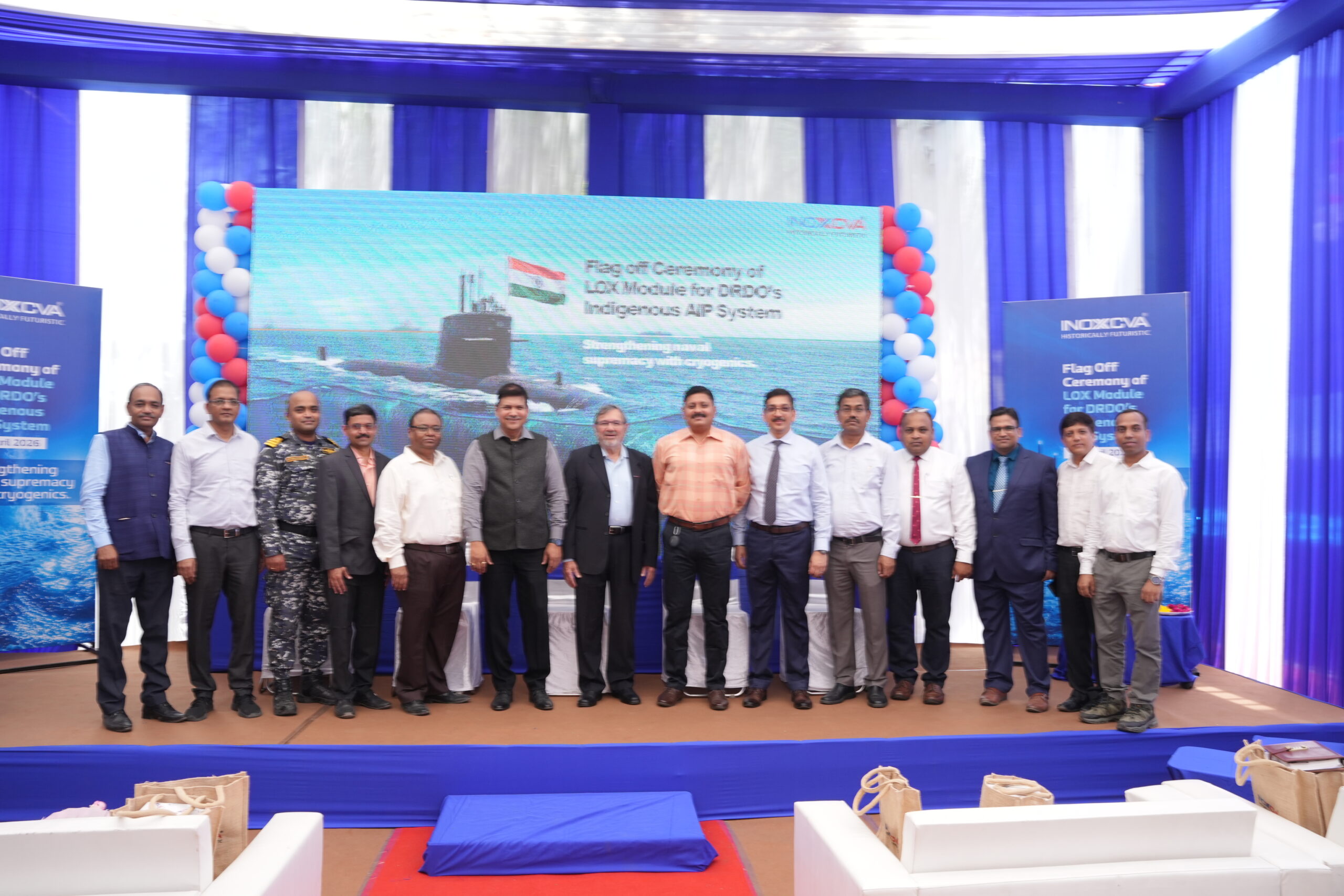
New Delhi: In a major boost to India’s indigenous defence capabilities, INOX India Ltd (INOXCVA) has flagged off a first-of-its-kind simulated Liquid Oxygen (LOX) storage module designed for the Indian Navy’s Air Independent Propulsion (AIP) system. The development marks a significant step toward improving the endurance and stealth of India’s conventional submarine fleet.
The module, dispatched from INOXCVA’s facility in Kalol, Gujarat, has been developed to support submarines in remaining submerged for longer durations without the need to surface—an operational advantage that enhances stealth and survivability during missions.

The AIP programme is being led by the Naval Material Research Laboratory (NMRL), a key laboratory under the Defence Research and Development Organisation (DRDO), based in Ambernath, Maharashtra. The newly developed module will now undergo Factory Acceptance Tests as part of the ongoing validation process.
Engineered to store oxygen in liquid form at extremely low temperatures, the cryogenic LOX tank meets stringent defence-grade standards for safety, purity, and reliability. Its integration into the AIP system is expected to significantly extend underwater endurance, allowing submarines to operate more discreetly over extended periods.
The module was formally flagged off by NMRL Director Dr Suman Roy Choudhury and INOXCVA CEO Deepak Acharya. The company’s role in the project spans design, engineering, fabrication, and testing of the specialised system.

Speaking on the occasion, Acharya highlighted the milestone as a reflection of INOXCVA’s commitment to delivering mission-critical, high-precision engineering solutions. He underscored the importance of the AIP programme in strengthening India’s maritime defence capabilities and expressed pride in contributing advanced cryogenic expertise to the initiative.
The AIP project is widely regarded as a cornerstone in enhancing the operational effectiveness of the Indian Navy. By integrating cutting-edge cryogenic technology, the Navy is expected to gain a strategic advantage in underwater endurance and stealth—key factors in maintaining a strong deterrence posture in the Indo-Pacific region.
This development reinforces India’s push towards self-reliance in defence technology, aligning with broader efforts to modernise its submarine fleet with advanced indigenous systems.