New Delhi: Prime Minister Narendra Modi’s two-day visit to Uzbekistan has highlighted India’s growing strategic engagement with Central Asia, with energy security, trade, defence cooperation, connectivity and cultural ties emerging as key areas of focus.
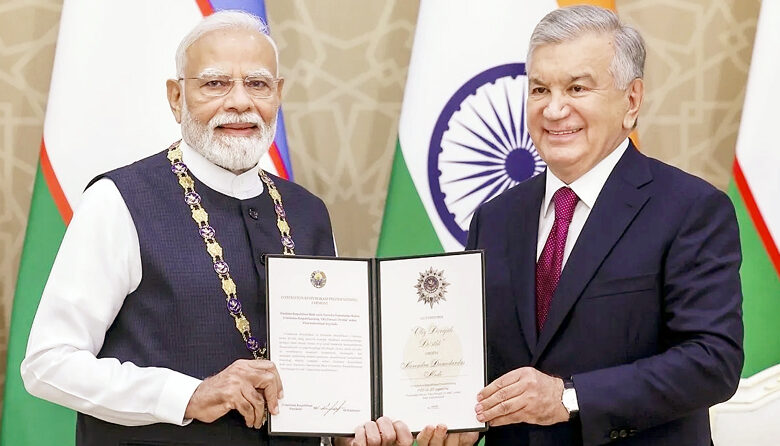
The visit was marked by a significant diplomatic gesture when Uzbekistan President Shavkat Mirziyoyev conferred the country’s highest civilian honour, the Order of Friendship, on Prime Minister Modi. The recognition underlined the deepening relationship between the two countries and reflected Uzbekistan’s growing importance in India’s broader Eurasian strategy.

Beyond the symbolism of the honour, the visit produced several developments with potential long-term implications for India’s strategic and economic interests.
Uranium Supply and Energy Security
One of the most significant areas of cooperation is the long-term supply of uranium from Uzbekistan. As India seeks to expand nuclear power while reducing its dependence on fossil fuels, securing reliable sources of nuclear fuel has become an important component of its energy strategy.
Uzbekistan is among the world’s major uranium-producing nations. Strengthening arrangements for uranium supplies could therefore help India diversify its nuclear fuel sources and reinforce long-term energy security.
The two countries also elevated their bilateral relationship to a comprehensive strategic partnership, accompanied by an ambitious target of taking bilateral trade to $5 billion by 2030. Trade between the two countries has already crossed the $1 billion mark, while the number of joint ventures has reportedly increased substantially in recent years.
New Tashkent and India’s Technology Partnership
India has also expressed its willingness to share expertise in technology, urban planning and digital infrastructure as Uzbekistan develops its New Tashkent project.
Indian experience with large-scale urban and technology-driven developments, including Gujarat’s GIFT City, could provide areas for potential cooperation in planning, digital systems and modern infrastructure.
The emphasis reflects an effort to move India-Uzbekistan relations beyond conventional diplomatic agreements towards practical economic and technological collaboration.
Defence and Security Cooperation
Defence cooperation was another important element of the engagement. The two sides have agreed to encourage their defence industries to explore opportunities for co-development and joint production.
India and Uzbekistan also share concerns over terrorism, extremism and separatist violence. Greater security cooperation between the two countries could contribute to regional stability while strengthening India’s presence in a strategically important part of Eurasia.
The two countries also signed agreements covering areas such as digital payments, healthcare, education and Ayurveda.
India further announced a $1 million grant for environmental rehabilitation efforts in the Aral Sea region, signalling an interest in supporting sustainable development alongside economic engagement.
Cultural Diplomacy
Cultural cooperation featured prominently during the visit. The establishment of an ICCR Sanskrit Chair at Tashkent State University of Oriental Studies and initiatives related to the preservation of ancient Buddhist heritage are aimed at strengthening the historical and civilisational links between India and Central Asia.
Prime Minister Modi also linked the Uzbek honour to the people of India and the long-standing historical relationship between the two societies, reinforcing the cultural dimension of the partnership.

Connectivity Remains a Major Challenge
Despite the progress, India’s ambitions in Central Asia continue to face significant logistical and geopolitical constraints.
India does not have direct overland access to Central Asia through Pakistan, making alternative routes essential for expanding trade. The Chabahar Port in Iran and the International North-South Transport Corridor are therefore important components of India’s connectivity strategy.
Critics have argued that delays in developing these routes could make ambitious trade targets more difficult to achieve. Faster progress on transport corridors, they contend, will be essential if India is to significantly expand commercial engagement with Uzbekistan and other Central Asian economies.
Domestic Political Debate
The Uzbekistan visit also generated political debate within India. While opposition parties welcomed the Uzbek government’s decision to confer its highest civilian honour on Prime Minister Modi, some questioned the extent to which the recognition should be portrayed as an unprecedented diplomatic achievement.
Critics argued that India’s prime ministers have historically received high civilian honours from foreign governments and said greater emphasis should be placed on the practical outcomes of foreign-policy initiatives.
Some opposition voices also raised questions about India’s connectivity challenges and the pace of major regional infrastructure projects.
Tashkent also carries a special historical significance for India because former Prime Minister Lal Bahadur Shastri died there in January 1966, shortly after the signing of the Tashkent Declaration. The unresolved questions surrounding his death continue to attract public and political discussion in India.
Some critics argued that the visit could have addressed the historical issue more prominently, while others focused on broader questions about India’s foreign-policy positioning.
Balancing China’s Influence
India’s growing engagement with Central Asia is also taking place against the backdrop of China’s substantial economic presence in the region. Beijing has invested heavily in infrastructure, trade and connectivity across Central Asian countries.
Strategic observers therefore see India’s challenge as going beyond diplomatic outreach. To build a durable regional presence, India will need competitive trade arrangements, reliable connectivity, investment and long-term economic partnerships.
India’s approach has increasingly emphasised strategic autonomy, allowing it to cooperate with different global and regional powers while prioritising its own national interests.
A Significant Step, but Implementation Will Matter
The Uzbekistan visit represents an important step in India’s effort to deepen its presence in Central Asia. Uranium cooperation, the $5 billion trade ambition, defence-industry collaboration, connectivity initiatives and cultural partnerships provide a broad framework for closer relations.
However, the success of these initiatives will ultimately depend on implementation. Faster execution of connectivity projects, stronger commercial engagement and sustained investment will be critical to translating diplomatic commitments into tangible economic and strategic gains.
For India, Uzbekistan is more than a bilateral partner. Its geographic position, natural resources and historical links with the wider region make it an important gateway to Central Asia. The latest engagement signals New Delhi’s determination to strengthen that relationship while pursuing a wider strategic role across the Eurasian region.