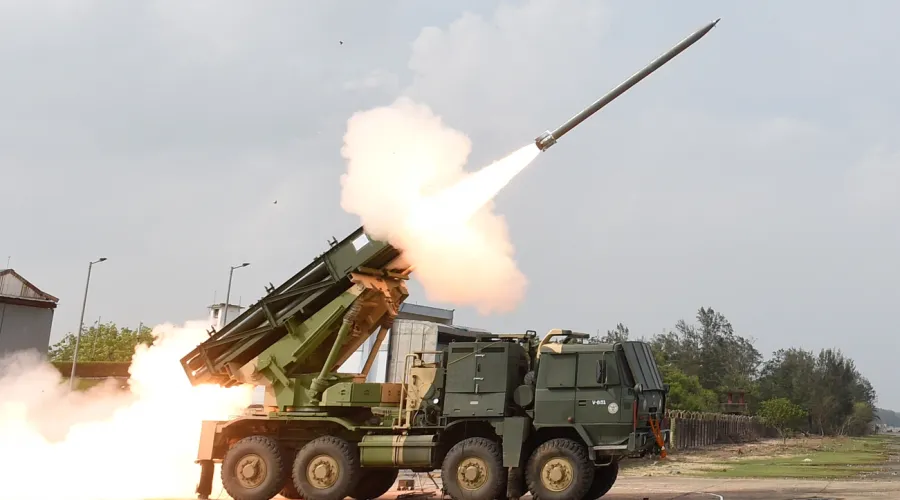
Cairo / New Delhi: Egypt is reportedly evaluating India’s Pinaka Multi-Barrel Rocket Launcher system, developed by the Defence Research and Development Organisation (DRDO), as it looks to upgrade its military capabilities. For Cairo, the system offers an appealing mix of affordability, precision, and battlefield flexibility that fits well with where the Egyptian armed forces want to go.
The move fits into a broader pattern for Egypt, which has spent the past decade actively diversifying its defence partnerships rather than depending heavily on a handful of traditional suppliers. That shift has largely been driven by a desire to protect strategic autonomy in the face of shifting global politics, potential sanctions, or sudden export restrictions. In that context, India’s expanding defence manufacturing base has become an increasingly attractive option — a non-aligned supplier offering advanced hardware without the political conditions that often come attached to deals with Western or Russian suppliers.

Cost is one of the clearest draws. Precision-guided artillery has become essential in modern warfare, but Western systems can be prohibitively expensive to acquire and maintain. A single guided rocket for the American HIMARS system, for instance, typically costs between $150,000 and $200,000. India’s Guided Pinaka rocket, by comparison, comes in at around ₹70 lakh — roughly $84,000. For a country like Egypt, which needs large rocket stockpiles for territorial defence, that price gap adds up to substantial savings without compromising on high-volume operational capacity.
Beyond cost, Egypt appears interested in moving away from older “dumb” rockets — which simply saturate an area — toward smarter, precision-guided munitions capable of hitting specific high-value targets. The Pinaka system offers serious firepower on its own: a single launcher can fire 12 rockets in just 44 seconds. The Guided Pinaka variant achieves its accuracy through an integrated Inertial Navigation System combined with GPS and India’s own NavIC satellite network for terminal guidance, allowing commanders to strike targets like enemy command posts, radar sites, and logistics hubs with fewer rockets and less collateral damage.
Range is another strong point. The extended-range Pinaka rockets can hit targets 45 to 60 km away, while the Guided Pinaka reaches out to 75-80 km. India has also developed a Long-Range Guided Rocket (LRGR) variant capable of striking targets at 120 km, which cleared key trials as recently as July 2026 — giving military planners the flexibility to use the system for both close tactical support and deeper strikes on enemy infrastructure, depending on the mission.

Egypt is also said to value the Pinaka’s modular design. Unlike some competing systems that need entirely different launcher platforms for different rocket types, a standard Pinaka launcher can fire its full range of rocket variants without major modification — simplifying maintenance, reducing spare-parts requirements, easing crew training, and lowering long-term operating costs.
India’s standing as a defence exporter has grown considerably in recent years, helped in part by Armenia’s induction of the Pinaka system — the rocket’s first major export success. Egyptian officials are believed to be watching closely how the system performs in that real-world deployment, since proven operational track records tend to build confidence among prospective buyers.
This evaluation is also part of a wider defence relationship taking shape between India and Egypt. Cairo has previously looked at India’s Akash surface-to-air missile system for air defence, as well as the BrahMos supersonic cruise missile for coastal and maritime security. Should these deals move forward, they could form the basis of a broader, longer-term strategic partnership between the two countries — one that extends into industrial cooperation and technology sharing.