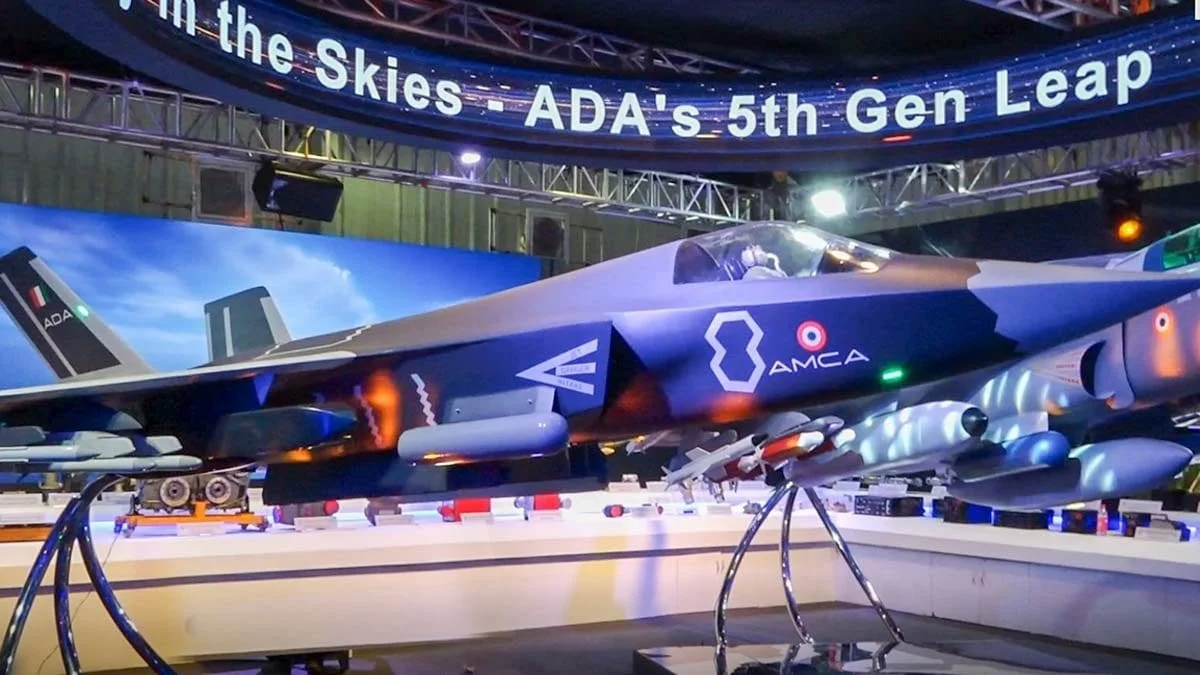
Mumbai: India’s aerospace sector is undergoing a significant shift, with the government handing over production of the Advanced Medium Combat Aircraft (AMCA) — the country’s upcoming 25-tonne fifth-generation stealth fighter — to a private-sector-led industry consortium.
Beyond fulfilling the Indian Air Force’s requirements, this newly appointed group has also been officially cleared to market and export the jet internationally, a notable departure from how India has traditionally approached defence manufacturing.

For decades, India’s defence production has prioritised domestic military needs above all else, with export ambitions treated as a secondary concern at best. By putting private companies in charge of building, maintaining, and promoting the AMCA on the world stage, New Delhi is signalling a clear intent: this fighter jet is meant to be globally competitive from the very start.
A Strategy Built With Exports in Mind
Back in March 2024, the Cabinet Committee on Security cleared ₹15,803 crore for developing AMCA prototypes. The inclusion of major private players like Tata Advanced Systems, Larsen & Toubro (L&T), and Bharat Forge substantially changes the programme’s financial trajectory and business outlook.
Unlike state-run manufacturing units, these private firms already come with established global business networks, extensive international supply chains, and dedicated marketing capabilities — resources that could prove far more effective in chasing overseas contracts.
Handing this responsibility to the private sector also breaks from the long-standing dominance of state-owned Hindustan Aeronautics Limited (HAL). By setting up an independent production line, the consortium won’t be tied to HAL’s existing order backlog, allowing them to offer foreign buyers faster, more reliable delivery timelines — without having to wait until the IAF’s own requirements are fully met.
A Crowded Global Market
Still, cracking the international fighter jet market won’t be straightforward. By the time the AMCA reaches full-scale production around 2035, it will be entering a highly competitive field, going up against established and emerging platforms like America’s Lockheed Martin F-35, South Korea’s KF-21 Boramae, Turkey’s KAAN, and possible Chinese fifth-generation exports.
To stand out against these well-entrenched rivals, the AMCA will need more than advanced stealth capability — it will have to prove it’s affordable and easy to maintain, backed by a dependable supply chain and consistent production output.

The Engine Question
The engine remains one of the most critical factors in determining the AMCA’s export prospects. The initial Mk-1 variant will run on the American-made GE F414 engine — a reliable choice, but one that comes with a catch: any country looking to import the jet would first need approval from Washington under US export regulations.
To get around this dependency, the upgraded AMCA Mk-2 is set to feature a new engine developed jointly by France’s Safran and India’s Gas Turbine Research Establishment (GTRE). Should India successfully develop this indigenous engine, it would gain full independent control over export decisions, free from external approval hurdles.
Price Could Be the Real Advantage
According to experts, cost may end up being the AMCA’s strongest selling point. If the consortium can manufacture this twin-engine stealth fighter more affordably than its Western counterparts, India could carve out a distinct niche in the global market.
That affordability could make the aircraft especially attractive to countries seeking next-generation air power but unable to access American or European jets due to steep costs or political restrictions. Likely markets include Southeast Asian nations looking to modernise their fleets and diversify defence partnerships, as well as countries across the Middle East, Africa, and Latin America that already maintain strategic ties with India — provided the aircraft delivers on performance and remains reasonably priced.
Racing Against the Clock
At the end of the day, no amount of marketing will matter if the jet isn’t delivered on schedule. The AMCA programme is targeting a prototype rollout between 2028 and 2029, with its first flight and eventual induction into the IAF expected by 2034.
Hitting these timelines will be crucial, since foreign militaries are generally reluctant to invest in an aircraft that hasn’t already proven itself in active service back home.
By putting private industry at the helm of both building and selling the AMCA, the Indian government is charting a new course for the country’s defence aerospace sector — one where the goal isn’t just replacing ageing jets, but building a genuine contender in the global arms market.