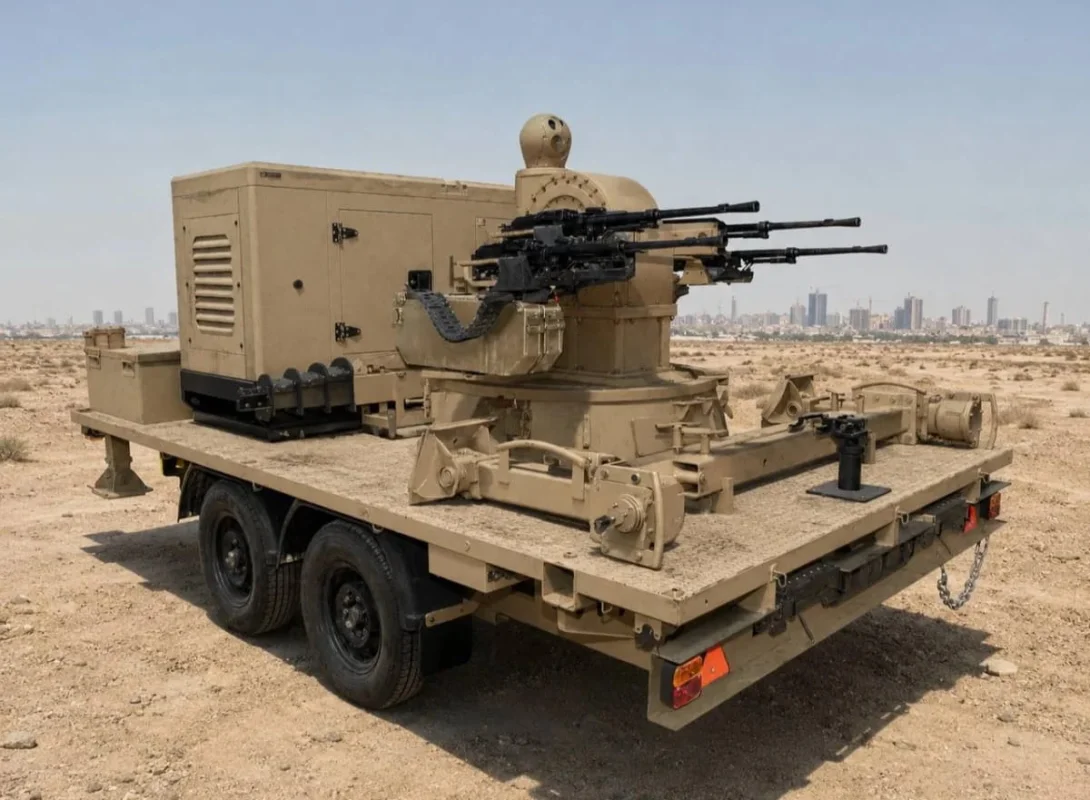
New Delhi: Russian state-owned defence conglomerate Rostec has reportedly offered its TKB-1167 ‘Bizon’ anti-drone system to the Indian Army, pitching the platform as a potential solution to the growing threat posed by small, low-flying unmanned aerial vehicles (UAVs).
Designed to intercept agile aerial targets that can evade conventional air-defence systems, the Bizon combines high-volume machine-gun fire with automated target tracking and specialised ammunition intended to improve interception accuracy and reduce ammunition consumption.

The system’s combat module features four 7.62mm PKT machine guns with a reported combined rate of fire of up to 3,200 rounds per minute. It also uses ammunition fitted with remotely controlled fuzes, designed to detonate near a target and disperse shrapnel to increase the likelihood of destroying an incoming drone.
Automated Detection and Tracking
A key feature of the TKB-1167 is its automated architecture, which is designed to detect, identify and track aerial threats before transmitting targeting information to the weapon mounts. The operator retains responsibility for authorising engagement, while onboard computing systems handle complex tracking functions.
This approach could help reduce the workload on personnel and simplify operation, although its effectiveness would depend on detection accuracy, reaction time and performance under battlefield conditions.
Potential Role in India’s Air Defence
According to the report, Rostec has confirmed that the system has been deployed in combat to protect military and civilian infrastructure. Designed for continuous, all-weather operations, the Bizon can reportedly function independently or serve as the final low-altitude layer of a wider, integrated air-defence network.

The system made its international public debut at the El Alamein International Airshow in Egypt in September 2026, bringing it into the spotlight as militaries seek cost-effective ways to counter the proliferation of small drones.
For India, which faces potential drone threats along its borders, a close-range interception system could complement existing surveillance and air-defence capabilities. However, its suitability would depend on trials assessing detection and engagement ranges, performance against different drone types, ammunition costs, mobility and integration with Indian military networks.
As of October 9, 2026, India’s Ministry of Defence had not issued an official statement confirming an evaluation, procurement decision or acquisition plan for the Russian system.
The reported offer therefore represents a potential avenue for defence cooperation rather than a confirmed addition to the Indian Army’s arsenal.