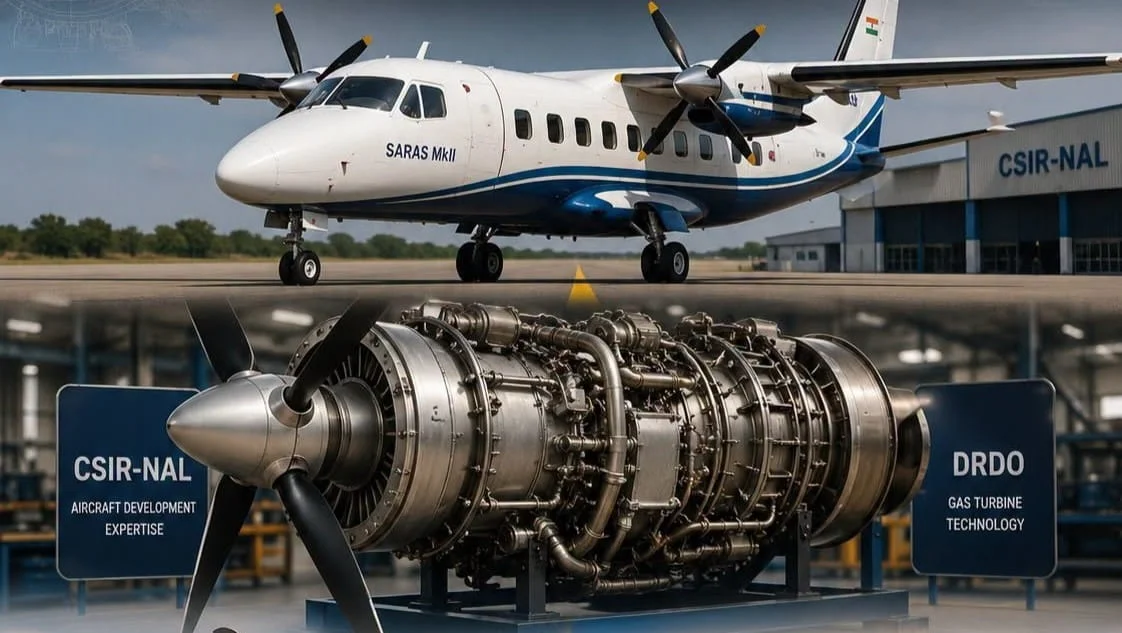
New Delhi: In a significant push toward greater self-reliance in aviation, the Council of Scientific and Industrial Research (CSIR) and the Defence Research and Development Organisation (DRDO) are working on a joint proposal to develop a homegrown turboprop engine — one that would eventually power the indigenous Saras Mk2 light transport aircraft and lay the groundwork for India’s future High-Altitude Long-Endurance (HALE) Unmanned Combat Aerial Vehicles.
The proposal is still at an early stage and will need funding approval from the Ministry of Defence. Whether that approval comes through will largely depend on how strong a case can be made for the engine’s long-term manufacturing potential — both for the Saras Mk2 itself and for possible use across other civilian and military platforms. Aero-engine development is an expensive, time-intensive undertaking, so a solid volume-based business case will be essential to justify the investment.

At present, the Saras Mk2 — a 19-seat transport aircraft being developed by CSIR’s National Aerospace Laboratories (CSIR-NAL) — relies on twin Pratt & Whitney Canada PT6A-67A engines. The PT6 is a well-respected engine family globally, but continued dependence on a foreign propulsion system remains a real constraint for what is meant to be India’s flagship light transport programme. Replacing these imported engines is seen as a necessary step if the programme is to achieve genuine manufacturing independence.
If the government does approve the project, officials and defence experts see it as far more than a simple engine swap — it could become the foundation for an entirely new family of Indian turboprop engines with applications spanning decades.
One of the most strategically significant uses for such an engine would be in India’s future HALE UCAV programmes. These are large, heavily armed drones built for long-endurance missions, and they demand highly reliable propulsion. An indigenous engine would insulate the supply chain from geopolitical disruptions and give Indian scientists the freedom to integrate mission-specific systems or make structural modifications without needing foreign sign-off.

Beyond the Saras Mk2 and combat drones, a locally built medium-power turboprop could also prove useful across a range of other military platforms — maritime patrol aircraft, specialised surveillance planes, intelligence, surveillance and reconnaissance (ISR) systems, and utility transport aircraft that need extended flight endurance.
Ultimately, though, the engine’s economic viability will hinge on securing enough aircraft orders. The Indian Air Force has already given the programme a starting base with its commitment to buy 15 Saras Mk2 aircraft. To build on that, CSIR-NAL is actively pitching the aircraft to regional airline operators as part of the government’s UDAN regional connectivity scheme. While the IAF order secures an initial production run, winning firm orders from commercial carriers will be crucial to help absorb the heavy research and development costs the new engine will require.
For years, India’s indigenous engine development — including DRDO’s long-running GTRE Kaveri project — has been focused almost entirely on jet propulsion for fighter aircraft. This new initiative marks a notable broadening of that ambition into the turboprop space, an area with substantial demand across both military and commercial markets.
In line with the Atmanirbhar Bharat push, successfully developing this engine would help cut India’s reliance on imported propulsion systems and strengthen its standing as a genuine manufacturer of transport aircraft and unmanned aerial systems.