New Delhi: French aerospace major Dassault Aviation has signalled a growing reliance on Indian industry as part of its global operations, underlining its commitment to the “Make in India” push through a widening web of local partnerships.
In its 2026 half-year financial report, the company revealed it is drawing up a comprehensive production plan — one that includes complete aircraft assembly and flight testing in India — as it prepares to bid for the Indian Air Force’s 114-jet Multi-Role Fighter Aircraft (MRFA) requirement.

The filing makes clear that Indian firms are no longer peripheral players but are now woven into Dassault’s global supply chain, contributing not just to military programmes but also to the manufacture of its Falcon line of business jets.
At the centre of this effort is Dassault Reliance Aerospace Limited (DRAL), based at the MIHAN Special Economic Zone in Nagpur. Set up as a joint venture with Reliance Aerostructure, the facility has steadily built up its capabilities and now plays a significant role in producing components for Falcon aircraft.
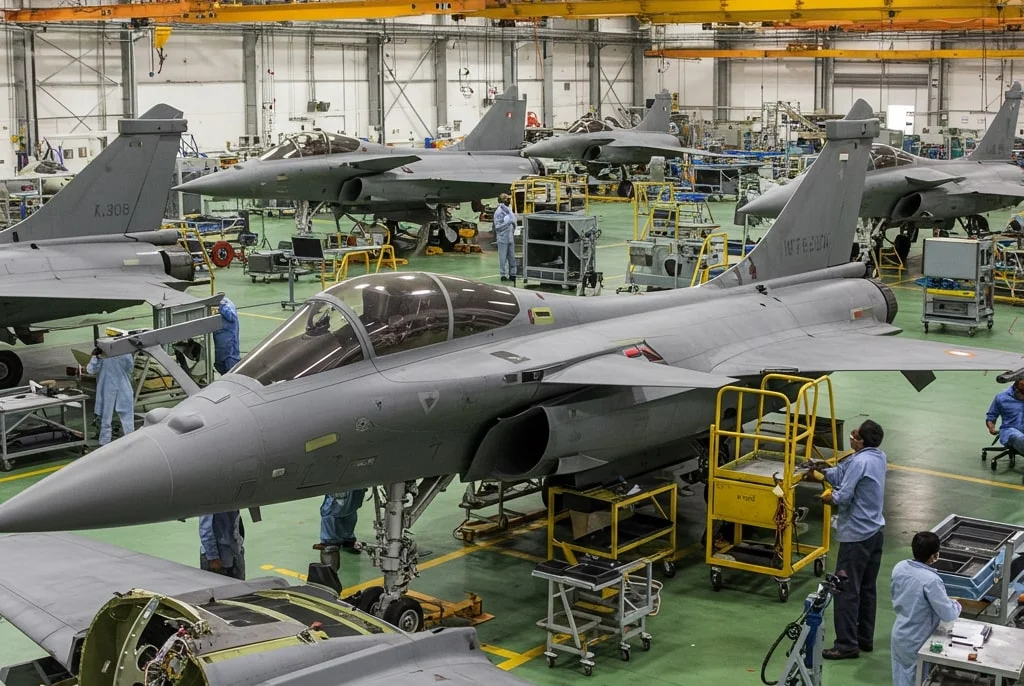
On the fighter jet side, Dassault has brought in Tata Advanced Systems Limited (TASL) as a second global source for the Rafale’s fuselage, with work being carried out at TASL’s Hyderabad facility. It’s a notable step — handing over a major share of airframe production to an Indian partner reflects real confidence in the country’s aerospace manufacturing maturity, and it strengthens Dassault’s long-term industrial commitment to India.
The report also highlights the role of Dynamatic Technologies, which manufactures the rear fuselage for the Falcon 6X. Already a trusted supplier to several global aerospace names, Dynamatic’s continued involvement points to how central Indian engineering has become to Dassault’s more intricate structural work.

Another key partner is Hical Technologies, which supplies flight control components for the Rafale — parts that sit at the heart of the fighter’s operating systems, underscoring just how deeply Indian firms are now embedded in high-value defence manufacturing.
Beyond its existing supplier base, Dassault has confirmed it is working on a full industrial roadmap for the MRFA programme that would include final assembly and flight testing on Indian soil. While the company hasn’t spelled out the exact production split, the plan suggests Dassault is willing to go well beyond component supply — offering full aircraft integration and long-term maintenance support, in line with New Delhi’s push for greater self-reliance in defence.
The financial report also confirmed that the Indian Navy’s order for 26 Rafale Marine jets was formally booked in the first half of 2025 — a deal that gave a significant lift to Dassault’s global defence sales for the period. With that contract now moving forward, the company’s attention has shifted to the much larger prize: the Air Force’s MRFA tender for next-generation fighters.
India remains one of Dassault’s top international priorities, and the company has made no secret that winning the MRFA contract is now a key corporate goal. Its industrial pitch has been shaped carefully around New Delhi’s expectations — deep technology transfer, a localised supply chain, and substantial domestic manufacturing.
Taken together, the expanding network of Indian partners suggests the country’s aerospace sector has moved well past simple licensed assembly. With firms like DRAL, TASL, Dynamatic and Hical now contributing to both civilian and military programmes, India is positioning itself as a genuine manufacturing hub within Dassault’s global industrial network.