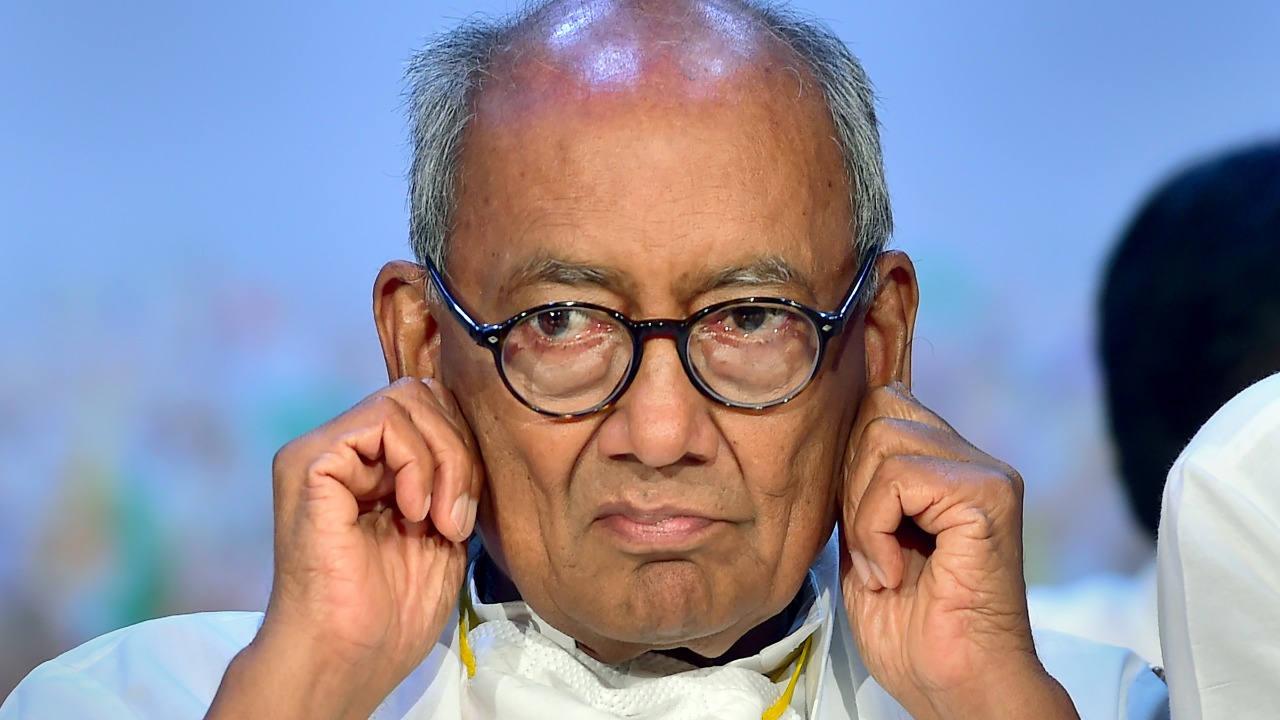
Bhopal: There is a simple, unwritten rule in Indian politics: a truly wise and far-sighted leader is not just someone who knows how to forge ahead in every situation, but someone who knows exactly when, where, and with how much dignity to take two steps back. In today’s chaotic era of opportunistic politics and leaders clinging endlessly to power, the political maturity displayed by former Madhya Pradesh Chief Minister Digvijaya Singh is genuinely commendable. He has sent a highly nuanced message to the country’s aging guard—one that not only elevates his own stature within the organization but also serves as a profound lesson for others.
Digvijaya Singh’s Political Acuity and Timing
For quite some time, political circles have been abuzz with speculation that the Congress party is unlikely to send Digvijaya Singh back to the Rajya Sabha. Typically, at such a delicate crossroads, established leaders either resort to open rebellion or express deep resentment behind closed doors. Yet, “Diggi Raja” has navigated this phase with an intelligence and tact that highlights his profound political wisdom. While one may completely disagree with his ideology, his understanding of political timing remains unmatched. He knows exactly how to composedly ground himself when the wind changes direction. Digvijaya Singh has masterfully demonstrated the rare art of maintaining absolute credibility within the organization without holding a major constitutional post.

Kamal Nath’s Stubbornness and the Delirium from Bhopal to Delhi
In stark contrast, when looking at his contemporary in Madhya Pradesh, the towering leader Kamal Nath, the situation appears entirely opposite and disheartening. There was a time when the Congress high command bypassed a young face like Jyotiraditya Scindia, placing its absolute faith in Kamal Nath’s vast experience by handing him the Chief Minister’s chair.
However, due to his administrative stubbornness and subsequent frustration, Kamal Nath not only lost the government in Madhya Pradesh but gradually gambled away his entire political capital in the state.
The entire country recently witnessed his desperate scramble from Delhi to Bhopal for a single Rajya Sabha seat. Despite this unprecedented, frantic run, he ultimately came up completely empty-handed. The resulting public embarrassment in political circles has cast a massive shadow over what remained of his credibility. This persistent failure to adapt to the changing times can instantly tarnish even the most golden historical legacy of a veteran politician.
The Rajasthan ‘Magician’s’ Resentment and Diminishing Stature
A similar script is playing out in Rajasthan with former Chief Minister Ashok Gehlot, often called the “Magician” of state politics. When an established leader starts believing that an entire state rests solely in his palm, and that neither the organization nor the government can exist without him, he commits his gravest political blunder. After spending a lifetime enjoying the highest echelons of power, a senior leader who actively blocks the path of the younger generation inadvertently diminishes his own respect.

In Rajasthan, Gehlot’s political animosity toward young leader Sachin Pilot, combined with an endless hunger for positions, has significantly shunk his stature. A serious question arises today: when you yourself have enjoyed lucrative, top-tier positions your entire life, who are you to question the ambitions of youths hoping for a change? Gehlot’s altered, rebellious tone and sharp language clearly indicate that he is hunting for a path outside the party line. In an obstinate bid to salvage his fading political relevance, he has put his own dignity at stake. The writing on the wall suggests that he will either exit the Congress party on his own or the high command will permanently sideline him following these outbursts.
History as a Witness: How Obstinacy Spoils Political Sunsets
The stubborn attitudes of Ashok Gehlot and Kamal Nath are hardly isolated incidents in Indian politics or within the Congress party. History bears witness to the fact that leaders who fail to transition into the honorable role of a ‘mentor’ at the right time end up ruining their own political twilight through sheer obstinacy. Captain Amarinder Singh of Punjab and Ghulam Nabi Azad of Jammu and Kashmir stand as living testaments to this reality.
Captain Amarinder Singh ruled Punjab politics unchallenged for a lifetime, but his refusal to surrender the Chief Minister’s chair at the very end pushed him to a point where he holds virtually no political relevance today. A identical fate befell Ghulam Nabi Azad, who parted ways with Congress to form his own regional outfit, only to become completely peripheral in provincial politics. The immense respect and political capital these leaders accumulated over decades vanished at the final stage of their lives, sacrificed to an blind hunger for power.
Politics is About Stature, Not Status
The bitter but undeniable truth of politics is that time never stands still. History rarely looks back kindly on leaders who refuse to read the room and gracefully clear the stage for the next generation. Senior politicians across the spectrum have much to learn from Digvijaya Singh’s dignified step back. They must realize that true politics is ultimately about ‘stature,’ not ‘status.’ A leader’s true height is never measured by the size of the chair they occupy, but by the grace and dignity with which they step away from it when the time is right.