Kanpur: Researchers from the Indian Institute of Technology Kanpur, in collaboration with scientists from the Indian Institute of Science Bangalore and the University of Lübeck, Germany, have developed a predictive framework to precisely control the propulsion and breakup of liquid droplets using laser pulses. The findings, published in the prestigious journal Proceedings of the National Academy of Sciences (PNAS), provide new insights into laser–matter interactions and could advance technologies ranging from targeted drug delivery and inkjet printing to laser-assisted manufacturing and biomedical applications.
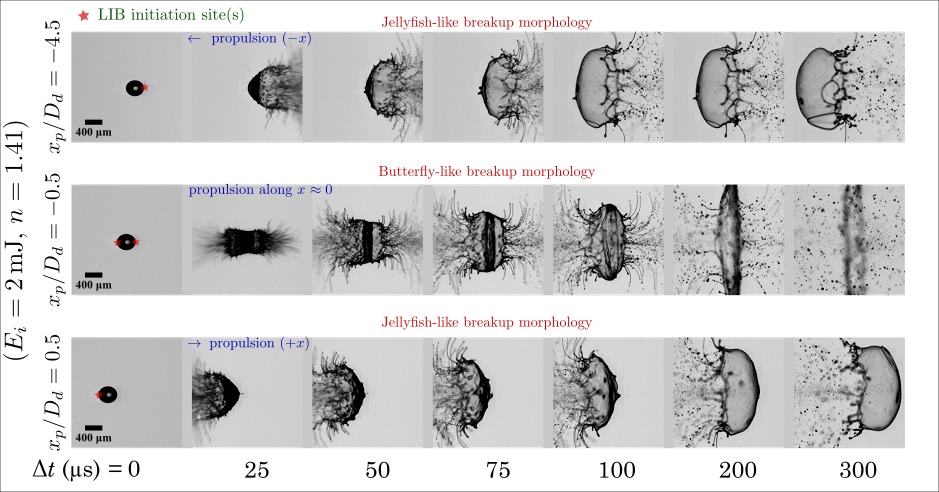
The study demonstrates that microscopic liquid droplets can be steered in multiple directions, including forward, backward, or radially outward motion, by carefully tuning the droplet position relative to the laser focus and adjusting the laser pulse energy. The researchers also identified how the location of the initial laser-induced plasma formation governs the subsequent deformation, fragmentation, and propulsion behavior of the droplet.

Combining high-speed imaging experiments with optical modelling and multiphase numerical simulations, the team developed predictive “placement-energy maps” capable of forecasting droplet response under varying laser conditions. The framework offers a reliable strategy for controlling highly dynamic laser-induced processes that have traditionally been difficult to reproduce consistently.
Speaking about the significance of the work, Dr. D. Chaitanya Kumar Rao from the Department of Aerospace Engineering, IIT Kanpur , said: “We have long been fascinated by the complex physics that emerge when high-power lasers interact with fluids and soft matter. In several of our earlier studies, we explored laser-induced atomization, bubble dynamics, and interfacial transport phenomena. This work builds on those foundations and takes an important step toward achieving deterministic control over laser-driven droplet behavior. The ability to predict and manipulate droplet propulsion and fragmentation with high precision can open new possibilities in biomedical devices, microscale transport, additive manufacturing, and energy systems.”
One of the key findings of the study is the identification of stable operational regimes and sensitive transition zones governing droplet breakup dynamics.

The researchers show that the underlying physics is strongly influenced by the interplay between laser focusing conditions, optical caustics formed inside the droplet, and the breakdown characteristics of the surrounding medium.
The paper, titled “Predicting and controlling laser-induced breakup and multidirectional propulsion of liquid droplets,” was authored by Awanish Pratap Singh, D. Chaitanya Kumar Rao, Maik Rahlves, Alfred Vogel, and Saptarshi Basu.
The research highlights IIT Kanpur’s continuing contributions to fluid mechanics, laser-fluid interaction, and advanced propulsion techniques, areas that are increasingly important for next-generation engineering and biomedical technologies.




 ---------------------------------------------------------------------------------------------------