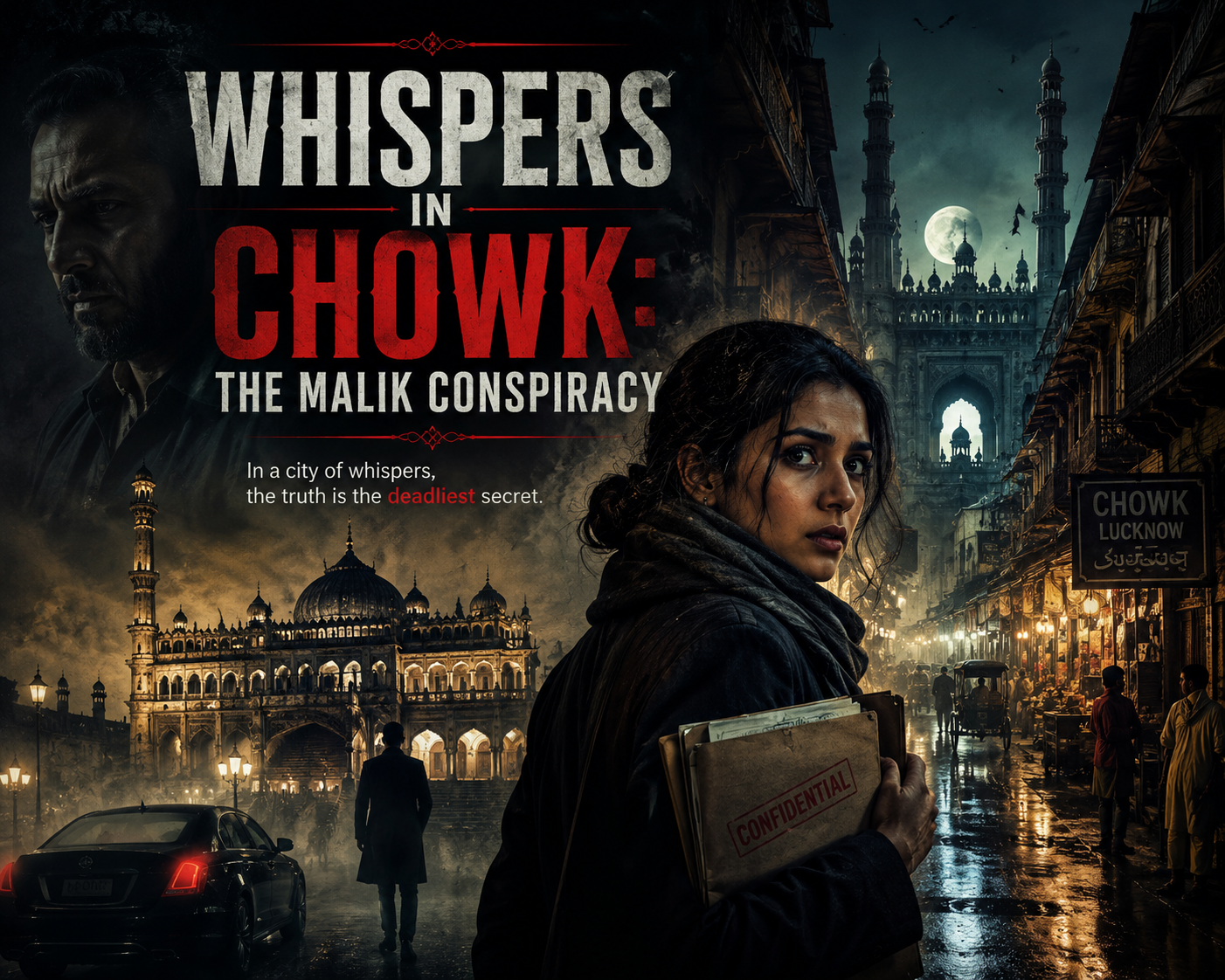
The night had a strange way of breathing in Lucknow.
It didn’t arrive all at once—it seeped in, slow and deliberate, like ink spreading through water. Fog rolled over the city’s old bones, swallowing streetlamps, muting footsteps, and softening even the proud outlines of its heritage. The Nawabi city, usually dressed in its daytime charm of kebabs, courtyards, and poetry, now looked like something else entirely—older, sharper, and quietly dangerous.

On nights like this, Lucknow didn’t feel lived in.
It felt watched.
And Ananya Singh had learned long ago that when a city starts watching you back, it is already too late to turn away.
The Journalist Who Never Looked Away
Ananya adjusted her scarf as she stepped into the narrowing lanes of Chowk. Her notebook was tucked inside her coat, but tonight even it felt heavy—like it carried more than ink and paper. It carried warnings she had ignored too many times.
She was an investigative journalist. The kind who asked questions people preferred buried.
And tonight, every instinct in her body was screaming that she had asked the right one at the worst possible time.
The call had been vague.
A gathering near Bara Imambara. Powerful names. No record. No cameras.
That was all it took.
Because in Lucknow, silence was never empty—it was arranged.
The streets around her were alive in the usual way: vendors packing up late, the smell of oil and spice lingering in the air, laughter spilling out of tea stalls. But underneath it all, something else pulsed tonight.
Unease.
People didn’t look at her directly. They looked past her. Through her. As if acknowledging her existence might bind them to her fate.
Ananya had seen fear before.
But this was different.
This was practiced fear.
Whispers in the Fog
By the time she reached the outer stretch near Bara Imambara, the fog had thickened into something almost physical. The grand arches loomed like half-remembered dreams, their outlines dissolving into mist.
This place was built for silence, she thought.
Tonight, it felt like silence was about to break.
A low murmur drifted through the air—voices, controlled and careful. Not the voices of common men. These were trained tones. Measured. Political.
She slipped behind a stone archway, pressing herself into the cold surface. Through the haze, she saw movement near the restricted inner courtyard.
Black cars. No number plates. Men stepping out without urgency, because urgency belonged to people who could afford consequences.
And then she saw the name she had been chasing for months.
Malik.
Not spoken. Never spoken aloud. But his presence was obvious in the way others shifted to make space for him.
A man who didn’t need introduction.
Only obedience.
Malik’s World
Ananya had written about Malik before—carefully, indirectly, like everyone else.
A shadow financier. A political ghost. A man who didn’t hold office but held influence like a weapon.
Every article she tried to publish had been stalled. Editors had gone silent. Evidence had vanished.
And people who asked too many questions about him… stopped asking anything at all.
But tonight, she had followed something different.
A real lead.
And real leads, she knew, were never safe.
From her position, she caught fragments of conversation:
“…ministerial shift before elections…”
“…media containment assured…”
“…the journalist issue will be handled…”
Her breath caught at that last phrase.
Journalist issue.
Not journalist.
Issue.
That was how they reduced people before removing them.
A slow chill crawled up her spine, but she forced herself to stay still.
Then Malik spoke.
His voice wasn’t loud.
It didn’t need to be.
“If truth becomes inconvenient,” he said calmly, “then it is no longer truth. It is a liability.”
A pause.
“And liabilities,” he added, “do not survive long in this city.”
The Trap Snaps Shut
Ananya backed away slowly, pulse hammering. She had what she came for. Enough for a story. Enough for exposure.
Enough to disappear for.
But as she turned, she saw him.
A man standing at the edge of the fog, watching her.
Not Malik.
Someone worse.
Familiar.
Raghav.
A colleague. A journalist she had once trusted enough to share drafts with.
His expression held no surprise.
Only confirmation.
“You shouldn’t have come here alone,” he said softly.
Her throat tightened. “You knew?”
“I tried to warn you.”
“That wasn’t a warning,” she snapped. “That was a delay.”
A faint, tired smile touched his face. “Same thing, depending on who pays you.”
The words hit harder than she expected.
“So it’s true,” she whispered. “You’re with him.”
Raghav didn’t deny it.
That was answer enough.
Behind him, footsteps began to multiply in the fog.
She took one step back.
Then another.
And ran.
The City Becomes a Maze
Lucknow transformed the moment she fled.
The lanes she knew became unfamiliar. The shortcuts twisted. The familiar turned hostile. It was as if the city itself was rearranging to confuse her.
Footsteps echoed behind her—controlled, deliberate, closing distance but never rushing. They didn’t need to rush.
They knew the city better than she did.
She darted through a spice market, knocking over baskets of dried chilies and saffron. A vendor shouted, but stopped mid-word when he saw the men behind her.
He lowered his eyes.
No one interfered.
That was the rule here.
Don’t get involved.
Don’t become involved.
She turned sharply into a narrow alley and pressed herself against a wall, trying to control her breathing.
Her mind raced.

Evidence. Phone. Notes.
Everything was still there.
But safety wasn’t.
A distant clock tower struck midnight.
Tick.
Time didn’t just pass in Lucknow tonight.
It hunted.
The Old Haveli of Lies
She reached it without knowing how.
The abandoned haveli near the old quarter.
One of Malik’s rumored locations.
Or maybe the only one she had left.
Inside, light flickered.
Not abandoned.
Occupied.
She slipped through a side entrance, stepping into darkness thick with dust and something colder—presence.
Voices again.
This time clearer.
Plans. Names. Funds. Elections.
And then, her name.
Ananya Singh.
She froze.
They knew she was inside.
The realization didn’t scare her as much as it should have.
Instead, it sharpened her.
Because now there was nothing left to lose.
She raised her phone slowly, recording.
Then stepped forward.
The Face of Power
Malik stood at the center of the room.
Not dramatic. Not theatrical.
Just present.
That was the most terrifying part.
He looked at her like he had been expecting her all along.
“So,” he said quietly. “The journalist finally arrives in person.”
No panic. No anger.
Only curiosity.
Ananya steadied her voice. “You control the city.”
A slight tilt of his head. “I stabilize it.”
“You destroy lives.”
“I remove instability.”
She almost laughed. Almost.
Behind him, Raghav avoided her eyes.
That hurt more than Malik’s presence.
“You don’t fear exposure?” she asked.
Malik stepped closer.
“No,” he said. “Because exposure only matters when people care.”
A pause.
“And people,” he added softly, “do not care anymore. They only consume.”
That sentence lingered in the air like poison.
Escape Is Not an Option—It Is a Choice
Sirens in the distance.
Or maybe hope.
She didn’t wait to confirm.
Ananya moved.
Fast.
Not toward the exit—but through it.
Glass shattered somewhere behind her. Shouts erupted. The carefully maintained calm of Malik’s world finally cracked.
She ran through corridors, out into the fog again, lungs burning, heart pounding like it was trying to escape before her.
Lucknow unfolded ahead of her like a broken map.
But this time, she understood something.
The city wasn’t trapping her.
It was revealing itself.
Dawn Over a Damaged Truth
By the time she reached the riverfront, the sky had begun to soften. The fog was thinning, retreating like it had seen enough.
Behind her, the haveli burned—not with fire, but with consequence.
Her recording was already uploading.
Somewhere, someone would see it.
Somewhere, the story would begin.
But Ananya didn’t feel victory.
Only clarity.
Raghav’s betrayal. Malik’s system. The silence of the city.
None of it was new.
It was just finally visible.
She sat on the cold stone steps as the first light touched Lucknow’s skyline. The city looked different now—not innocent, not guilty.
Just human.
Flawed.
Complicated.
Complicit.
And alive.
Final Truth
Ananya opened her notebook one last time.
Wrote a single line.
Lucknow does not hide its darkness.
It teaches you to live with it.
Then she closed it.
Because the story was no longer just about exposing a man.
It was about exposing the comfort of silence.
And as the sun rose fully over the city, Ananya understood something that would change everything she ever wrote again:
In Lucknow, truth didn’t set you free.
It only decided what kind of prison you were willing to survive.