Lucknow: The sun hung low over Lucknow, its amber light spilling across the ancient domes and corridors of the Bara Imambara. Long shadows stretched like silent witnesses across its vast courtyard, where history itself seemed to breathe through stone and silence. The monument—majestic, intricate, and defiant—stood at the center of a world now teetering on the edge of chaos.
It was 2025. Borders were unstable, alliances fragile, and cultural heritage sites had become battlegrounds for ideology as much as territory. In this fractured reality, an extremist faction had emerged with a singular, destructive ambition: erase symbols of the past to control the narrative of the future. Their next target was Bara Imambara—a monument not just of architecture, but of identity.

As dusk deepened into night, war drums echoed faintly in the distance, like a heartbeat growing louder. The air itself felt heavy, charged with anticipation. The defenders knew what was coming.
They had gathered quietly at first—historians, soldiers, architects, local volunteers, and wanderers who had all once walked the halls of memory that this monument preserved. They were not a formal army. They were something older and more instinctive: protectors bound by belonging.
Among them stood Ayaan.
He was not the loudest voice in the room, nor the most flamboyant presence. But when silence fell, people naturally looked toward him. A former tactical officer turned heritage defender, Ayaan carried the calm of someone who had already survived chaos and learned its language. His eyes, steady and observant, reflected both fatigue and unwavering resolve.
“Positions are ready,” he said quietly, surveying the courtyard from the grand staircase. “We hold here. We don’t let them reach the inner halls.”
No one asked what would happen if they failed. Everyone already knew.
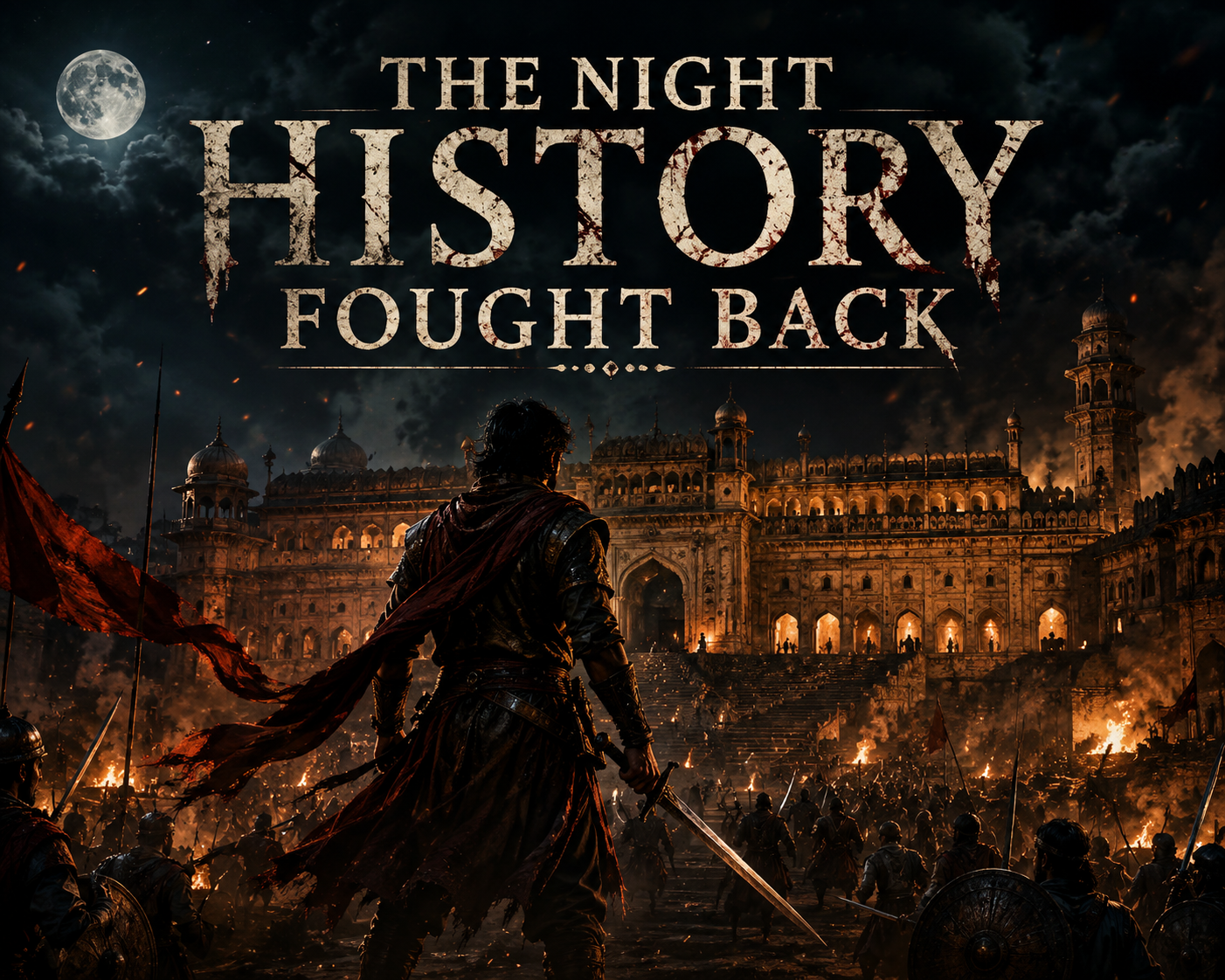
The defenders moved with discipline born not of formal training alone, but of purpose. Traps had been laid in narrow passageways. Weak entry points were reinforced with makeshift barricades. Torches lined the perimeter, their flames flickering against the carved walls, casting restless patterns over centuries-old inscriptions.
The Bara Imambara, with its vast central hall and echoing labyrinth, seemed almost alive in that moment—watching, waiting.
Ayaan placed his hand briefly on the cold stone railing. “You’ve stood for hundreds of years,” he murmured. “Tonight, we stand with you.”
Then the first wave arrived.
They came like a shadow breaking into motion—dark silhouettes emerging from the far end of the courtyard, moving with precision and ruthless intent. Their battle cries shattered the silence, echoing off stone and sky.
“Hold!” Ayaan’s voice cut through the tension.
The clash began instantly.
Steel met steel. Sparks flew into the night air. The courtyard, once a place of reflection and architectural wonder, transformed into a storm of motion and sound. Every strike carried meaning; every block was a refusal to yield.
Ayaan moved through it like a thread weaving order through chaos. He was not reckless—he was precise. Each movement was calculated, each step placed with intention. He slipped between attackers, disarmed one with a swift twist, redirected another into a wall where he collapsed under his own momentum.
But the enemy did not break.
They surged forward relentlessly, testing defenses, probing weaknesses. The defenders held, but the pressure mounted like a rising tide.
At one point, Ayaan noticed a breach forming near the eastern corridor. A massive attacker—armored, brutal in build—was hammering through the defenders’ line with a heavy axe. Two defenders had already fallen back.
Without hesitation, Ayaan crossed the courtyard.
He didn’t shout. He didn’t announce himself.
He simply arrived.
The brute swung. Ayaan ducked beneath the arc, felt the wind of destruction pass over his shoulder, and countered with a strike to the weapon’s joint. Metal groaned. The axe faltered for a split second—just enough.
Ayaan stepped in, redirected the man’s balance, and brought him down hard onto the stone floor. The impact echoed like a crack through silence. The breach closed.
Around him, the defenders regained momentum.
But victory in one moment did not mean safety in the next.
As the night deepened, exhaustion began creeping into every movement. Breathing grew heavier. Arms slowed. The initial surge of adrenaline gave way to strain. Yet the defenders fought on, fueled by something deeper than stamina.
Memory.
Every carved wall around them, every arch and corridor, held generations of stories. Weddings had been celebrated in its echoes. Scholars had debated beneath its ceilings. Children had run through its passages, laughing as their footsteps multiplied into infinity.
They were not just defending stone.
They were defending continuity.
Ayaan sensed the faltering rhythm in his team. He stepped back onto the staircase, raising his voice—not loud, but carrying.
“Look around you,” he said. “This place was built by hands like ours. By people who believed something should last longer than fear. Don’t let tonight be the night that belief dies.”
Something shifted.
Fatigue did not vanish, but purpose sharpened it into focus.
The defenders tightened formation.
Then came the turning point.
From the opposite side of the courtyard, the enemy commander emerged.
She moved differently from the others—measured, controlled, almost elegant in her stillness. Dark armor absorbed the torchlight, and her gaze carried conviction rather than chaos. Where others fought with aggression, she fought with belief.
Her eyes locked onto Ayaan.
“You are defending a relic,” she said, her voice cutting cleanly through the noise.
Ayaan stepped forward. “It’s not a relic. It’s memory.”
She smiled faintly, as if that distinction meant nothing.
Then she attacked.
Their duel unfolded in the center of the courtyard, drawing attention even amid chaos. Every clash between them rang louder than the rest of the battlefield. Steel met steel in rapid rhythm—attack, counter, redirect, evade.

She was fast. Precise. Trained not just to fight, but to dismantle.
Ayaan adapted.
He stopped reacting and started anticipating.
The battle around them blurred into distance. For both, everything narrowed into timing, breath, and intent. She pressed forward with relentless precision, forcing Ayaan into defense after defense.
But defense was not surrender.
It was patience.
He waited for the smallest inconsistency—the fraction of hesitation between her movements.
And then he found it.
A slight overextension. A shift in weight.
In that instant, Ayaan stepped inside her reach, deflected her blade, and struck the weapon from her grip. It clattered across the stone.
For the first time, her composure broke.
Not in rage.
In realization.
She had lost not to strength, but to endurance.
Around them, the momentum of battle changed. The attackers hesitated. The defenders pressed forward.
And then came dawn.
The horizon began to glow, slowly at first, then expanding into gold. Light spilled across the courtyard, revealing the aftermath of struggle—scarred stone, exhausted fighters, and the stillness that follows survival.
The second wave of attackers arrived just as the sun rose fully.
Elite units. Sharper, faster, more disciplined. But something had shifted overnight. The defenders were no longer simply reacting—they were unified.
Ayaan raised his blade once more.
“Now,” he said.
The final charge was not chaos—it was convergence. Every defender moved as part of a single intention. The attackers, despite their training, found themselves overwhelmed not by numbers, but by unity.
One line broke.
Then another.
And then, suddenly, there was no front left to hold.
The enemy began to retreat—not in collapse, but in recognition. The cost had become too high, the resistance too firm.
Silence slowly returned to Bara Imambara.
Not empty silence.
Earned silence.
Ayaan stood in the center of the courtyard, chest rising heavily, sword lowered. Around him, survivors gathered—some injured, some leaning on each other, all still standing.
The monument rose behind them, unchanged yet profoundly marked by what had occurred within its walls. It had not been destroyed. It had been defended.
But more than that, it had been witnessed.
Ayaan looked up at the morning light touching the arches. For a moment, exhaustion softened into something quieter.
Understanding.
They had not just survived a battle.
They had reaffirmed something older than conflict: that memory, once shared, becomes stronger than the force that tries to erase it.
Behind him, someone began to speak softly about the fallen. Others joined. Names were spoken. Stories were remembered. Loss was acknowledged, not ignored.
And in that act, the monument lived again—not as stone, but as continuity.
Ayaan finally sheathed his blade.
“This isn’t the end,” he said quietly.
No one disagreed.
Because they understood now what the night had proven:
Heritage is not protected once. It is protected always—by those willing to stand between memory and forgetting.
And as the sun rose fully over Bara Imambara, its light did not mark the end of a battle.
It marked the beginning of a promise.