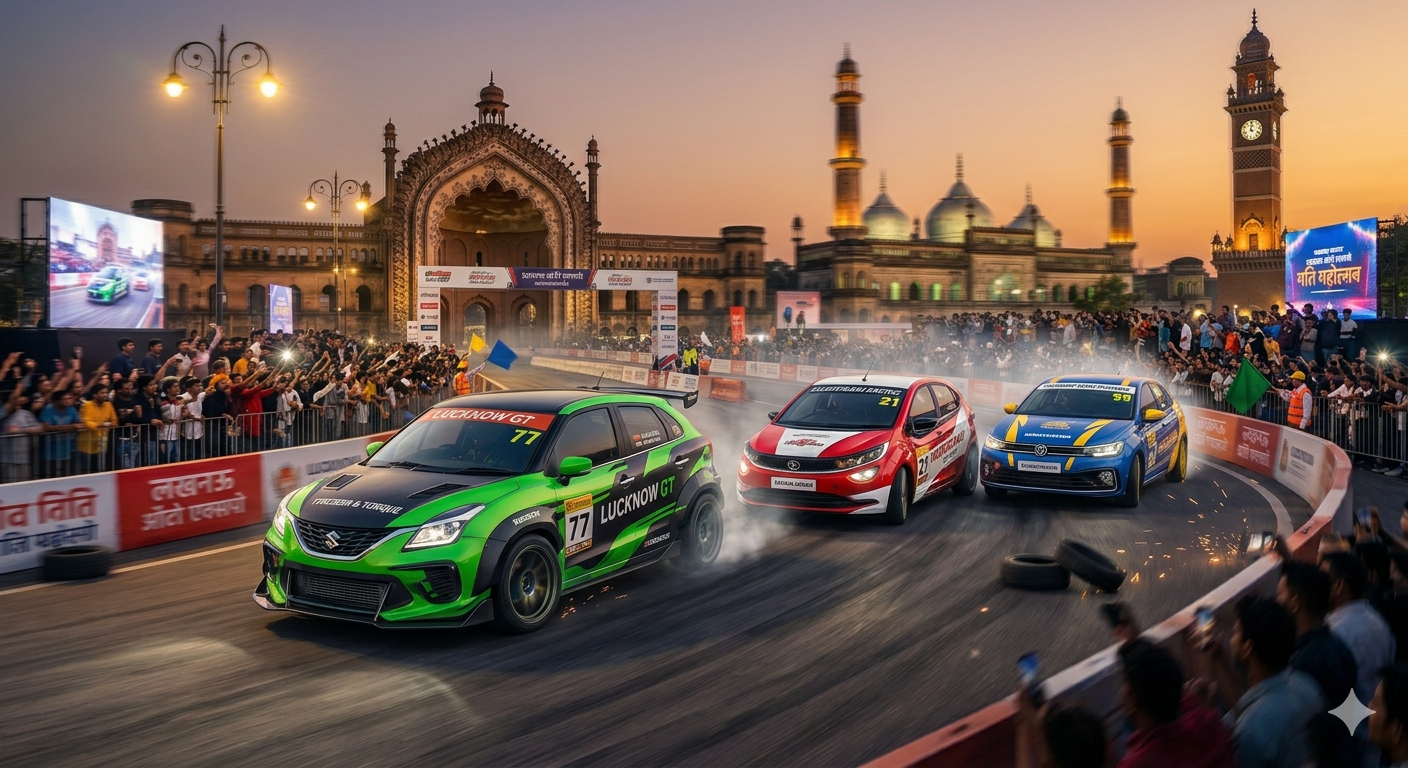
The sun dipped low over Lucknow, bleeding gold and amber into the sky as it reflected off the still waters beside Marine Drive. The stretch of road—smooth, winding, and dangerously alive at dusk—looked almost innocent in daylight. But as evening arrived, it transformed into something else entirely.
A battlefield.

A stage.
A religion for speed.
And at its center stood a name that had become legend.
Rohan. The Speed Racer of Marine Drive.
The Man Who Spoke in Speed
Rohan was not a driver in the ordinary sense. He never had been.
For him, speed was language. The engine was voice. The road was canvas.
His machine—a sleek, aggressively modified sports car—was an extension of his instincts. Every bolt, every adjustment, every recalibrated system had been tuned by him personally. Mechanics often said the car behaved like it could think.
Rohan didn’t disagree.
He believed machines understood intent.
And his intent was simple: perfection at 200 km/h.
Every night before a race, he would walk along Marine Drive alone, listening to the silence of the asphalt. He didn’t pray. He observed. The curves, the friction points, the wind direction near the river bend—everything mattered.
Because in racing, small details didn’t decide victory.
They defined it.
The Storm Before the Grand Prix
The Marine Drive Grand Prix was not just an event in Lucknow—it was an obsession. Drivers came from across India, each one carrying ego, ambition, and machines designed to dethrone the reigning champion.
Rohan had won it multiple times.
But repetition never meant safety.
This year, something felt different.
The rumors started in garages and underground racing circles.
A new name.
A new threat.
Vikram.
No one spoke about his past. No records. No official racing history. Only stories—reckless overtakes, impossible drifts, and a driving style that ignored logic.
“He doesn’t race lanes,” one mechanic said. “He creates them.”
Rohan heard it all without reacting.
But silence did not mean indifference.
It meant calculation.
Training at the Edge of Control
In the days leading up to the Grand Prix, Rohan pushed himself harder than ever before.
He trained when others slept.
He raced against no one but time itself.
The engine screamed under pressure as he practiced acceleration bursts along empty stretches. Tires burned. Brakes overheated. Yet Rohan kept going, adjusting, refining, correcting.
His mind was a machine within the machine.
Every movement had purpose.
Every hesitation was eliminated.
Even breathing became rhythmically aligned with gear shifts.
But there were moments—brief, fleeting—when he felt the presence of something new.
A challenge not just of speed, but of unpredictability.
Vikram was not yet seen.
But his shadow was already racing alongside Rohan.
Race Day: The City Becomes a Circuit
Morning broke bright and sharp.
Marine Drive transformed.
Barricades lined the road. Spectators crowded every available space—balconies, rooftops, roadside trees. Vendors shouted over the rising roar of engines warming up. The air smelled of fuel, dust, and anticipation.
The Grand Prix had begun.
Rohan arrived quietly.
No dramatic entrance. No display.
Just presence.
And that presence was enough.
Across the starting line, he finally saw him.
Vikram.
Leaning casually against his car, helmet in hand, smiling like the concept of danger amused him. His machine looked less engineered and more tamed chaos—scratches, modifications, and uneven enhancements suggesting experimentation rather than discipline.
Rohan studied him for three seconds.
That was all he needed.
Unpredictable. Aggressive. Emotional driver.
Dangerous combination.
The Flag Drops
Silence shattered.
The flag fell.
Engines exploded into motion.
The world blurred instantly.
Rohan launched forward with precision, his start clean, controlled, surgical. No wheel spin. No wasted motion.
Vikram, however, surged like a strike of lightning—wild, aggressive, almost reckless. He overtook two racers within seconds, cutting through gaps that shouldn’t have existed.
The crowd erupted.
Within the first kilometer, it was clear:
This wasn’t a race anymore.
It was a duel.
Machine Against Instinct
Rohan maintained rhythm.
Vikram disrupted it.
Every corner became a confrontation.
Rohan took the inside lines with mathematical precision, calculating grip, friction, and exit velocity.
Vikram attacked from impossible angles, forcing errors, exploiting hesitation that didn’t even exist.
“Who is he?” Rohan thought once.
Then dismissed the thought.
Thinking was delay.
And delay was defeat.
The river beside Marine Drive reflected the flashing headlights like fractured lightning. The wind grew stronger as speeds increased. The sound of engines blended into a continuous roar, as if the entire city had become one breathing machine.
Lap after lap, neither gave ground.
The First Risk
Rohan saw his opening.
A narrow gap between two turns—barely visible, barely survivable.
He took it.
The car responded like instinct.
For a brief moment, he was ahead.
The crowd held its breath.
But Vikram did not react like others would.
He didn’t chase.
He countered.
Instead of following, he cut an entirely new line—one that didn’t exist in Rohan’s mental map.
Within seconds, he was beside him again.
Equal.
Again.
Rohan’s eyes narrowed.
This was not randomness.

This was adaptation.
Pressure Builds
The race intensified.
Tires screamed against asphalt. Engines pushed beyond safe limits. Heat shimmered off both machines like mirages.
Rohan felt it then—fatigue creeping into precision.
A millisecond delay in judgment.
A fraction of hesitation.
That was enough for Vikram to strike again, forcing him wide on a corner.
The crowd roared.
For the first time, Rohan was not leading.
He was responding.
And responding was dangerous.
The Inner Battle
Inside the cockpit, Rohan’s world narrowed.
No crowd.
No noise.
Only speed.
Only strategy.
Only survival.
He recalibrated mentally, shutting out emotion. He remembered why he raced—not fame, not titles—but mastery.
Control over chaos.
But Vikram represented something else.
Chaos without control.
And somehow… it worked.
That realization disturbed him more than the overtakes.
Final Lap: The Breaking Point
The scoreboard flashed.
Final lap.
Equal position.
Everything came down to this.
The crowd rose to its feet. Even those who didn’t understand racing felt the tension physically. It was in the air. Heavy. Electric.
Rohan exhaled slowly.
This was no longer about winning.
It was about defining identity.
He accelerated.
Vikram matched instantly.
They entered the final stretch side by side.
The river, the lights, the city—it all blurred into streaks of color and sound.
Only one turn remained before the straight finish.
The Final Corner
Rohan saw it.
The perfect line.
The perfect drift.
The perfect exit speed.
But Vikram was already moving to block.
For a split second, Rohan understood something critical:
Vikram wasn’t racing the track.
He was racing him.
Rohan adjusted.
Not aggressively.
Not defensively.
But intelligently.
He feigned the drift early.
Vikram committed to the block.
And that fraction of miscalculation was everything.
Rohan slipped through the inside line—tight, precise, flawless.
The tires screamed.
The car obeyed.
Time slowed.
Then snapped forward.
The Finish
Straight stretch.
No turns.
No interference.
Only acceleration.
Rohan pushed everything remaining into the engine. The car responded like it had been waiting for permission to unleash itself fully.
Vikram was still there.
Still close.
Still fighting.
But the line was approaching faster than either of them could reclaim.
The crowd became a single roar.
A storm of sound.
And then—
Rohan crossed.
After the Storm
Silence returned in fragments.
Then exploded into celebration.
Rohan stepped out of the car slowly, breath steady, eyes still sharp. The world around him felt distant, almost unreal.
He looked across.
Vikram had stopped too.
For a moment, neither spoke.
Then Vikram nodded once.
Not defeat.
Not victory.
Respect.
Rohan returned the nod.
No words were needed.
The Legend Continues
As confetti filled the sky and Marine Drive erupted in celebration, Rohan stood on the podium once again.
But something had changed.
Victory still tasted familiar.
But challenge… had evolved.
Somewhere on that track, a new rival had emerged.
And in that rivalry, Rohan realized something important:
Legends are not defined by how often they win.
But by who forces them to race harder than ever before.
And Lucknow… had just begun its fastest chapter.




 ---------------------------------------------------------------------------------------------------