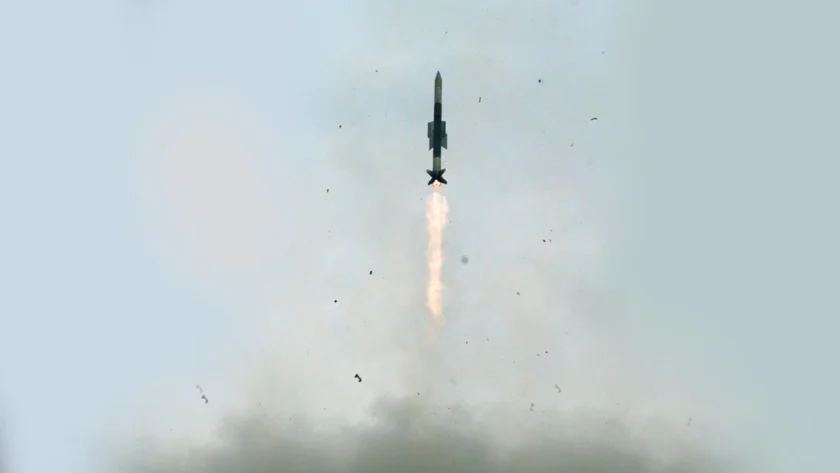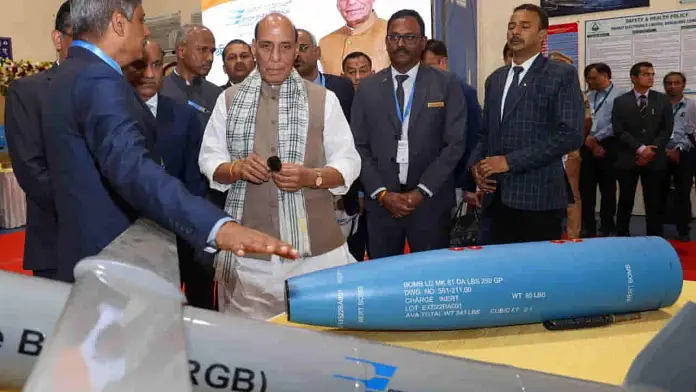
New Delhi/Bengaluru | Defence Minister Rajnath Singh on Sunday inaugurated a new missile integration facility at Bharat Electronics Limited (BEL) in Bengaluru and flagged off the combat systems of the third and fourth regiments of the Akash missile system.
During the event, the Defence Minister also formally unveiled the Mountain Fire Control Radar, designed specifically for deployment in high-altitude and mountainous terrains.

Strengthening India’s Air Defence
Describing the development as a major step towards strengthening India’s air defence capabilities, Singh said indigenous air defence and anti-drone systems had proven their effectiveness during Operation Sindoor. He noted that domestically developed systems successfully detected and neutralised threats, demonstrating India’s growing technological self-reliance in critical defence sectors.
“When victories are achieved through indigenous weapons and technology, the nation’s confidence doubles,” he said.
What is the Missile Integration Facility?
The newly inaugurated facility aims to integrate various systems and sub-systems into a fully operational combat platform. Missiles, radars, communication systems, and control units will be assembled and tested under one roof before final deployment.
Officials said the facility will accelerate production timelines, improve quality control, and enhance coordination between different defence components.
The dispatch of the third and fourth Akash regiments is expected to significantly reinforce India’s layered air defence architecture. Meanwhile, the Mountain Fire Control Radar has been tailored to detect enemy movement and provide precise missile guidance in rugged terrain.
Focus on Indigenous Technology
During his visit, Singh was briefed on BEL’s advanced indigenous defence technologies, including AI-based solutions, electronic warfare systems, avionics, naval platforms, electro-optics, and tank electronics.

He highlighted BEL’s contribution to strengthening network-centric operations, emphasising the importance of integrated systems, real-time data sharing, and decision-support capabilities in enhancing combat effectiveness.
The Defence Minister also reviewed ongoing research and development projects, including the Quick Reaction Surface-to-Air Missile (QRSAM) system, Tejas Mk-2, Advanced Medium Combat Aircraft (AMCA), Project Kusha (MR-SAM/LR-SAM), counter-drone systems, and naval weapon control systems.
These initiatives, officials said, are strengthening operational preparedness across land, air, and sea domains while reducing dependence on foreign technology.
Emphasis on AI and Quantum Technologies
Singh underscored that Artificial Intelligence and quantum computing are no longer futuristic concepts but essential components of modern warfare. He stressed their growing role in real-time decision-making, autonomous systems, cyber defence, and precision operations.
Calling upon BEL, other defence public sector undertakings, and industry partners to stay ahead in the technological race, he urged greater collaboration with start-ups and academia. Rapid prototyping, cross-disciplinary innovation, and accelerated product development, he said, would be key to building world-class defence systems under the vision of a self-reliant and developed India.
The visit concluded with an interaction between the Defence Minister and young scientists and start-up representatives, where he encouraged them to continue advancing cutting-edge indigenous defence technologies.